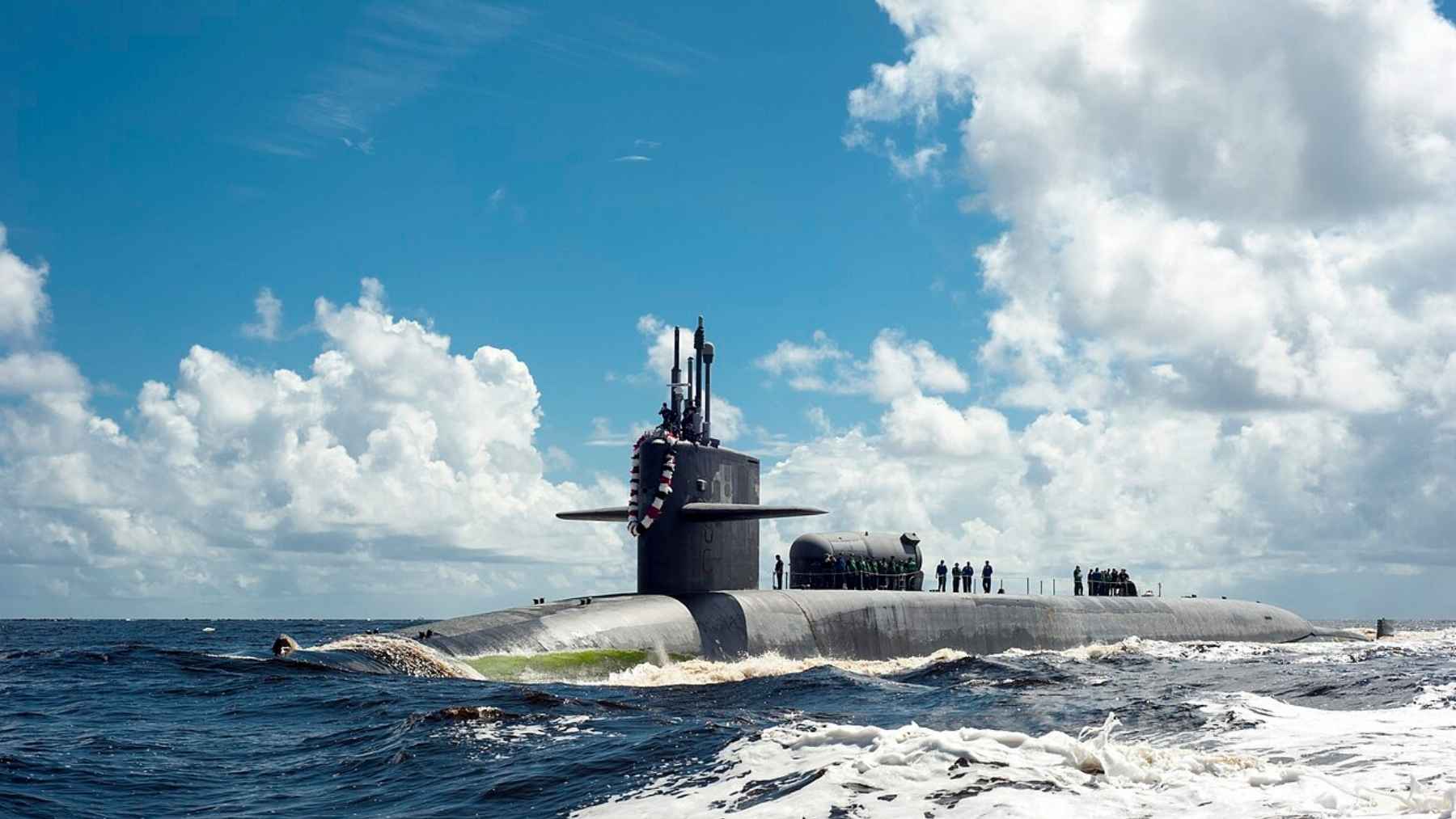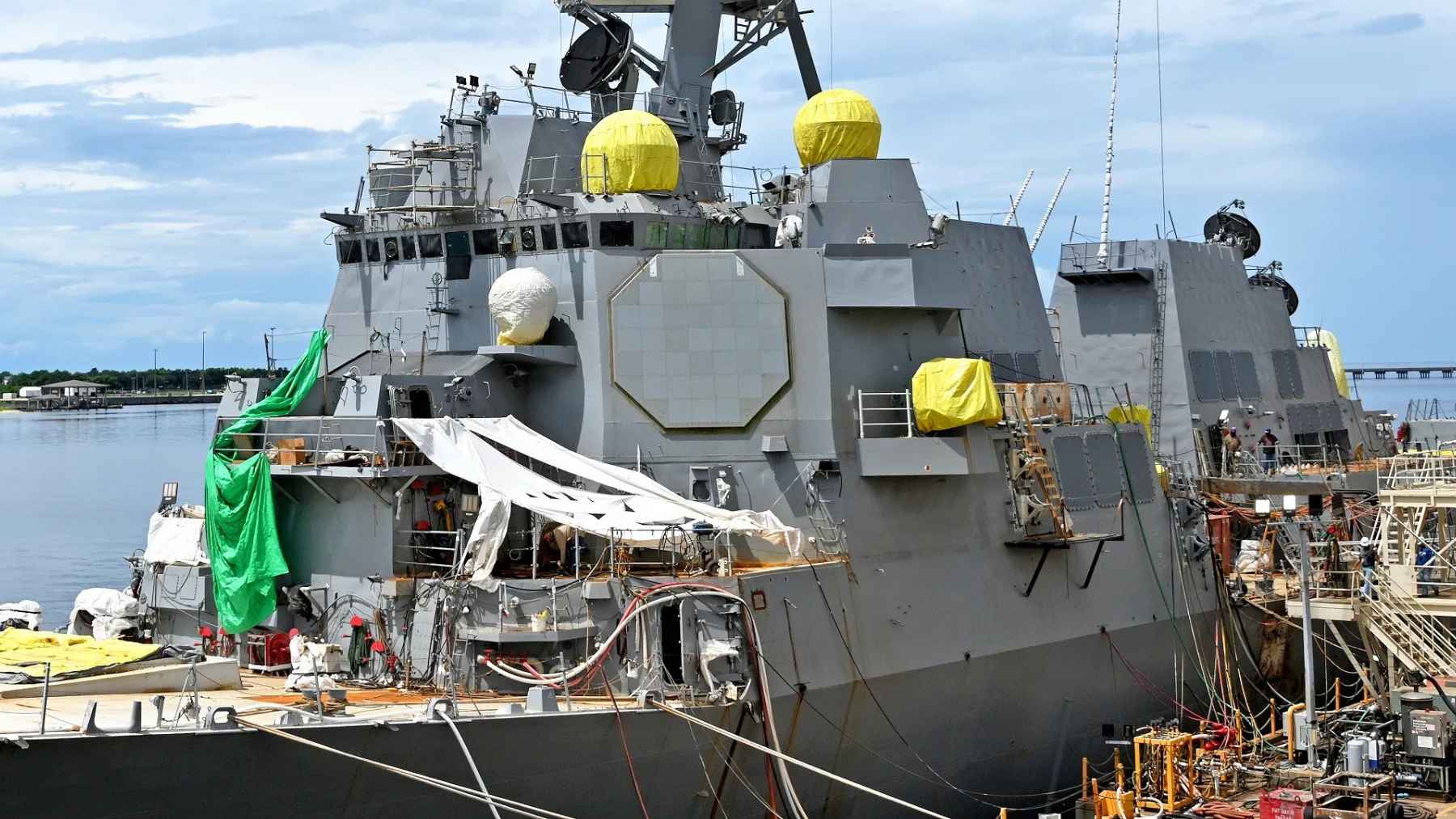

The Navy just made a claim you don’t hear from the Navy very often: one of its newest destroyers can do the air and missile defense work of two of its older ones. That math comes straight from the service’s own release, published August 28 by Naval Surface Force Pacific, and it’s a pretty bold way to grade your own ship. The ship in question is USS Jack H. Lucas, the first Arleigh Burke-class destroyer built to the new Flight III design, and right now it’s the only one of its kind actually at sea.
The reason it can allegedly pull double duty comes down to wiring. Every earlier ship of the class runs a 450-volt electrical grid. This one’s wired for 4,160 volts, with gas-turbine generators that put out 4 megawatts each. Basically, the Navy rebuilt the ship’s entire power and cooling plant to feed one radar.
So what does that radar actually do?
The AN/SPY-6(V)1 is the piece everything else on this ship was redesigned around. It’s built from four fixed faces, and each face stacks together 37 radar modular assemblies. Each of those assemblies is its own little radar in a 2-foot cube, so think of every face as 37 small radars working as one big one. Raytheon says the modular build makes the system cheaper to maintain and easy to scale up or down for other ships.
Raytheon rates it at 30 times the sensitivity of the SPY-1 radar it replaces, a figure the Navy’s repeated, and claims it can pick up a target half the size at twice the range. Sensitivity buys you two things in radar land: you’ll spot smaller stuff, and you’ll spot it farther out. Both matter a lot when what’s coming in is a sea-skimming missile or a drone with the radar signature of a pelican.
As far as I can tell, neither the Navy nor Raytheon publishes actual detection ranges for this thing, which you’d expect for a radar this sensitive. What the Navy does say is that the combination of SPY-6 and the new Aegis Baseline 10 combat system lets the crew run air defense and ballistic missile defense at the same time without either job degrading. That’s where the two-for-one claim comes from, because those missions used to get split between two Flight IIA destroyers.
So why does a radar need a new power grid?
Because the old one was full. The Navy says the 450-volt grid on the Flight IIA ships is near capacity, with little room left for a modern radar, let alone anything after it. Higher voltage lets you push a lot more power through a hull without turning every cable run into a fire hazard. It’s the same logic as the high-voltage lines crossing the countryside before a transformer steps things down for your house.
So the Flight III got the 4,160-volt grid, the 4-megawatt generator sets, bigger air conditioning units and a larger chilled-water supply to carry the heat away from the radar and combat system. The steel hull was modified to carry the extra weight, and displacement climbed to over 9,500 tons from roughly 9,300 on a Flight IIA. The Navy also says the new grid leaves headroom for directed-energy weapons later, which mostly means lasers.
Frankly, the electrical numbers are the best argument that it’s a different ship. The Navy calls Flight III a new type-model warship rather than an upgrade, and marketing aside, nobody re-wires a warship from 450 volts to 4,160 for a facelift.
Here’s how the two versions stack up on paper.
One ship at sea, and it’s still in testing
The Navy commissioned Jack H. Lucas in Tampa, Florida, on October 7, 2023, and almost three years later the ship’s still working through initial operational test and evaluation. That’s the phase where the Navy takes everything the shipyard and the contractors promised and checks it actually holds up at sea, system by system, hull to combat suite. The release has it on a packed at-sea schedule for another 13 months. So this isn’t wrapping up anytime soon. And the ship doubles as the test bench for the whole variant, since whatever its crew finds gets fixed on the 24 hulls behind it.
Is that slow? Not really. You’d arguably want the lead ship of a redesign this deep to spend years getting shaken out. Once testing ends, Jack H. Lucas takes over as air and missile defense commander for a carrier strike group, which makes it the ship responsible for everything that’s flying at the carrier and its escorts.
The ship got a live audience for that job in August. Pacific Dragon 2026 ran from August 6 to 13 around the Hawaiian Islands, the same waters that have hosted an American drone missile warship and a wind-powered boat that launches missiles. The exercise was led by U.S. 3rd Fleet, with the Missile Defense Agency and allied forces drilling ballistic missile defense as a group and swapping tactical data between ships. “Jack H. Lucas represents a quantum leap in surface warfare lethality,” said Capt. Rob Niemeyer, the ship’s commanding officer, in the Navy’s release, crediting the crew rather than the hardware for the result.
Ted Stevens is next, and the Navy already set off live explosives beside it
The second Flight III, the future USS Ted Stevens, recently finished its Full Ship Shock Trials. That’s the test where the Navy detonates live ordnance in the water near its own brand-new destroyer and then checks whether the ship can keep operating, because a warship that only works until the first near miss isn’t much of a warship. Stevens passed. The Navy says the commissioning date is getting close, and that’s as specific as anyone’s getting.
Behind it sits the future USS Louis H. Wilson Jr., and behind that the rest of the 23 hulls spread across contracts and shipyard slots. The older ships aren’t being left alone either: Raytheon is backfitting a smaller SPY-6 variant onto the 47 existing Flight IIA destroyers, starting with USS Pinckney, so the sensitivity jump eventually reaches the whole class. We’ll see how far the two-for-one arithmetic stretches once more than one Flight III is actually out there to test it.
Jack H. Lucas came out of Pacific Dragon on August 13, 2026, and it’s back on a test schedule with 13 months left on the clock, while Ted Stevens sits shock-tested and waiting on a commissioning date.
Image credit: Chris Cavas