
The Navy has spent a couple of years selling drone boats on endurance. Eight days at sea, 400 nautical miles offshore, nobody aboard and no chase boat behind. Then you ask what happens when the tank runs low, and the answer has always been that the boat turns around and drives home.
Off Virginia in August, a Navy team tried something else.
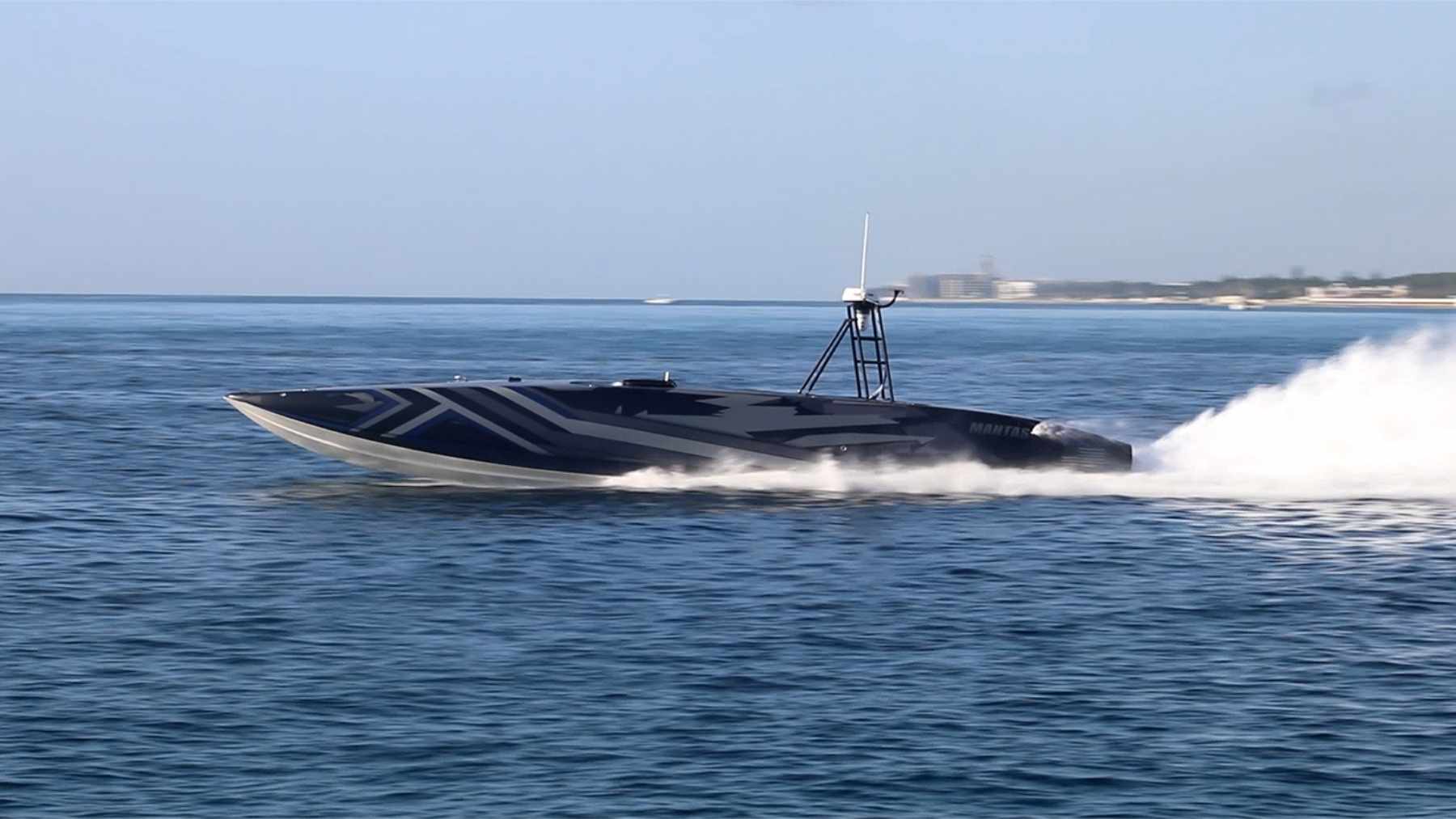
On August 11, the Naval Air Warfare Center Weapons Division ran a refueling demonstration in the water off Joint Expeditionary Base Little Creek-Fort Story. The training support vessel USNS Vindicator (TSV 5) towed a piece of hardware called the TCCD, short for towable capture and connection device. A 38-foot uncrewed boat called the T38 came up behind it, pushed a fuel probe into it, took on fuel and let go. The team ran that cycle dozens of times underway, plus more alongside the pier.
The Navy put the total at 400 gallons (1,514 liters) moved during the event. Sealartec, the Israeli company that builds the connector, counted roughly 100 connection cycles across the few days leading up to it and on the day itself.
So what is a towable capture and connection device?
If you have watched a fighter jet refuel in midair, you already have most of it. A tanker streams a hose with a basket on the end, the receiving jet flies a probe into the basket, and fuel moves while both aircraft keep flying. Sealartec does the same trick at sea level, with a floating body towed astern and a robotic mechanism inside it that grabs the boat and holds on.
A conventional refueling rig needs hands. In an astern replenishment, the receiving ship follows the tanker, a hose comes back on a line, and sailors on the receiving deck haul it in and hook it up. The T38 has nobody to do any of that.
The Navy has already run the roomier version of this. In April, the oiler USNS Guadalupe ran an astern replenishment with the uncrewed Seahawk off Southern California, ahead of Seahawk going to sea with the Theodore Roosevelt carrier strike group. The Navy’s own fact file lists Seahawk at roughly 135 feet, against 38 feet for the T38.
DARPA has taken a third route with a much bigger machine. Its uncrewed Defiant passed lines and connected hoses with a crewed vessel off California during trials, and that team ran the transfer with water rather than fuel.
I would like to know how fast the fuel actually moved, and the Navy has not said.
The boat was not driving itself
So how much of this was actually autonomous? The connector, mostly. You will see the word robotic in every account of this and the hardware earns it, but the boat does not. The Navy describes the T38 as remotely controlled, and Spencer Holloway, who directs the Future Capabilities Office inside the Blue Water Instrumentation program, calls the August work operator-assisted. Somebody was steering that probe into the basket.
Amitai Peleg, Sealartec’s CEO, wants that person gone. He describes a version where the boat closes on the connector by itself, talks to it over automated protocols and lines itself up on its own maneuvering algorithms. That version is the next demonstration.
Refueling is the least glamorous problem in maritime autonomy and arguably the most decisive. A boat that has to break off and steam back to a pier is spending a big share of its working life commuting.
Hypersonic testing is what this is for
Blue Water Instrumentation exists because the Navy keeps firing things that fly farther than its instrumented ranges. Holloway says the flight profiles for hypersonic and precision long-range fires testing run thousands of miles past fixed range boundaries, which leaves the sensors that record the shot spread across open ocean with no fixed instrumentation anywhere near. Uncrewed boats are the affordable way to put those sensors out there and keep them there. Every run back to a fuel dock takes one of them off the board for days. As Holloway put it in the Navy’s release, “every time an unmanned vessel must return to port for fuel, we lose persistence.”
The T38 has already shown what persistence looks like when nothing interrupts it. The same hull spent 192 hours at sea off California in May, around 400 nautical miles (460 miles) out, with no escort trailing it. Maritime Tactical Systems, which builds the boat in Melbourne, Florida, lists the T38 at 38 feet (11.2 meters) with 4,000 pounds (1,814 kilograms) of payload capacity and burst speeds the company puts above 70 knots.
BWI wants the operator out next
The program’s next milestone strings the whole sequence together as one evolution. The boat finds the ship, closes on the connector, captures, takes fuel, lets go and goes back to work, with nobody steering any of it. Holloway lists two jobs before that can happen. He wants less latency in the command-and-control link, because latency is what makes precise maneuvering ugly, and he wants next-generation local positioning systems aboard so the boat can find the connector without a human eye on a screen.
Sealartec has worked with this crowd before. Naval Surface Warfare Center Carderock’s Stiletto testbed ran the company’s autonomous capture system off Norfolk last year, according to The Jerusalem Post, and Carderock helped sponsor the August demonstration alongside U.S. Fleet Forces Command and NSWC Dahlgren. The Littoral Combat Ship Mission Modules Program Office and the Navy’s acquisition executive for robotics handled the contracting that put a Florida boat builder and an Israeli robotics firm on the same water in seven months.
Seven months is quick for anything with a Navy program office attached to it, and the people involved know it.
Peleg wants the next hookup to happen without an operator on the stick, and Holloway’s team has two fixes to make before it does. The Navy published its account of the August 11 demonstration, 400 gallons and all, on September 2.
 @charlesclawson ROOKIE2 months ago