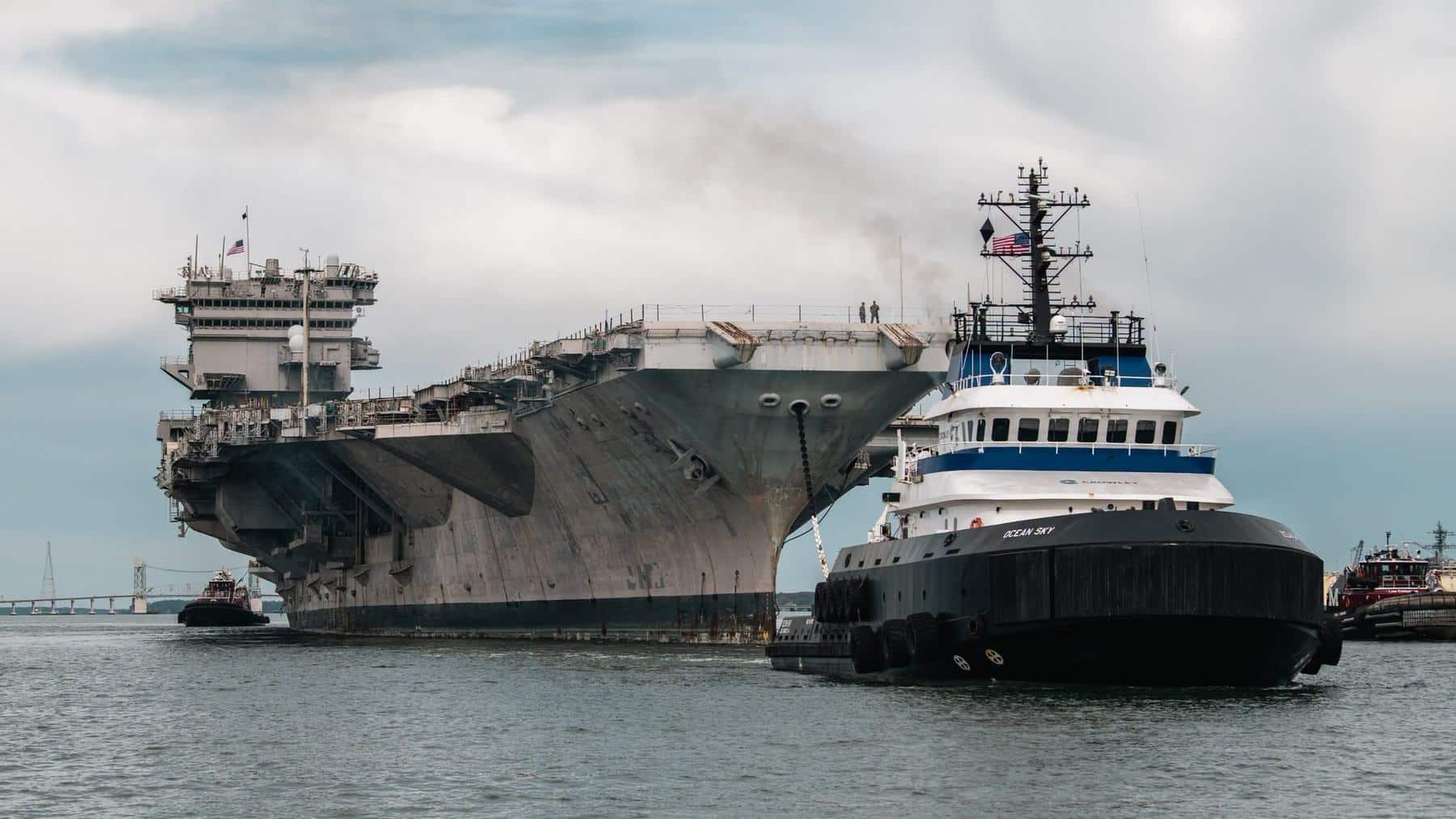

Tugboats pulled the former USS Enterprise out of Newport News on Nov. 2, because her reactors have held no fuel since 2017.
Bryan Clark of the Hudson Institute says a submarine's reactor compartment comes out in one piece, but the Enterprise's is too big, so the hull itself has to come apart.
NorthStar won the reopened competition on July 15 at $418.5 million, about $118 million less than its first award.
The SS United States is scheduled to leave the same stretch of the Mobile River on Nov. 9, about four days before the Enterprise arrives.
Ask The Box:
Aircraft carriers usually leave port with a fair amount of ceremony. Sailors line the rails in dress uniforms, families wave from the pier, and the local TV stations send someone down with a camera.
But the former USS Enterprise’s last trip out of Newport News, Virginia, went pretty differently. She left on the morning of Monday, Nov. 2, with tugboats doing the work, because her reactors haven’t had any fuel in them since 2017. She’s headed for Mobile, Alabama. And if you’ve got a soft spot for the Big E, you may want to look away about now, because she’s going there to be cut up.
We wrote about the plan back in September, when the Navy still hadn’t named a tow date. Well, now it’s happening. PAE Maritime, the Navy office that handles surface ship acquisition, confirmed the departure that same day, and USNI News ran a photo from shipbuilder HII of the hulk coming off the pier.
So how do you move a 94,000-ton ship with no power?
Slowly, and with a lot of help.
The Coast Guard calls this a dead ship tow. A dead ship is about what it sounds like: she can’t drive herself or steer herself, so the tugs handle everything. The filing says she “has no capability to maneuver under its own power,” which is a very formal way of describing the world’s biggest call to AAA.
The current schedule has her arriving on or around Nov. 13, so we’re looking at about 11 days to get from Virginia, around the bottom of Florida and across the Gulf. In her working days she could top 30 knots. I can’t find a published speed for the tow, but it’s safe to assume she isn’t doing that now.
I also can’t tell you how many tugs are on the job. The Navy’s announcement doesn’t say. I’ve seen tug names floating around online, but nothing official, so I’m not going to pass them along as fact.
She’s a lot for any tug to handle, either way. The Enterprise is 1,123 feet long, compared with 1,106 feet for the USS Gerald R. Ford, according to Stars and Stripes. USNI puts her at 94,000 tons, compared with about 100,000 for the Ford. That tonnage comes from her working days, by the way, and USNI itself said 95,000 tons back in July, so I’d treat it as a ballpark. I haven’t seen anyone publish what the hull weighs after 14 years out of service. My guess is a good deal less, but that’s all it is.
Eight reactors is a lot of reactors
The Nimitz and Ford classes get by with two apiece. The Enterprise, which entered service in 1961 as the world’s first nuclear-powered carrier, needed eight.
So does that mean eight nuclear reactors are being dragged past Florida right now? Technically, yes. But defueled means the nuclear fuel, the stuff that makes a reactor a reactor, came out years ago, and the Navy finished that job in 2017. So there’s nothing running in there. The hardware is still aboard, though, and USNI cites a 2023 environmental assessment on low-level radiation in the compartments.
That hardware is why this job is so awkward. Bryan Clark of the Hudson Institute told USNI that a nuclear submarine’s reactor compartment can come out in one big piece and get hauled away. On the Enterprise, though, “the reactor compartment is too big,” so the hull itself has to come apart. The Navy’s current plan is to take the reactors apart as the hull comes down, then send the radioactive waste to licensed disposal sites.
Enterprise was also the first nuclear carrier the Navy ever decommissioned, so she’s going through this first. Frankly, I think that’s what makes this tow more than a sad day for ship fans. The USS Nimitz is due out of active service in 2027, and the rest of her class comes after that.
So what does $418.5 million get the Navy?
It gets the whole ship towed, dismantled, recycled and disposed of, with the contract going to NorthStar Maritime Dismantlement Services. Stars and Stripes reports the job should recycle about 35,000 tons of steel.
The price has a bit of a history. NorthStar first won this work in 2025 at $536.7 million. HII’s ShipCycle subsidiary challenged the process, arguing technical problems kept it from getting a final proposal in on time, and in February a federal court ordered the competition reopened. NorthStar won again on July 15 at $418.5 million, and Forbes notes that’s about $118 million less than the first award. HII dropped its challenge in October. I can’t think of many procurement fights that end with the price going down, so that’s arguably a pretty good outcome for you and me as taxpayers.
The running total is a little murkier. USNI’s July report says about $1.3 billion, and you’ll see that figure a lot this week. But the three items in that same report ($902 million for inactivation, $111 million for storage and the $418.5 million contract) add up to about $1.43 billion, the number Stars and Stripes used. I’m not sure how the Navy squares those two.
The schedule’s a bit fuzzy too. The contract says the work should be done by September 2030, while the Coast Guard’s filing says December 2030. The first award had it finishing in November 2029, so it’s already moved once. I’d go with the contract, but nobody has done this job before, and I wouldn’t bet much on either date.
Mobile is getting ready for her
If you keep a boat around Mobile Bay, this one’s for you. The Coast Guard proposed a set of safety zones on Oct. 1, including a 100-yard radius around the ship and everything involved in towing her. That one moves with her, but only once she’s inside the Coast Guard’s Mobile sector, so she hasn’t been dragging it up and down the Atlantic.
Once she reaches the Mobile Bar entrance, the proposal also closes the federal channel from there up to the Cochrane Bridge until she’s tied up, unless you get permission first. After that, a 200-foot zone stays around her at the yard, at 701 South Royal Street, with the proposed rule running through Dec. 31, 2030. The comment window closed Oct. 16, and I haven’t found the final version yet. So check for the Coast Guard’s radio and bulletin notices before you head out that week.
Then there’s the timing, which is pretty cruel if you love old ships.
That stretch of the Mobile River has spent more than a year and a half hosting the SS United States, the old ocean liner that’s about to become a reef. She’s expected to leave on Monday, Nov. 9, weather permitting, and Fox 10 in Mobile reports that sinking operations are scheduled to start Nov. 12. So two of the most famous ships America ever built will miss each other by about four days.
The Enterprise name is sticking around, at least. A new Ford-class Enterprise, CVN-80, is being built at Newport News, though Forbes says her delivery has slipped from March 2028 to March 2031. Kevin Cormier, the Navy’s deputy portfolio acquisition executive for carriers, closed out the old ship’s send-off with “Fair winds and following seas,” after more than 1 million nautical miles under nuclear power.
The Navy and the Coast Guard both have her reaching Mobile around Nov. 13. Tows run on the weather, so I wouldn’t set your watch by it, and NorthStar’s contract gives it until September 2030 to finish the job.
 A 13-foot-wide US Navy nuclear mini-sub rolled across the seabed off Scotland on wheels, found an F-14 upside down in fishing nets nearly 1,900 feet down and brought its secret Phoenix missile up with a Soviet spy trawler watching, after a month of sonar ships had come up emptyMilitary · 48 minutes ago
 Drone boats that ride almost awash like a drug smuggler’s semi-submersible just went to three American companies to prototype, and the Pentagon’s spec asks each one to haul 18,000 pounds of Marine supplies up to 2,000 nautical miles alone and sink itself on commandMilitary · 7 hours ago
 A torpedo-shaped American underwater drone carrying a synthetic-aperture sonar just beat three rival bidders to hunt sea mines for the Royal Navy, which picked 24 of them in sets of three, each set with its own machine that lowers them into the water and hauls them back aboardMilitary · 8 hours ago