
Most of the small drone boats I write about do one of two jobs. Some run on sunlight, crawl around the ocean for months and report what they see. Others carry a warhead, go out once and don’t come back. A San Diego company called Seasats builds one of the first kind, and it has now started building the fast version at volume.
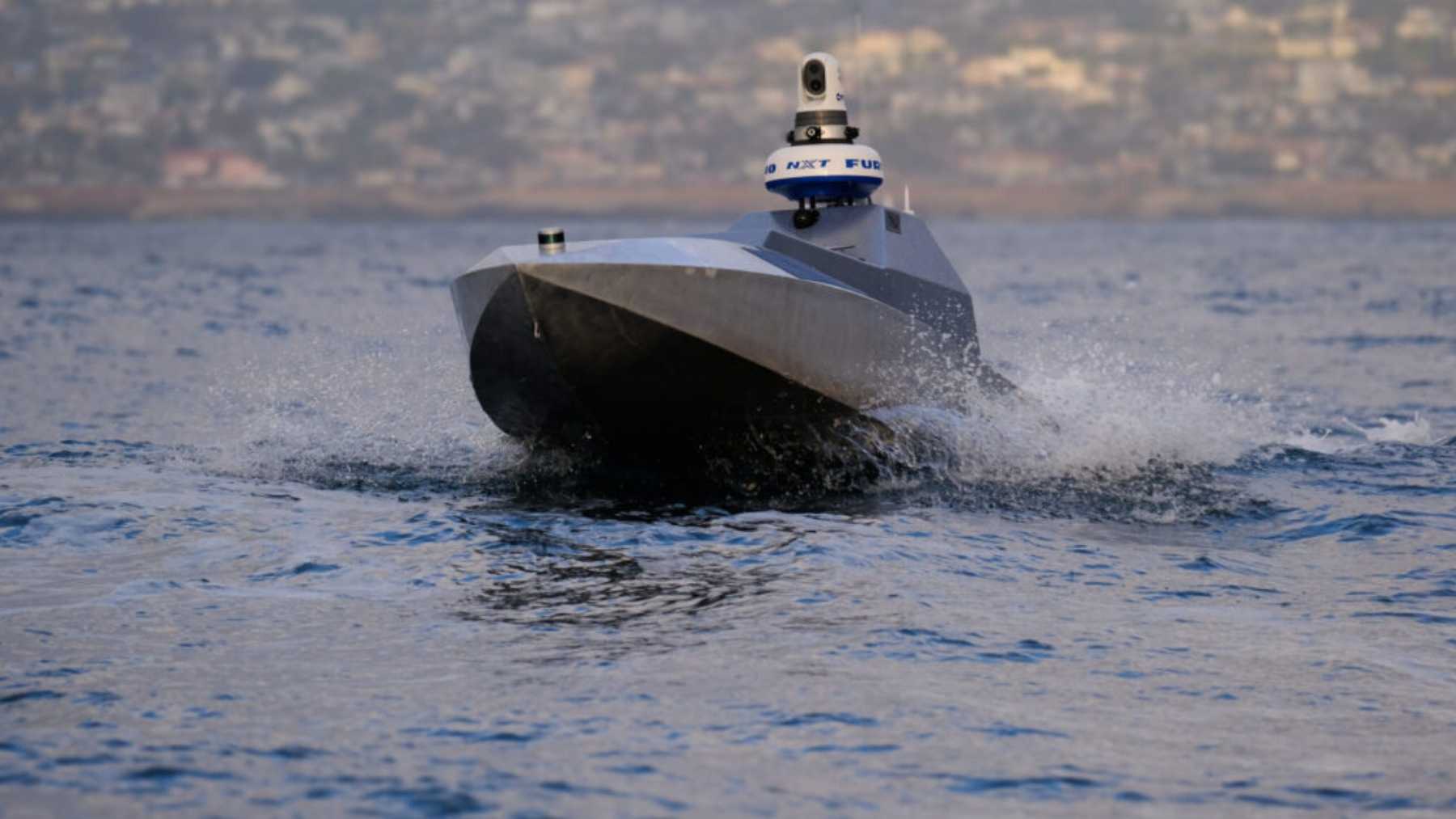
Seasats said on September 3 that the Quickfish, its 17-foot interceptor, is in production and can be supplied in volume. Before that, one of them sat through a two-week Navy electronic-warfare exercise on the Michigan shoreline, carrying several payloads, and finished the whole run.
Two weeks is the number that got my attention. I’ll come back to it.
So what is a Quickfish?
It’s a boat with nobody aboard, and it’s bigger than you’d think from the photos. Seasats publishes a product sheet for the Quickfish, so those are the numbers I’m using here rather than the ones that floated around when the boat was unveiled last October. Empty it weighs 1,450 pounds, and full it weighs 1,900, which leaves about 450 pounds for whatever a customer bolts in. You pick your engine: a gas jet drive for shallow or weedy water, or a diesel inboard-outboard. The hull is aluminum plate cut flat and welded together, which is what lets partners in Australia, the Philippines and Japan build their own under agreements they signed with Seasats. A new operator gets three days of training and that’s supposed to be it.
The boat it grew out of is the Lightfish, the 11-foot solar drone that keeps running into Chinese warships in the Pacific. That one is patient and slow. The Quickfish borrows its electronics and software and trades the months-long endurance for speed. “It’s like you’ve got a high-speed platform that can carry big, heavy payloads,” Seasats CEO Mike Flanigan told USNI News when the boat came out.
There’s a garage in the hull
Here’s where it gets interesting. The Quickfish carries its aerial drones inside a watertight bay in the hull, and Seasats says the bay takes more than one aircraft at a time, in a mix of sizes and types. Four powered ports inside it run 5 to 28 volts at up to 300 watts, so the aircraft sit in there charged and waiting.
Why does that matter? Most drone-launching boats I’ve seen carry the aircraft strapped to the deck in plain view, which works fine for an afternoon demo on flat water and much less fine when spray is coming over the bow for a week. Moving them below deck solves the weather problem. It also means a Quickfish going past you looks identical whether the bay holds cameras, a communications relay or a strike package, and those three are the company’s own examples.
Two weeks in Michigan with the jammers running
Silent Swarm is an experimentation event that the Navy’s Crane lab runs each July out of the Alpena Combat Readiness Training Center, up on Michigan’s Lake Huron coast. In plain terms, it’s where small uncrewed systems get taken out on the water and hit with jamming, spoofing and GPS denial to see what keeps working. Michigan’s military department put this year’s dates at July 13 to 24.
Seasats says it brought five of its boats, Lightfish and Quickfish together, and ran them with a handful of operators. A production Quickfish went the full two weeks with several payloads aboard. If you’ve ever watched a demo boat get trailered home on day three with a dead battery, you’ll understand why a company brags about lasting to the end.
It had company out there. REGENT’s Squire seaglider, the one the Marines were waiting on, ran the same event.
Seasats and its own spec sheet don’t quite agree
Two numbers have moved, and I’d rather flag them than quietly pick the flattering one. The sheet lists a sprint of 34 knots or better; the company said this month that the boat does more than 40. Flanigan put payload capacity at 600 pounds in that October interview, while the empty and full weights on the same sheet leave 450. Neither gap is enormous, and both are the kind of thing that shifts while a design firms up, but the bigger figures are the company’s word rather than a published test.
Then there’s the sea state line. The sheet gives an operational limit of Sea State 6, which is roughly 13 to 20 foot seas, and a survivable limit of Sea State 10. I can’t tell you much about the second one, because the published sea state tables I can find stop at 9, and no test report behind that line has been made public. Treat it as the builder’s number.
The Pentagon went shopping for this exact boat in July
On July 29 the Defense Innovation Unit opened a competition called Suitable Warfighting Adaptive Payloads, or SWAP-USV, with up to $100 million in prize money and another $200 million set aside to buy whatever wins. It wants a crewless boat that already exists, carrying at least two market-ready aerial drones, able to cover 200 nautical miles at 10 knots. We went through those rules when they landed.
The Quickfish sheet claims a sprint range past 400 nautical miles, so the performance floor isn’t the hard part here. Seasats pointed at SWAP-USV in its production announcement and said the boat can be delivered on the unit’s timeline. The company stopped short of saying it entered, and DIU hasn’t published a list of who did.
The money landing right now is still going to the slow boat. Flanigan told Tectonic Defense on September 4 that the Navy and Marine Corps placed more than $24 million in committed orders across nine buys during August, and every one of them was a Lightfish.
Image credit: Seasats