- 4 MONTHS AGO · ENERGYBritain just enlisted America’s biggest fusion startup to prove a reactor can breed its own fuel, turning lithium into tritium with the machine’s own neutrons, because the world’s entire supply weighs one packed carry-on and shrinks 5.5% a year
- 3 MONTHS AGO · ENERGY864,000 shots a day is what a commercial laser fusion plant needs, the only machine that has ever pulled more energy out of a target than it put in fires about 400 times a year, and the site picked to close that gap is a reactor switched off in 2011
- 2 MONTHS AGO · ENERGYAmerican-built magnetic sensors have just arrived in Prague for a tokamak designed to hit 5 tesla and 2 million amps, after their shielding took microwave beams at a 2.1-millimeter wavelength inside a German fusion machine, and they beat the 200-ton steel skeleton there
- 2 MONTHS AGO · ENERGYA 17,600-pound steel pump built to empty the world’s biggest fusion reactor works by freezing gas in place at 452 degrees below zero, and the one gas that refuses to stick, helium, gets caught instead by 15 pounds of charcoal ground from coconut shells
- TODAY · THIS ARTICLEA 44-ton British fusion machine dumped 10 million amps into a target of nested shells in two millionths of a second and crushed it in stages, with no fuel inside and nothing lit, and the biggest machine of its kind, in New Mexico, peaks at 26 million
A gasoline engine splits its work into two. First, the piston compresses the mixture; then the spark plug ignites it. And neither part has to be any good at the other’s job.
A diesel skips the plug and makes the squeeze do both, which works fine in a truck. According to a British fusion company, it’s also the expensive way to do fusion. So on September 22, that company announced it had squeezed half working, at least on test targets that weren’t trying to achieve fusion.
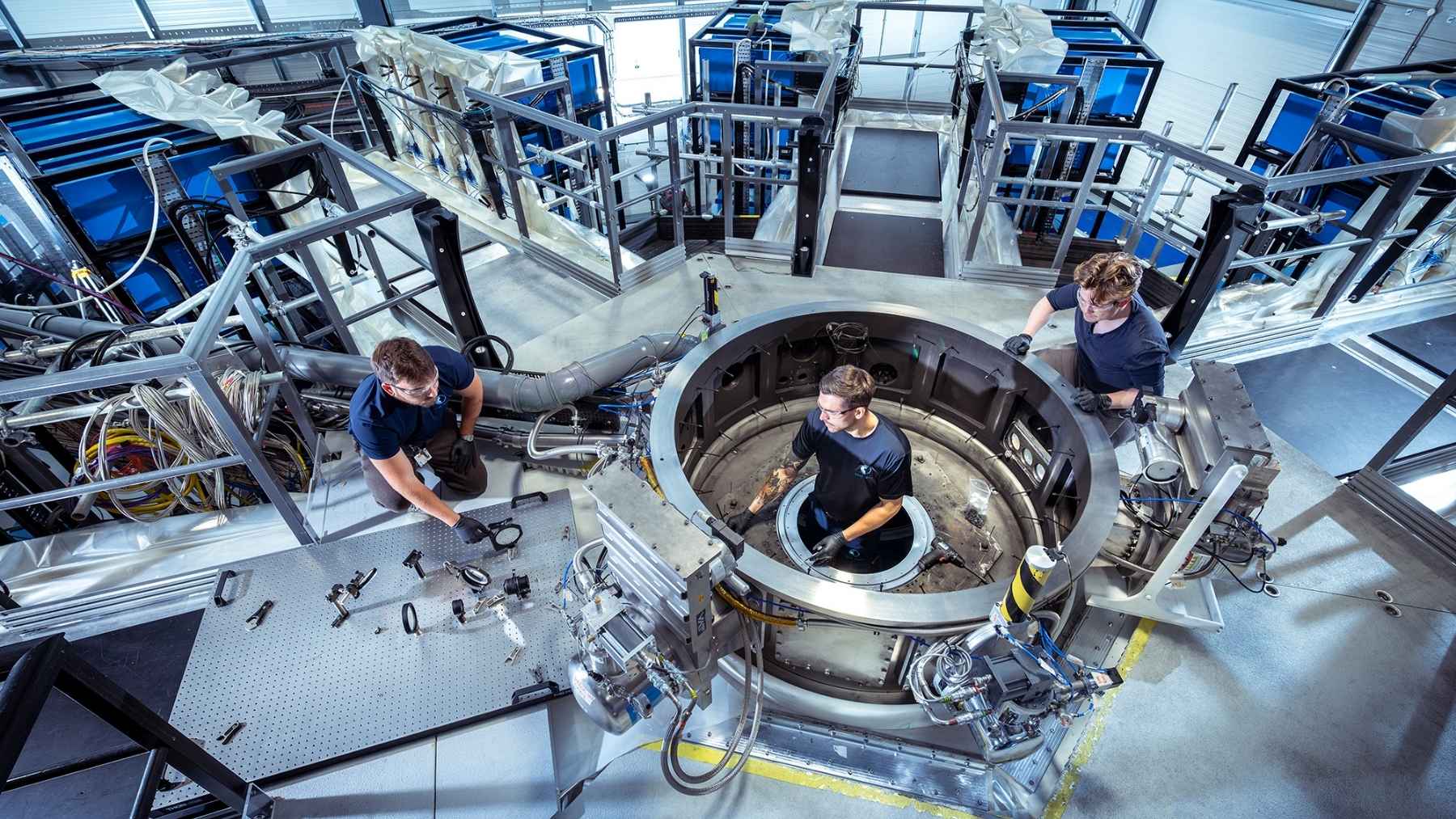
The company is First Light Fusion, based in Yarnton, just north of Oxford, and the machine is M3, a 44-ton bank of capacitors built around a vacuum chamber in the company’s own building. According to First Light’s announcement, a series of shots on M3 crushed a target built from several nested shells, and did it in the controlled, staged way the company’s fusion design calls for. First Light was careful to spell out what the experiments weren’t. They didn’t ignite anything or measure fusion gain. They tested the compression step on its own.
Which is a smaller claim than the phrase “fusion milestone” usually comes with. And a more believable one.
So what is M3, exactly?
A capacitor’s basically a battery with no patience. It can’t hold much, but whatever it holds, it’ll hand it all over at once.
M3’s got 192 of them, arranged in six banks around a vacuum chamber about 5.6 feet across, and the whole setup sits inside an enclosure roughly 52 feet on a side. First Light’s own spec sheet puts the machine at 44 tons, with about nine miles of cable running through it, 300 diagnostic probes watching every shot, and enough thin plastic insulation film to cover almost four football fields.
On a typical shot, the machine runs at 140,000 volts, which stores 1.22 megajoules of energy. That reads like a weapons-grade number. It’s about a third of a kilowatt-hour, which is what your 1,500-watt space heater uses in about 14 minutes. From there, the timing is almost violent. M3 dumps that energy in about two millionths of a second, and the current peaks at 10 million amps.
10 million amps sounds like a lot… But it’s actually not what First Light wanted. The pitch during construction was more than 14 million, close to 500 lightning strikes landing at once in the company’s own comparison, and you’ll still see that figure around.
The spec sheet today says 10, and I can’t find anywhere that First Light explains the gap. My read is that 14 million’s what the bank does at its full 200,000-volt rating, and 10 million’s what you get at the 140,000 volts it typically runs at, since peak current in a machine like this scales with the charge voltage, and 140 is 70% of 200. First Light hasn’t spelled that out anywhere I can see, so that’s my math, not theirs.
Each shot’s a bit of an event, too. First Light says M3 fires once every other day during a campaign, and the company designed and built it in 18 months for about $4.6 million, £3.6 million at the exchange rate when it opened. For a 10-million-amp machine, that’s pretty cheap!
What actually gets crushed?
In this business, a “liner” is just a thin metal tube. Run enough current down it, and the magnetic field that current makes squeezes the tube inward on itself. First Light’s standard version is aluminum, 0.63 inches across, a bit fatter than an AA battery, with a piece of acrylic (the clear plastic big aquarium walls are made of) sitting in the middle to take the hit.
How fast does the tube collapse? Faster than anything you’d want near you, that’s for sure. In the platform experiments, First Light’s Oliver Nash presented at an American Physical Society meeting, a laser velocity gauge (photonic Doppler velocimetry, basically a radar gun that uses light instead of radio waves) tracked the inner wall of the tube moving inward at about 19,000 mph, call it 5.3 miles every second, by the time it had closed from a radius of 0.31 inches to 0.18.
Simply put: Take a tube and make it much smaller, very quickly.
The September shots used a more complicated target. Instead of one tube, the shells are nested, and First Light says the geometry of the nest is what turns one fairly crude electrical pulse into several shock waves arriving on a schedule, each one squeezing the inside a little harder without heating it too early. The point, in the words of Mark Thomas, First Light’s CEO, is to “simplify the machine by putting more functionality into the target.” Jeremy Chittenden, the Imperial College plasma physicist who chairs the company’s science advisory board, called it a significant step and noted that the generator driving it was a low-voltage one.
So is this fusion fuel getting squeezed to fusion conditions? Not yet.
Chittenden’s wording is “materials,” the announcement says the next phase moves toward “fusion-relevant fuel conditions,” and the integrated test that adds the rapid heating comes only after that. There’s no date on either step yet, and the announcement doesn’t say what hardware would deliver that second burst in a finished system. I’m not going to guess.
So why would you want a weaker machine?
First Light has given us a bit of insight here. The machines that compress fusion fuel today have to deliver a huge burst of energy with extreme precision, and every shot beats on the hardware. The company’s estimate is that a FLARE-style compression driver (FLARE is its name for the two-step design) could come in at a tenth the cost of comparable inertial fusion systems.
That’s the company’s number, and “could ultimately” is doing a fair bit of work in it. But the logic holds up. If the target handles the timing, the machine’s job shrinks to delivering a lot of current on schedule, and a machine with one job’s cheaper to build and cheaper to keep running.
For scale, the biggest pulsed-power machine on Earth is Z, at Sandia National Laboratories in Albuquerque. We covered Z recently: 2,160 capacitors, 26 million amps, 20 megajoules dumped in about 100 billionths of a second. First Light knows that machine well, since it has run its own targets on Z and set the facility’s record for pressure in quartz doing it. On a typical shot, M3 stores 1.22 megajoules to Z’s 20 and peaks at 10 million amps to Z’s 26, and First Light describes it as the second-highest-current pulsed-power machine running anywhere right now. I haven’t checked every capacitor bank on Earth, so take that as the company’s claim.
That statistic is pretty huge when you consider that First Light built M3 for the price of a decent house in Palo Alto, and it’s now using that machine to show a fusion design doing its compression on a budget driver. The company stopped planning its own power plant a while back, and now pitches FLARE as a fuel system someone else’s machine could run.
Still, a cheap compression stage is just one stage. ITER, the giant tokamak in southern France, just took delivery of the last 440-ton slice of a plasma chamber that’ll weigh 5,732 tons, and that project’s been collecting parts for years. A 44-ton machine in an industrial park outside Oxford, crushing a tube narrower than a quarter, isn’t competing with that, and from the looks of things, First Light doesn’t claim it is. It’s one piece of a different approach, in the same broad family as the Canadian machine that collapses a lithium can around its plasma. Lighting the fuel once it’s squeezed is a separate problem, and First Light’s own announcement says these shots didn’t try to do that.
First Light published the result on September 22, 2026, and the company says the next phase moves its nested-shell targets toward the fuel conditions fusion requires, with the heating step coming only afterward.
 A reactor built from 664 two-inch uranium cubes hung on wires in heavy water under a German castle was Heisenberg’s last shot at a chain reaction, and two of the surviving cubes now show it needed about twice the uranium and heavy water it held, more of both than Nazi Germany hadEnergy · 2 weeks ago
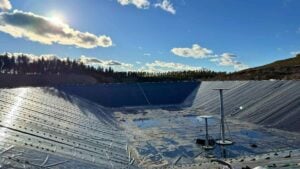 A 66-foot-deep gravel pit in Finland just started taking in about 100 million gallons of tap water, and once a nine-acre lid goes on top, it’s meant to hold enough summer heat at up to 194°F to cover as much as nearly a quarter of the town’s yearly heat demandEnergy · 2 weeks ago
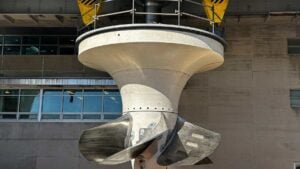 A 375,000-pound turbine now spins inside a Tennessee dam in place of one that ran for more than 80 years, and a federal watchdog just found that 196 of the 240 welds on the ring guiding water out of it failed on a job where some welders weren’t qualifiedEnergy · 2 weeks ago