- 2 MONTHS AGO · ENERGYA 120-foot steel building stands over a sealed plutonium reactor in Washington state with open air between the two, put up for under $10 million to stay shut for up to 75 years, and the crew that checked the reactor’s roof flew a drone into that gap so nobody stood next to the core
- 2 MONTHS AGO · ENERGYA 20-foot vacuum chamber in Albuquerque takes 26 million amps from 2,160 capacitors in about 100 billionths of a second, around 200 times a year, each shot shaking the ground like a small earthquake, and the lab that runs it wants one 10 times bigger
- 3 WEEKS AGO · ENERGYA 375-foot-wide concrete tank in South Carolina wrapped in 289 miles of wire has been topped off with nuclear-waste grout after eight years of pumping, as the plant feeding it ran 24 hours straight for the first time and sent 112,000 gallons in a single day
- 6 DAYS AGO · ENERGYA 1,050-ton slab at the bottom of a 115-foot Ontario shaft is the foundation of the Western world’s first grid-scale small reactor, and the 300-megawatt machine meant to stand on it will now be late, because its engineering is still being finished as the concrete goes in
- TODAY · THIS ARTICLEA 7.9-foot concrete pedestal cast in a factory and topped with a 3-foot-square rubber pad is how a small reactor plans to ride out earthquakes, and depending on the ground, one plant could stand on as many as 594 of them set between its foundation and the reactor building
If you’ve ever stuck a rubber pad under a washing machine to keep it from wandering across the laundry room on the spin cycle, you already get the basic idea here. Rubber’s pretty good at soaking up shaking. And it turns out it’s good enough that the team behind a British small modular reactor wants to set the whole reactor building on it.
On November 18, Skanska UK said it had finished building and testing a full-scale aseismic bearing pedestal for Rolls-Royce SMR. The work happened at Bentley Works, a Cementation Skanska facility in Doncaster, England. “Aseismic” is basically engineer-speak for earthquake-resistant. The pedestal is the concrete block that holds up one of those rubber bearings, and you’d need hundreds of them for a single plant.
So what does it look like? According to Concrete Connect, each pedestal is a precast block of reinforced concrete about 3.9 by 3.9 feet across and 7.9 feet tall. On top sits a laminated natural-rubber bearing roughly 35 inches square, sandwiched between a steel plate above and another below.
Depending on the ground at a given site, one plant could need anywhere from 540 to 594 of these pedestal-and-bearing sets. That’s a lot of identical concrete.
So how does a building float on rubber?
Normally a building is tied straight into the ground, so when the ground moves, everything on top moves with it. Base isolation puts a flexible layer in between. The bearings let the ground shift underneath while the building above moves a lot less, and World Nuclear News says they soak up and spread out the energy of the shaking, so less force gets through to the structure on top.
The word “laminated” matters too. Bearings like this are generally built up from layers of rubber bonded to steel, which makes them stiff when you push down on them and soft when you push them sideways. That’s pretty much exactly what you want under something as heavy as a reactor building. It’ll hold the weight up without squashing, and it’ll still let the ground slide around below.
Isn’t Britain a weird place to worry about this? Kind of. A regulatory document on this design, published by the Office for Nuclear Regulation (ONR), says big earthquakes are unlikely in the UK, but that the hazard is still serious enough that reactors built there have to plan for one. And ONR’s research page on aseismic bearings points out that no nuclear power plant in the UK has ever used seismic isolation, so it’s new ground for British regulators as well.
We’ve seen what happens when heavy nuclear gear meets a real quake before, including two Virginia reactors that shut themselves down during an earthquake. And sometimes engineers go looking for trouble on purpose, like when a 500,000-pound transformer went onto a shake table to see how it’d handle a quake.
Why does each bearing need a pedestal?
So why not bolt the bearings straight onto the foundation? Concrete Connect places the pedestals between the plant’s foundation slab and the bearing system, which makes each one a riser that its bearing sits on. When Rolls-Royce SMR hired Skanska back in January, it said the pedestal is what lets it use one standard design whatever the soil and earthquake risk look like at a given site. ONR makes a similar point about the isolation layer as a whole: it’s what lets a standard design go to different sites without engineers having to redo the detailed analysis for every location.
I haven’t seen either company explain why the pedestal’s 7.9 feet tall specifically. Still, one standard block, with the count going up or down depending on the site, sounds like a fairly sensible way to avoid redesigning the foundations every time the reactor moves to a new location.
Why not just pour them on site?
You could, and a lot of concrete work gets done exactly that way. But pouring each pedestal in place means building forms, tying rebar, pouring and curing 540 to 594 times on an exposed stretch of coast on Anglesey, in North Wales, in whatever weather the Irish Sea feels like sending that day.
Interesting Engineering, which covered the trial, says building them off site could make them more consistent, better made and quicker to deliver. That’s frankly the whole pitch behind a small modular reactor. World Nuclear News says about 90% of the Rolls-Royce SMR is meant to come out of factories, in modules about 52 feet long and 13 feet wide. So it’d be a bit odd if the concrete holding all of it up was still poured on site.
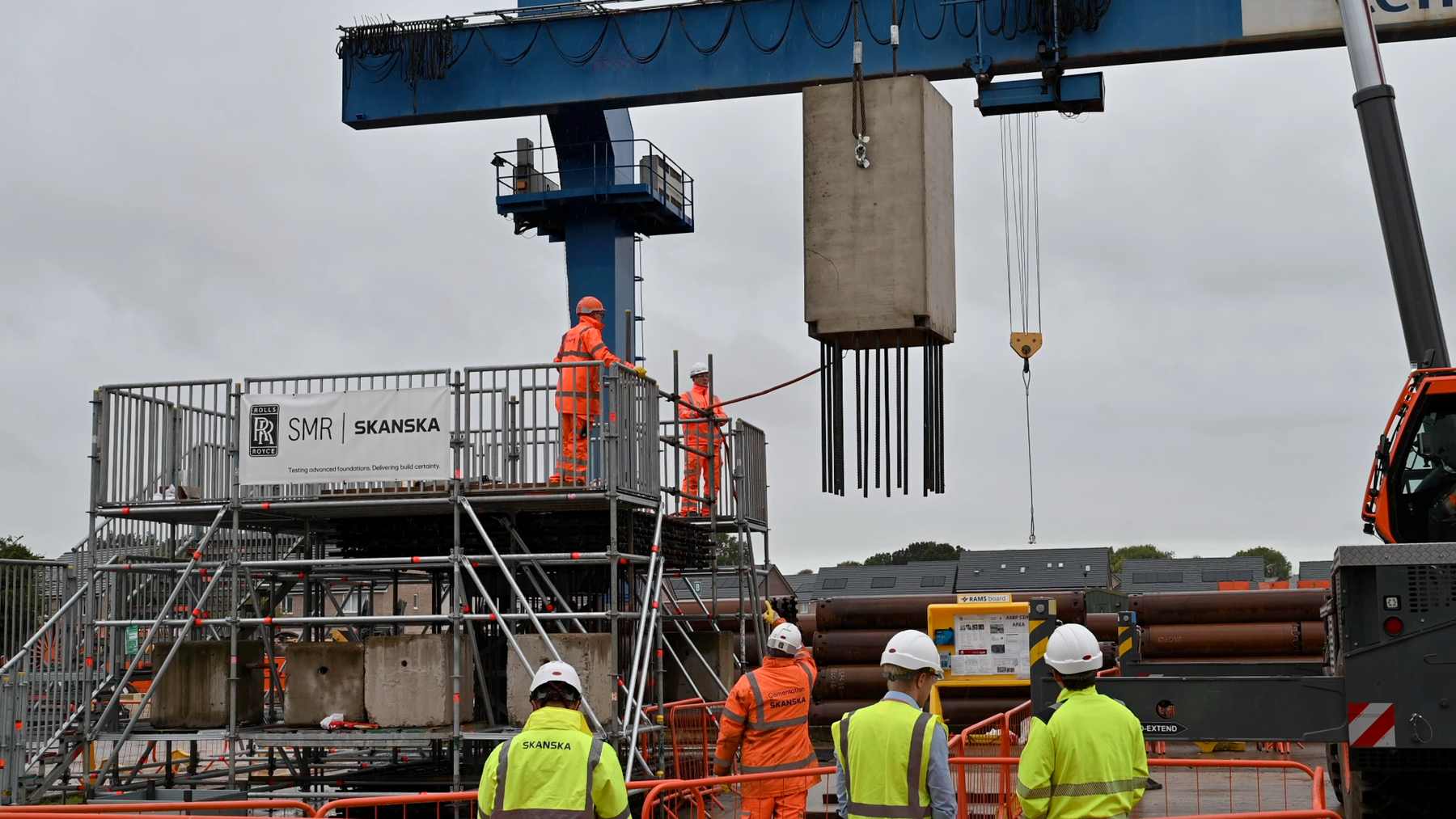
That’s what Skanska was testing. According to Concrete Connect, the team made a full-size pedestal, then lifted it, set it in place and leveled it. Skanska hasn’t published the tolerances it hit or how long each step took, and I couldn’t find a weight listed anywhere either. The photos show it going in on a crane. Basically, it’s a dress rehearsal for a job that’ll eventually be done hundreds of times per plant.
Ruth Todd, operations and supply chain director at Rolls-Royce SMR, called the demonstrator “an important step in developing a factory-built approach to delivering our SMRs.”
So is this reactor approved yet?
No. It’s a demonstrator, a one-off built to prove the method before anyone commits to making hundreds of them. The reactor design itself is still in Step 3 of the UK’s Generic Design Assessment, the final step of a review run by the Office for Nuclear Regulation, the Environment Agency and Natural Resources Wales.
If you haven’t run into GDA before, it’s basically Britain’s way of vetting a reactor design before anyone tries to build it on a specific site. Regulators go through the safety, security and environmental case. If they’re happy at the end of Step 3, the design gets a Design Acceptance Confirmation from ONR and a Statement of Design Acceptability from the environmental regulators.
Assuming it gets through, the first plants are headed for Wylfa, on Anglesey. Rolls-Royce SMR was picked to deliver small reactors through GBE-N, the government-owned nuclear developer, and World Nuclear News says Wylfa was named as the site for three units, with room for up to eight. Skanska says first power in the UK is expected in the mid-2030s, with the Czech Republic close behind and Sweden after that.
A final investment decision is expected in 2029, according to World Nuclear News. That’s arguably a long runway for a part that’s already been built and tested, but nuclear projects haven’t exactly been known for rushing.
Before any of that happens, though, the design’s going in front of the public. The Environment Agency says Step 3 comes with a consultation that’s open to the public and other stakeholders, and it’s scheduled to start in February 2027.
 A 650,000-ton haul in 9,000 carloads has already been moved by railcars that carry their own batteries and roll along the rails with no locomotive pulling them, and the same self-propelled cars are now headed to a Texas Gulf Coast plant to shuffle freight cars around its tracksEnergy · 17 hours ago
 A 36,000-foot-rated underwater robot modeled on a deep-sea fish can land on the seafloor, take samples and map it in 3D, is light enough for a small team to launch from an ordinary research ship, and already went about 19,700 feet down off Bermuda ahead of a crewed diveEnergy · 18 hours ago
 A 350-mile power cable buried along a railroad from northern Iowa to northern Illinois is planned to carry 2,100 megawatts at 525,000 volts, and sites are being scouted in Iowa for a nuclear plant of up to 1,000 megawatts that would send its power east through itEnergy · 19 hours ago