
- 2 MONTHS AGO · MILITARYA 115-pound underwater drone runs like a torpedo on two tail thrusters and spins a third pointing straight down to stop and hover over anything shaped like a mine, and the Spanish Navy launches the 5.2-foot machine from small boats so a diver doesn’t have to go down first
- 2 MONTHS AGO · MILITARYA 56-foot British drone boat built to carry 8,818 pounds in a 20-foot shipping-container slot spent September off Portugal catching what sonobuoys radio back, a job a patrol aircraft burns flight hours circling to do, and the Royal Navy has already bought a second receiver
- 1 MONTH AGO · MILITARYA 19,800-pound American drone boat spent two weeks running around the clock in an Australian port and can watch one patch of ocean for 23 days on 790 gallons of diesel, from a hull 37 feet long that fits inside a 40-foot shipping container
- 5 DAYS AGO · MILITARYA 17,500-ton British nuclear missile submarine just came home to its Scottish base after an estimated 217 days hidden underwater, about 12 days longer than any Royal Navy patrol before it, and the Ministry of Defense will not confirm how long the boat was at sea
- TODAY · THIS ARTICLEAn 8.8-ton drone submarine that fits inside a shipping container runs on hydrogen fuel cells adapted from space launches, can cover 3,100 miles or stay out 45 days, and five NATO allies have bought it while the navy back home has about 20 drones for 151,000 miles of coast
You’ve probably sat behind a 40-foot shipping container on the interstate more times than you can count. It’s the big steel box riding on the back of a semi, and pretty much nobody gives it a second look.
So it’s a little funny that one of the longest-range underwater drones you can actually buy right now is built to fit inside one.
The drone is called the Guardian, and it comes out of a shop in Burnaby, British Columbia, just outside Vancouver. Neil Manning, the CEO of Cellula Robotics, told CBC News that five NATO allies have bought it, and that orders are on their way to customers in Europe, the U.S. and Asia. CBC’s report doesn’t name those allies. It does point out that Canada hasn’t bought one, which is arguably the most awkward bit of the whole story. We’ll get to that.
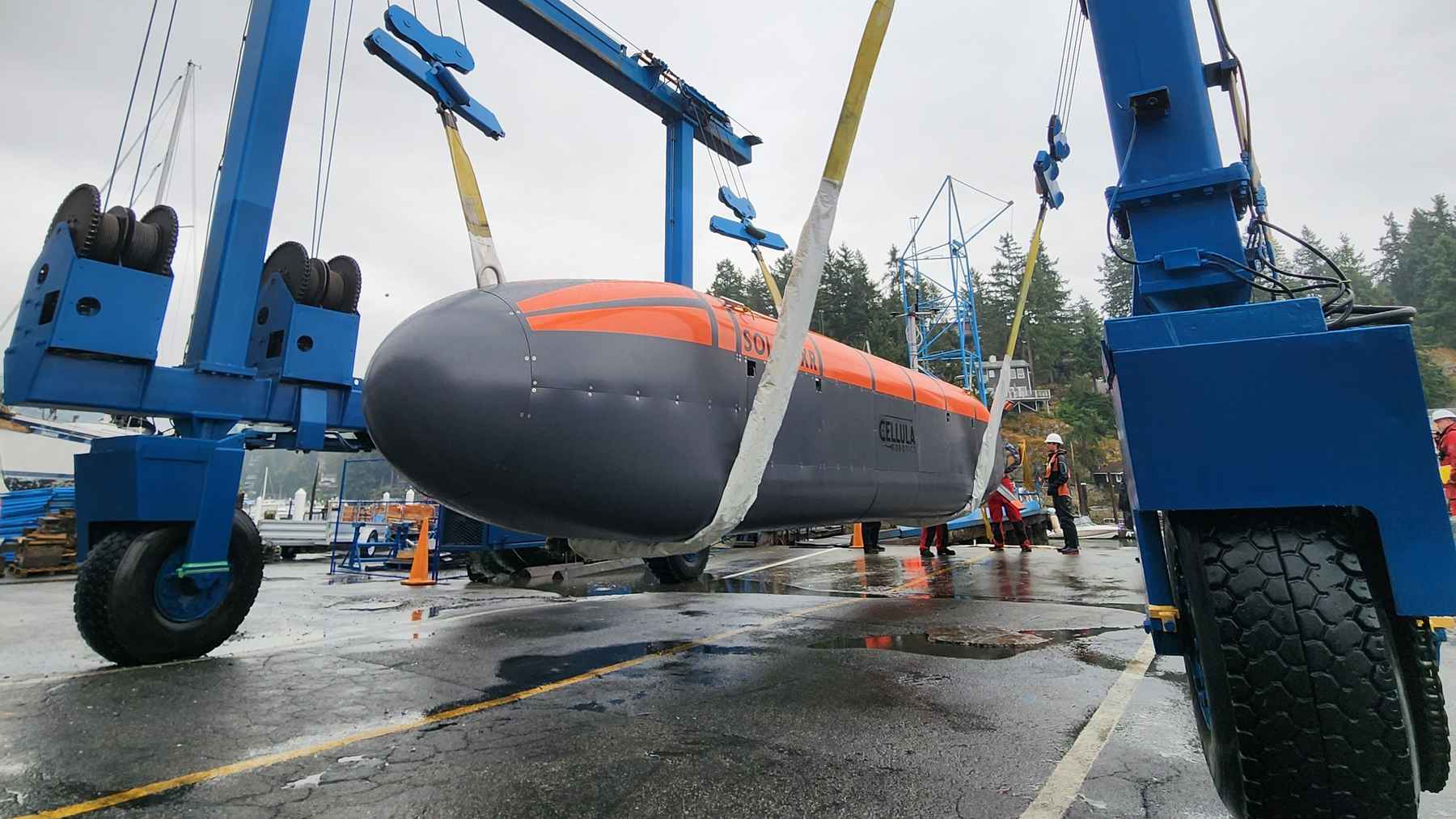
The Guardian’s spec sheet lists it at just over 38 feet long and about 5 1/2 feet tall and wide, so the shipping container comparison holds up. The hydrogen version weighs roughly 17,600 pounds, or a little under 9 tons. It comes in three depth ratings, good for about 1,000, 3,300 or 9,800 feet. There’s room inside for up to about 1,320 gallons’ worth of sensors and gear, split across two bays or one big one. Cellula lists its speed at 8 knots, which is a little over 9 mph and slower than you’re supposed to drive through a school zone.
So how does a drone stay underwater for over a month?
Plenty of underwater drones run on lithium-ion batteries, the same basic chemistry that’s in your phone. Batteries are simple and quiet, but they’re heavy for the amount of energy they hold, and once they’re drained the drone has to head home.
The Guardian runs on a hydrogen fuel cell instead. A fuel cell makes electricity by combining hydrogen with oxygen, and the only thing it gives off is water. Cellula describes the setup as an air-independent propulsion system, which basically means the drone doesn’t need to come up for air the way a diesel submarine does when it runs its engines.
CBC reports the fuel cell tech was adapted from NASA’s space launches. That’s a pretty fancy family tree for a machine that’s going to spend its working life in the dark under the ocean.
You don’t have to take the hydrogen pitch on faith, either. Cellula also sells a battery-powered Guardian, and it publishes both versions side by side. The fuel cell version is rated for about 3,100 miles of range and the battery version for about 1,650 miles, in a hull that’s the same length.
Now, here’s where it gets a little messy. CBC says the Guardian can stay at sea for up to 45 days, and the marketing copy on Cellula’s own product page says over 45 days submerged. The spec table on that same page lists 925 hours for the fuel cell version, which works out to 38.5 days. I can’t tell you which mission each number assumes, because the page doesn’t say, and it doesn’t say what speed the 3,100-mile figure is based on either. Still, both numbers come out to more than a month on one load of hydrogen.
So why put hydrogen in a submarine when it’s struggled so much in cars?
Honestly, I’d say a drone like this is a pretty sensible home for it. Hydrogen cars have had a rough time mostly because there are so few places to fill up. A drone that leaves from a dock or a ship, works for a month and comes back doesn’t care about that. It just needs hydrogen waiting where it starts.
There’s a lot of cable to watch down there
Most internet traffic between continents doesn’t bounce off satellites. It runs through cables lying on the seafloor, and those cables carry more than 95% of the world’s internet traffic, according to CBC. NATO allies have been keeping a closer eye on them over sabotage concerns.
That’s the kind of job the Guardian is built for. Its autonomy options include pipe and cable tracking, so it can follow a line along the bottom by itself without anyone steering. It can hover in one spot or anchor for long stretches, raise a retractable mast to look around at the surface, and send data home by satellite. Cellula says a single dive can cover up to about 3,100 miles of seabed survey.
For a sense of scale, the Guardian is about twice the length of the 19-foot drone submarines headed for a Rhode Island production line. We’ve also covered an American team working with this same Guardian platform. Drones have been showing up in hard-to-watch water on the surface too, like the Danish drone boat that sat at anchor in a poorly covered patch of the Baltic.
The navy back home has about 20 drones
Canada has a three-ocean coastline of about 151,000 miles, and the Royal Canadian Navy has about 20 underwater drones for all of it. They’re American-built drones fitted with sonar tech from Kraken Robotics, another Canadian company. The navy uses them to hunt mines and run tests, and surveillance isn’t part of the job.
So why hasn’t the navy bought a Guardian?
Basically, because nothing’s ready to plug in. According to CBC, an internal document obtained through an access-to-information request shows defense officials talked about a short-term fix, which was checking whether Canadian underwater drones could help cover the navy’s surveillance gaps. Vice-Admiral Dan Charlebois, the navy’s commander, confirmed to CBC that there’s no interim solution yet. “We’re just not there yet,” he said.
Charlebois also told CBC that the products the navy needs already exist in Canada, and that the procurement system can be challenging. It’s a bit of an odd spot to be in, since Canada’s Department of National Defence paid Cellula years ago to develop a fuel cell that would let underwater drones handle long-range, long-duration missions.
Ottawa’s bigger plan is an underwater surveillance system that’s still in the initial procurement phase. CBC puts its estimated cost at C$250 million to C$499 million, which is about $175 million to $349 million at the Bank of Canada‘s Nov. 19 rate of 1.4317 Canadian dollars per U.S. dollar. CBC says it isn’t clear yet whether foreign companies will be allowed to bid.
In the CBC report published Nov. 21, Charlebois said the navy should start receiving large autonomous vehicles in the early 2030s, and Ottawa wants the full underwater surveillance system delivered by 2043.
 A 20-foot German drone submarine just came off a production line for the first time with its tail planes rebuilt into an X, two propellers turning against each other and dive planes on its motor pods, and the first hulls go to European governments before the year is outMilitary · 18 hours ago
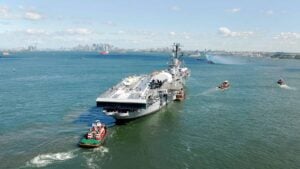 A 27,100-ton aircraft carrier once moved just 15 feet when six tugboats pulled on her with 30,000 horsepower after 24 years at a Manhattan pier, because her four 16-foot propellers had dug into the river mud, and freeing her took three weeks of dredging nearly 40,000 cubic yardsMilitary · 21 hours ago
 A 9,700-pound cache of primer explosive in 68 barrels that have sat more than 20 years at an Iowa ammunition plant, now too degraded to move after their water bath partly evaporated, has until Monday to be blown up in place before a forecast cold snap makes the material worseMilitary · 21 hours ago