
Wind turbines kill birds. Spend five minutes in the comments under any wind power story and someone will tell you so, usually in all caps.
They’re not wrong, either. The trouble is that nobody really knows how many die at sea. A bird that hits a blade miles offshore drops into the water and disappears, and most of those collisions happen at night, which doesn’t exactly help anyone count them.
So the Netherlands has started doing something I didn’t know a government could do with an offshore wind farm. It tells the turbines to slow down.
On October 4, from midnight to 6 a.m. local time (6 p.m. to midnight Saturday on the East Coast), the Dutch Minister of Climate and Green Growth ordered offshore wind operators to bring their rotors down to fewer than two turns a minute. The order went out through Rijkswaterstaat’s Start/Stop notices, and Rijkswaterstaat is the Dutch agency that runs the whole procedure (think of it as a rough cousin of the Army Corps of Engineers). The notice lists the Borssele, Hollandse Kust Zuid and Hollandse Kust Noord farms, and the Netherlands Enterprise Agency counts 381 turbines across them.
Two weeks later, the ministry ordered two more three-hour windows for the night of October 17 into October 18, one from 7 to 10 p.m. and another from midnight to 3 a.m.
Vogelbescherming Nederland, the Dutch bird protection group that helped design the system, says the October 4 slowdown went ahead. I couldn’t find anyone confirming how the October 17 and 18 windows actually played out. The operators do have a track record, though. The Dutch Coast Guard checked the five slowdowns ordered this spring from the water and from the air, and every wind farm involved had complied.
Two older farms off the Dutch coast aren’t on the list yet. Rijkswaterstaat says the Egmond aan Zee farm has to join in 2027 and the Prinses Amalia farm in 2028.
So how slow is two turns a minute?
Pretty slow. Tim van Oijen, the group’s North Sea specialist, said in a piece Vogelbescherming published on October 16 that the blades normally turn up to 15 times a minute, with tips hitting around 155 mph at full speed.
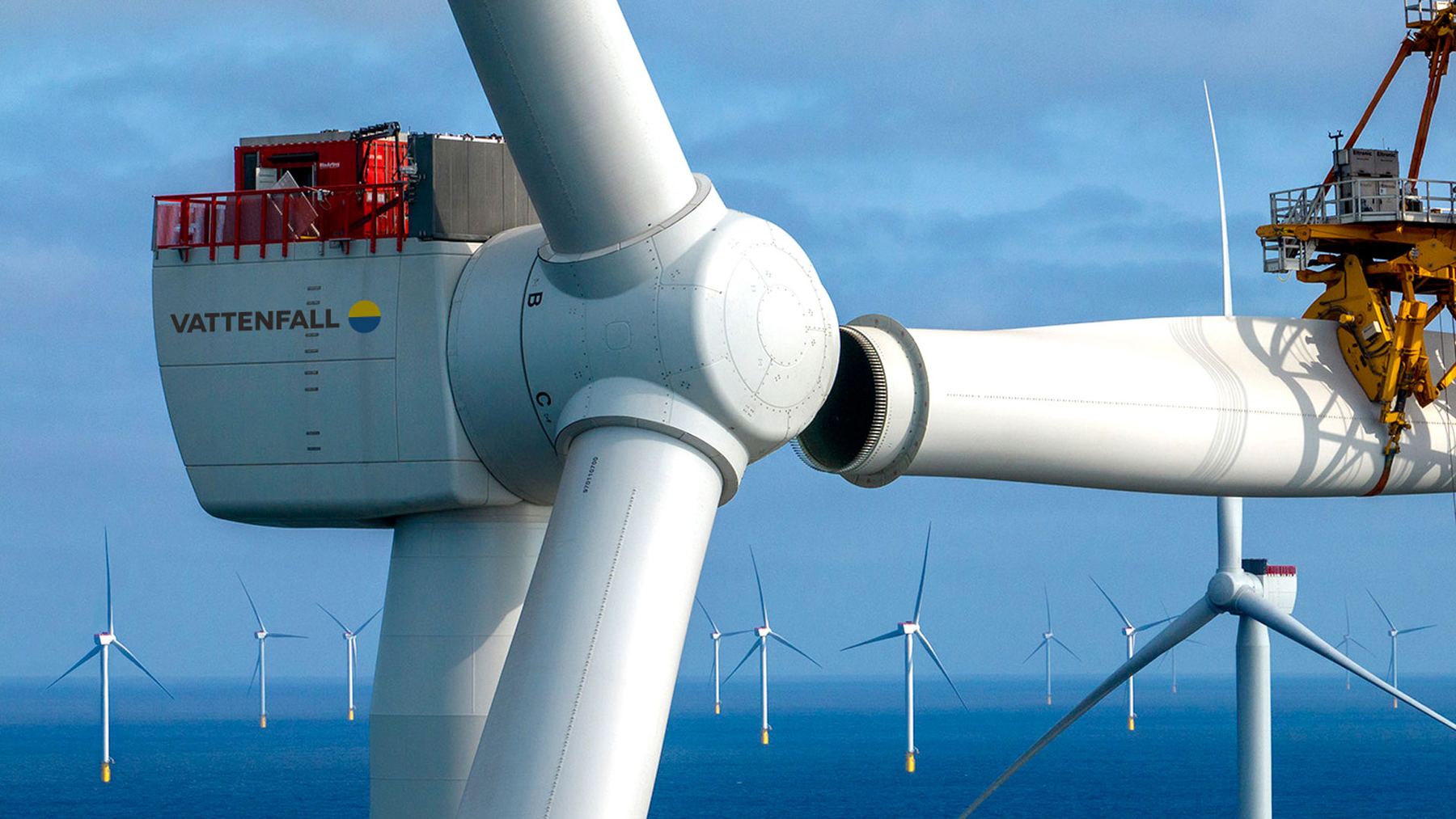
The biggest machines on the order list are the 11-megawatt turbines at Hollandse Kust Zuid, which carry 318-foot blades on a 656-foot rotor, according to the farm’s operator, Vattenfall. (It’s the same farm where a Dutch crew has been growing kelp between the towers.) I ran the numbers on that rotor. At just under two turns a minute, its blade tips move at a bit under 47 mph, while Van Oijen’s figure for a blade at full speed is around 155 mph.
Forty-seven mph still isn’t something I’d want to fly into. But it’s arguably a lot easier to dodge, and that’s basically the whole idea.
So why not just stop them when the radar sees birds?
That was my first thought too, and apparently it was Rijkswaterstaat’s as well. The agency says on its own site that switching turbines off the moment radar spots a wave of birds looks like the logical approach. Then it explains the problem, which is the grid.
A power grid has to make exactly as much electricity as people are using, every second of the day. Pull several wind farms off at once with no warning and the grid operator suddenly has a hole to fill, and Rijkswaterstaat says doing that to multiple farms at the same time makes the grid unstable. These farms aren’t small, either. By the Netherlands Enterprise Agency’s figures, the ones on the October order list add up to about 3.8 gigawatts of capacity. That’s a lot of power to yank out of a country’s supply on short notice. And the birds don’t send a calendar invite.
So the Dutch went with a forecast instead. A model built by the University of Amsterdam predicts how many birds will cross the North Sea between 82 and 984 feet up, which is roughly the band where the blades spin. It runs on radar data collected over the past few years plus the latest weather forecasts. A team of bird experts checks the prediction, TenneT (the national grid operator) checks whether the power supply can take the hit, and then the minister decides.
The catch is timing. Everything has to be settled about two days ahead, because Rijkswaterstaat says that’s how long TenneT needs to keep the supply stable. The agency and TenneT looked at deciding just one day out, but Rijkswaterstaat found the bird forecast didn’t get significantly better with the extra day.
Van Oijen isn’t thrilled with that. He told Vogelbescherming that migration doesn’t always let itself be predicted two days early, by the models or by the experts, so the system isn’t entirely ideal. That’s a pretty fair complaint, and frankly a bit of an understatement when you’re asking a computer to guess what a sky full of songbirds will do on a Saturday night.
So where does the radar come in?
This is where it gets a little counterintuitive. Rijkswaterstaat does have bird radars out there, on offshore platforms and turbines, and each station is really two radars from Robin Radar Systems. A horizontal one tracks where birds are flying, a vertical one measures how high they are, and together they plot the flight paths in 3D.
The agency says its bird radars can pick up birds as far as 3.7 miles away and up to about 4,900 feet. They log direction, speed, distance and a rough size class (small, medium, large or flock), and the software filters out clutter from turbines, airplanes and weather. When the system was going in, a Rijkswaterstaat technical manager described the hardware as the same kind of Furuno radar you see spinning on ships.
Here’s the twist. Rijkswaterstaat’s own review of the program, published in March, says the forecast model is built on data from the horizontal radars alone. The vertical radars, the ones that measure altitude, haven’t been validated yet, and their data isn’t used for the slowdown procedure. Live radar data could make it into a third version of the model, which the agency expects a couple of years from now.
Which means the radar is basically the model’s teacher, not its trigger. A technical review done for the program also estimated the model would need 10 to 20 years of radar data to produce representative results. The procedure has only been running for about three years, so that’s a pretty long runway.
The Dutch capped it at 60 hours a year
When the procedure formally kicked in, the rule was simple. If the model predicted more than 500 birds per kilometer per hour, the minister could order a stop. That basically means 500 birds crossing an imaginary line a kilometer long (about 800 per mile) every hour.
It never happened. Rijkswaterstaat says the threshold was set so high that it never produced a single stop decision, even when the radar showed real migration peaks. I’d say that’s an unusually honest thing for a government report to admit. The stops that did happen, like the six last fall that added up to 36 hours, were voluntary, according to Van Oijen.
So the government rewrote the rule. The site decisions for these farms (basically their permits) were amended in January, and since this spring the fixed threshold is gone. The model still needs a trigger number, but the project team can now adjust it, and this spring it was set at 115 birds per kilometer per hour. On top of that there’s a cap: the minister can order up to 60 hours of slowdowns a year, counted from the start of each fall migration. Van Oijen says this is the first year the stops are mandatory.
Sixty hours sounds like plenty until you look at the calendar. The minister can only call these stops at night, between 6 p.m. and 6 a.m., during two migration windows: February 15 to May 15 and September 20 to November 30. By my math, that’s 60 hours out of roughly 1,900 night hours in those windows, or about 3%. I’d call that a fairly tight leash.
Van Oijen would like more room. He said that if the stops always landed on exactly the right nights, 60 hours would cover every migration peak, but the models sometimes miss. So the turbines occasionally slow down when they didn’t need to, and keep spinning when they should have stopped. A slightly bigger allowance would help, in his view.
So does any of this actually save birds?
Honestly, nobody can say yet. Van Oijen told Vogelbescherming that reliable death counts are very hard to collect at sea, and that newer tools, like cameras paired with blade sensors that pick up vibrations, are still in development.
What researchers do have is traffic data. Van Oijen pointed to Dutch radar research showing about 1.6 million birds a year passing through a single offshore wind farm at blade height. His argument is basically a precautionary one: if you can avoid even a few percent of the collisions on peak nights, it’s worth doing.
I also couldn’t find a published figure for how much electricity the October slowdowns cost the operators, or how many birds actually crossed those farms on those nights. Rijkswaterstaat says it’s working on a plan to study how well the procedure works, and the Dutch offshore wind ecology program has asked TNO, a Dutch research organization, for advice on the equipment needed to measure that at sea.
Frankly, I think the Dutch approach is a pretty sensible one, especially next to what you see in the US. A Wyoming wind farm went the camera tower route, stopping one turbine at a time when an eagle shows up, and there’s a separate experiment going on with blade colors that birds might spot more easily. The Dutch are working at the scale of an entire coastline, which is a very different job from protecting one species on one ridge.
Van Oijen’s bigger point is about where the next farms go. “Location is everything,” he said, and his group wants all this migration data used to pick the sites for new ones.
The fall migration window stays open through November 30. As of October 30, the last order on Rijkswaterstaat’s list is the three-hour slowdown that ended at 3 a.m. local time on October 18, which leaves 48 of this year’s 60 hours, by my count.