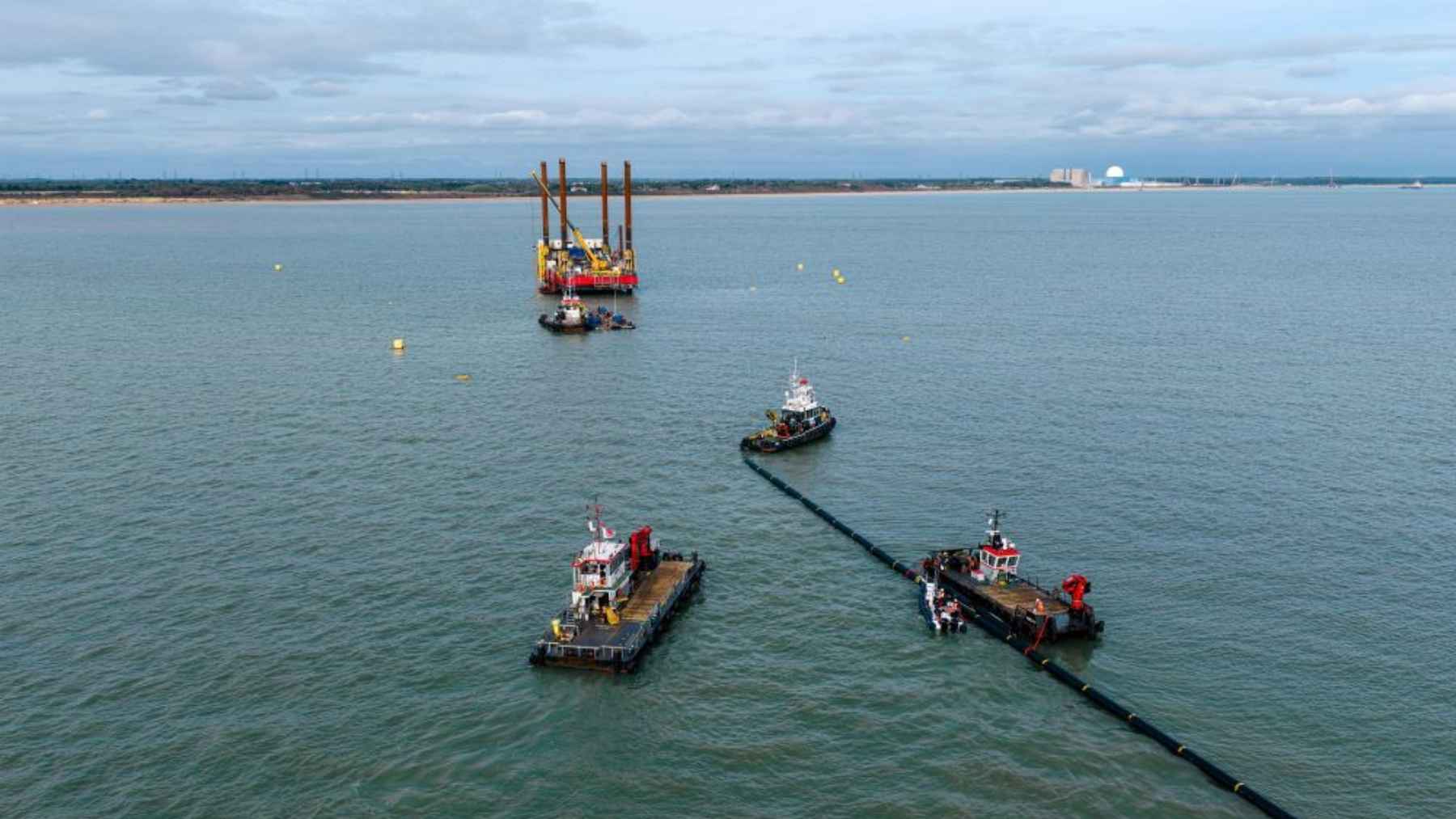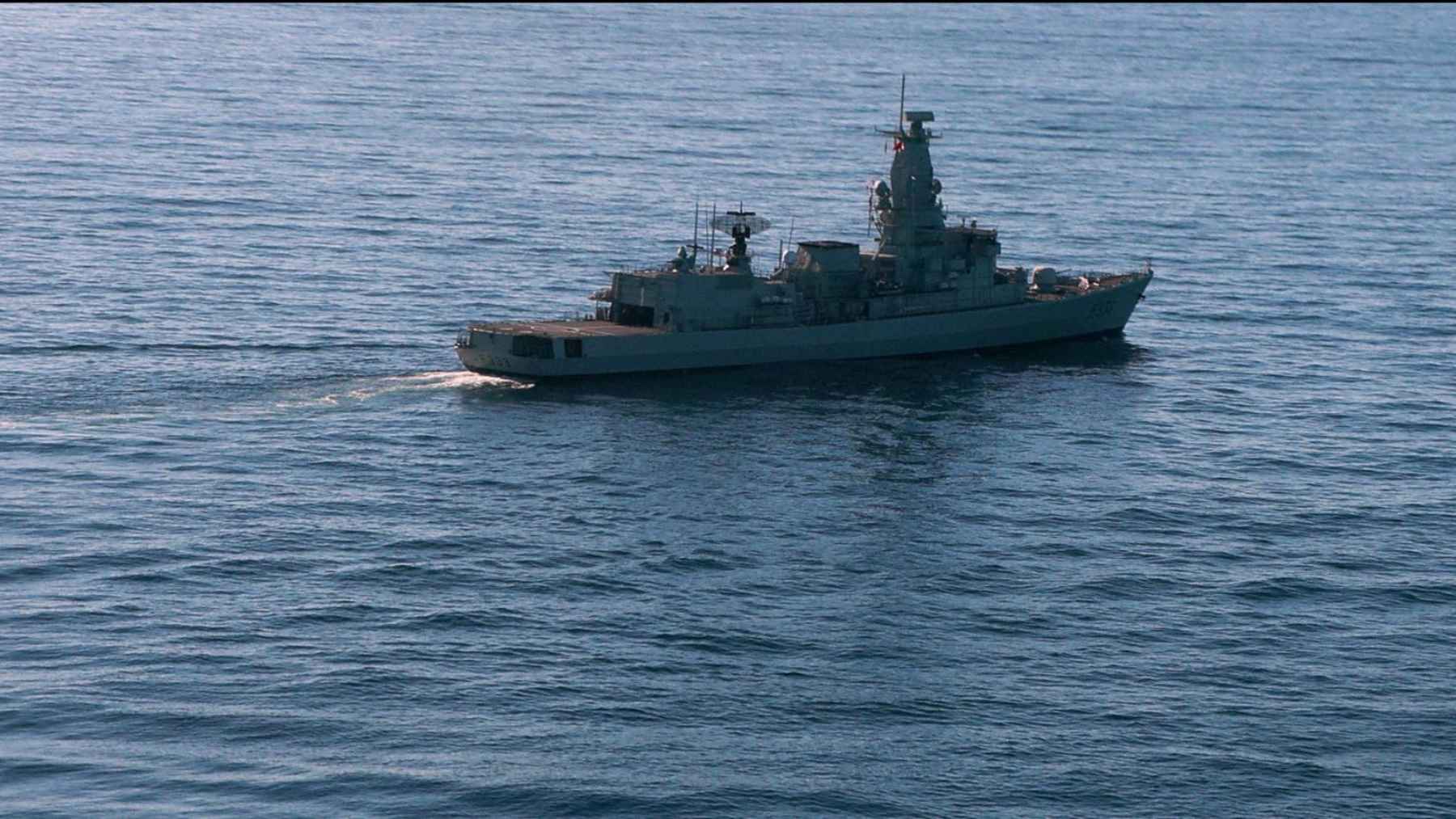

The US is the world’s biggest exporter of liquefied natural gas, and a good share of those cargoes cross the Atlantic to Europe. Some of them end up in a pretty unusual spot: a 958-foot ship parked in the open Adriatic, about 5 miles off the coast of Ravenna, Italy.
That ship is the BW Singapore. It belongs to Snam, the company that runs most of Italy’s gas transmission network, and it’s been working off Ravenna for about a year and a half. In that time it’s taken in more than 30 LNG cargoes, and Milano Finanza reports most of this year’s first-half deliveries came from the US.
If you’re not sure what a ship like that does, here’s the short version. Natural gas chilled to around minus 260°F turns into a liquid that takes up roughly 600 times less room, and that’s how it crosses oceans. The BW Singapore is what the industry calls an FSRU (a floating storage and regasification unit). It holds about 45 million gallons of that liquid, warms it back into gas and sends it ashore through a pipeline, with room for up to 5 billion cubic meters (about 177 billion cubic feet) a year, according to Snam.
So what’s the problem?
Well, the Adriatic. The BW Singapore sits out in open water with nothing between it and the weather, and when a storm rolls through, the tankers bringing in gas struggle to unload on schedule. Luigi Patìmo, who heads the Italian arm of Spanish construction group Acciona, told Milano Finanza a protective wall would let the terminal run “seven days a week without interruption.”
So what’s going into the water?
Ravenna’s port authority is building a breakwater roughly 2,900 feet long to shield the terminal, and it’s made of 18 hollow concrete boxes called caissons. The job costs more than €200 million. The port awarded it to a group led by Italian builder RCM Costruzioni, with Acciona as its partner.
A caisson is basically a concrete ship with no engine. It’s divided inside into cells and it’s watertight, so as long as those cells are full of air, it floats. Flood them and it sinks, which is exactly what you want once it’s sitting over the right spot. After that it gets ballasted so it stays put. The port hasn’t said what goes into the cells on this job, though sand and rock are the usual choices.
The third box went down on October 27, according to RCM. The first one was laid on the evening of September 27, so the work is moving at roughly one box every two weeks. That lines up with the 15-day pace Ravenna’s mooring company was planning for before the first tow.
The contractor lists the boxes at 174 by 72 feet. The biggest ones are a bit wider, at around 79 feet, and stand close to 46 feet tall, based on figures local paper Ravenna&Dintorni published ahead of the first tow.
I’d love to tell you what one of them weighs. I can’t find a published figure from the port, the contractor or Snam, though, and I’m not going to guess. For comparison, the caissons going into Genoa’s new breakwater, which we’ve covered before, come in at 16,500 tons each, but those are built for water up to 164 feet deep, so they’re a much bigger beast. And the tunnel elements going down in the Baltic for the Fehmarn link are in another league entirely, at 81,000 tons apiece.
Ravenna’s caissons are cast inside the port in the Kugira Dos, a floating dry dock RCM describes as one of the largest in the Mediterranean. A floating dry dock is pretty much what it sounds like. Workers build the box on a huge platform with walls, then the whole dock partially sinks itself until the finished caisson floats free. It’s a frankly elegant setup, because nobody ever needs a crane big enough to lift one of these things.
How do you move a floating concrete box?
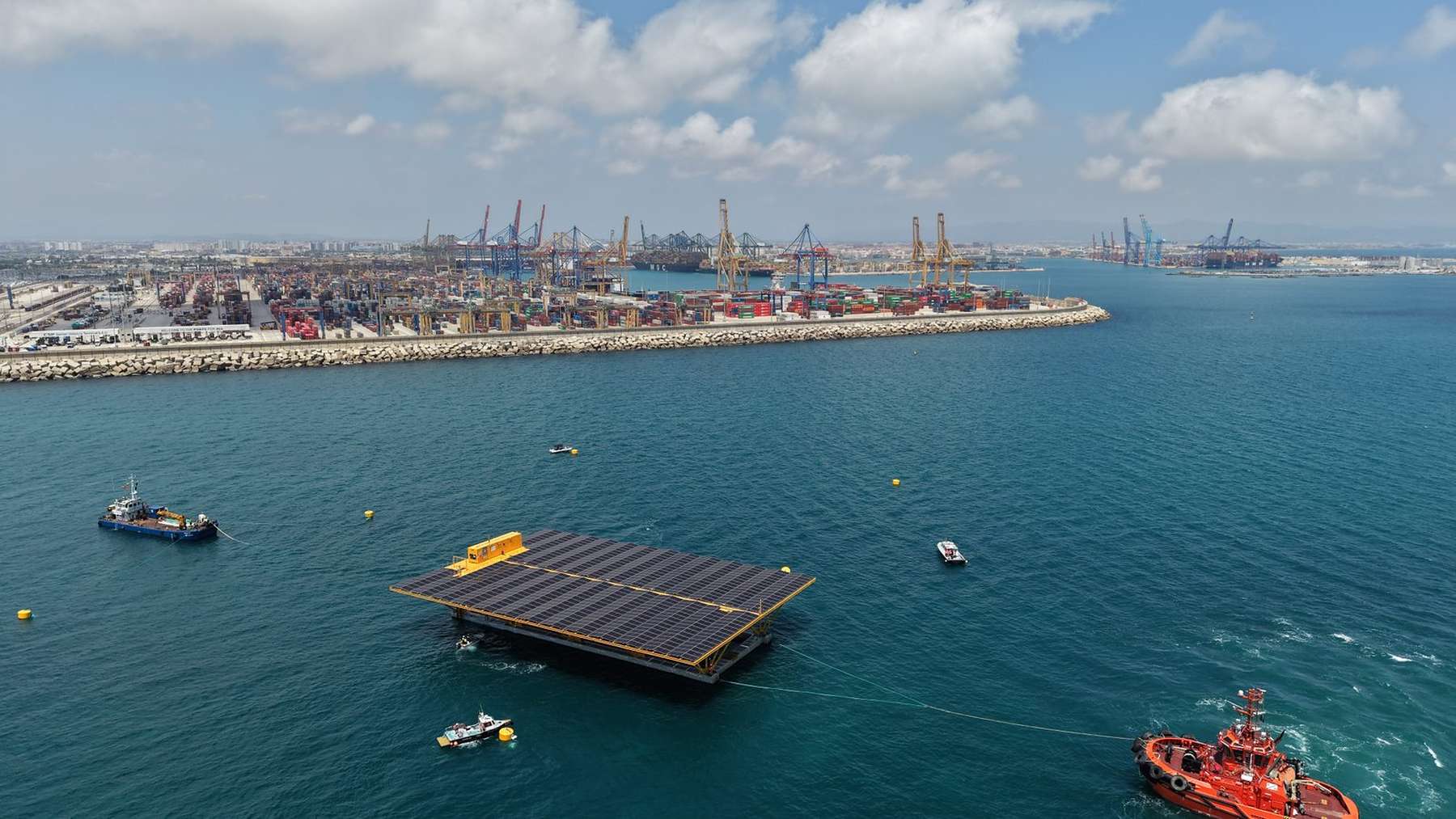
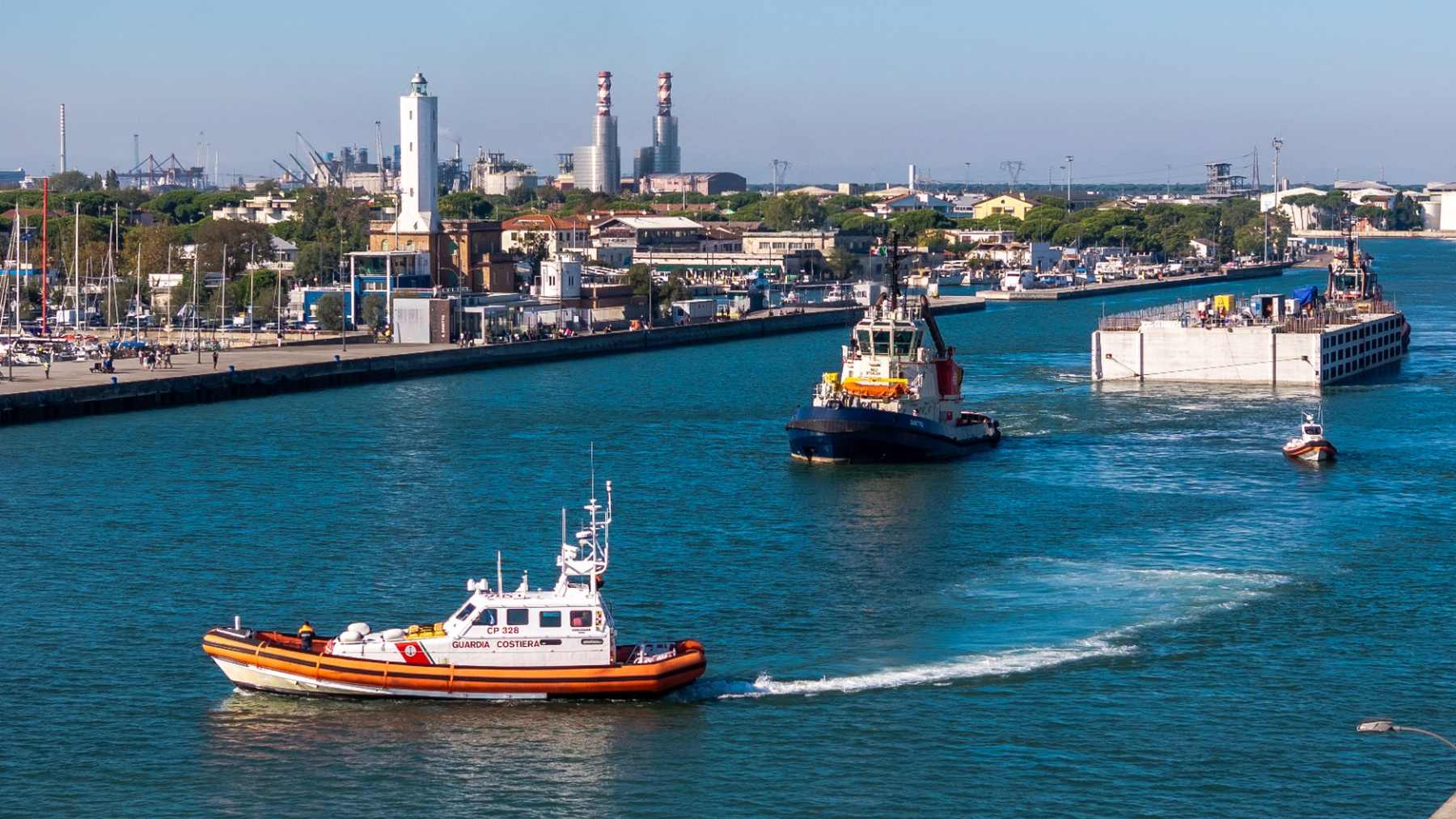
Very slowly. Ravenna’s mooring company laid out the plan before the first tow: the box leaves port around 6 a.m., two harbor tugs pull it out at about 0.8 knots, and the whole trip, including tying it up offshore, was expected to take six to eight hours.
If you’re keeping score, 0.8 knots is a little under 1 mph. That’s about a third of a normal walking pace, so you could comfortably outwalk one of these boxes if there were anywhere to walk. Alberto Antonelli, who heads the mooring company, pointed out to Ravenna&Dintorni that his crews aren’t really moving a vessel in the usual sense, since the thing “has no propulsion.”
Once it’s about 5 miles out, near the platform where the BW Singapore is moored, the caisson gets tied to six buoys. Then the cells are flooded and it’s lowered onto a bed of stone in about 56 feet of water. Divers watch it go down, and satellite positioning tracks exactly where it lands. That system goes by GNSS, and it’s the same family of tech as the GPS in your phone, just a lot more precise.
The seabed under that stone bed got some serious prep work first. The builders consolidated it with more than 26,000 gravel columns. If that sounds strange, think of soft mud as something that squeezes out sideways when you put weight on it. Drill a hole, pack it with gravel and repeat that thousands of times, and the ground gets a lot stiffer and drains better, so it doesn’t sink as much under a heavy load. The port hasn’t detailed the exact method used here, but that’s the general idea. Honestly, 26,000 might be the figure in this whole project I find most impressive, because nobody’s ever going to see a single one of them.
What happens once all 18 boxes are down?
Laying the caissons isn’t the end of the job. Starting next year, the builders will add a superstructure on top and a permanent wave wall that rises about 34 feet above the sea. The whole breakwater is due to be finished by the end of 2027.
At one box every two weeks or so, the remaining 15 would go down sometime around next summer. That seems like a pretty comfortable cushion, though I suspect the Adriatic in January might have some opinions about the schedule. Bad weather is the whole reason this wall is being built in the first place.
If €200 million sounds like a lot of money to protect one ship, keep in mind Milano Finanza counts Ravenna among Italy’s main entry points for LNG. A terminal that can’t unload when the sea kicks up isn’t much use to anyone, so the wall is probably a pretty reasonable trade.
RCM said on October 28 that the fourth caisson would be laid within the next week, and work on the 13th is already underway in the Kugira Dos.