
Fusion power comes with a running joke you’ve probably heard: it’s always 20 years away, and it’s been that way for about 60 years now. The joke hasn’t slowed the hardware down any. In southern France, the biggest fusion experiment on the planet has spent years collecting parts from factories on three continents, and early on the morning of Friday, October 2, the last big one rolled through the gate.
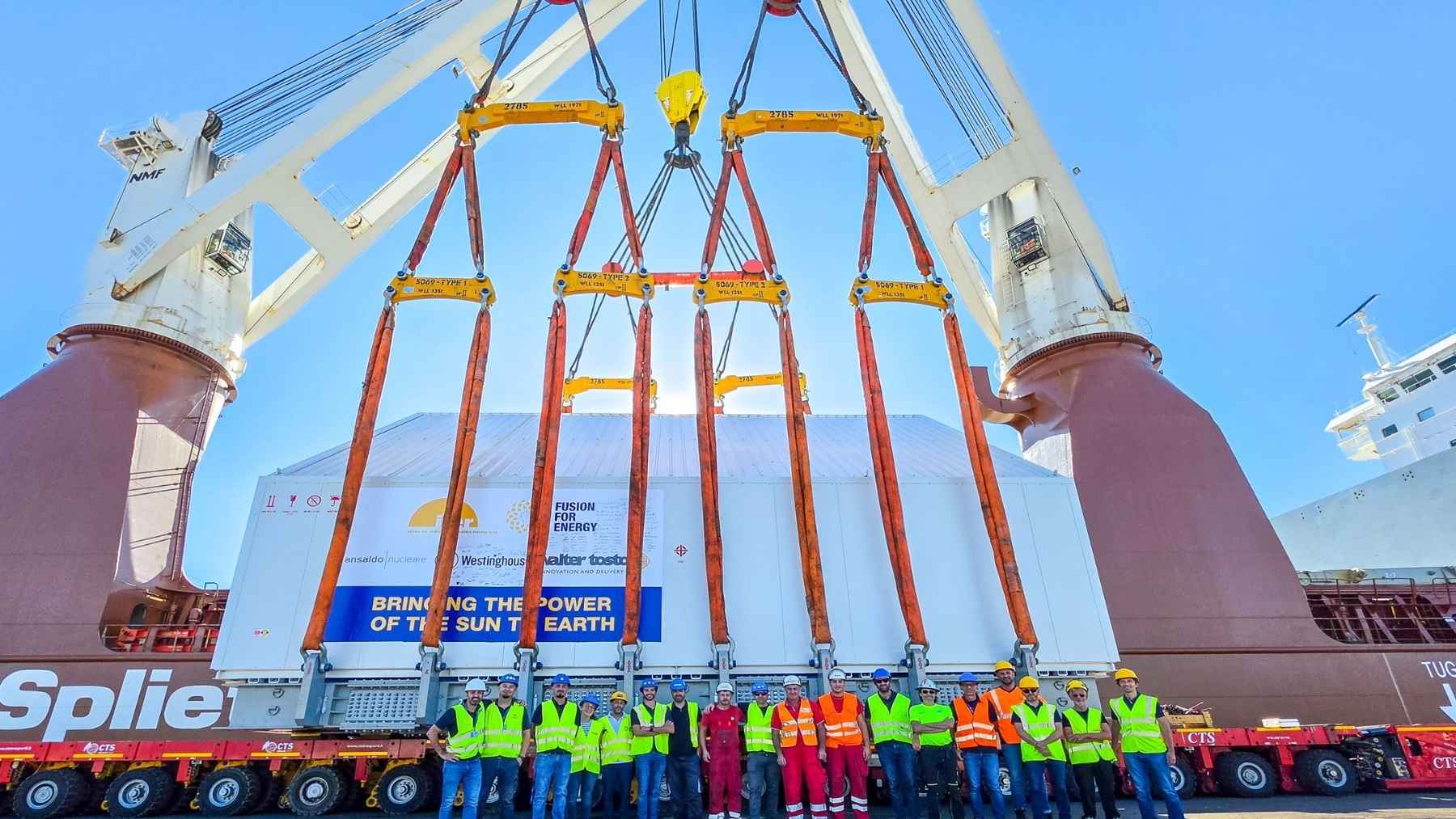
That part’s vacuum vessel sector #2, the ninth and final slice of the plasma chamber at the heart of ITER. We covered its send-off from the factory in Italy back in September, when the arrival was still a date on a calendar. Now it’s done traveling. According to the ITER Organization, the load that arrived measured nearly 48 feet long, 32 feet wide and 28 feet tall, and weighed 639 tons, protective packaging and steel frame included.
That last detail matters. The bare steel section weighs more than 440 tons on its own, and the rest of the load is the white crate and the cradle that kept it safe on the road. You don’t haul a precision-machined component across two countries without wrapping it up first.
So what exactly is a vacuum vessel?
It’s the chamber where the fusion reaction will actually happen. Picture a double-walled steel donut. Superheated plasma swirls around inside it while enormous magnets keep that plasma from ever touching the walls. You can see why: the plasma inside will run about 270 million degrees Fahrenheit, and the walls, thick as they are, are still metal. The vessel also doubles as the machine’s first containment barrier.
The finished ring will measure nearly 64 feet across, stand about 37 feet tall, and weigh 5,732 tons once all nine sections are welded together. Five of those sections were built in Europe by a consortium of Ansaldo Nucleare, Westinghouse and Walter Tosto, and sector #2 was finished at a workshop in Monfalcone, Italy. The other four came from Korea, and the first of them showed up six years ago.
One figure made me read it twice. Fusion for Energy, the EU agency handling Europe’s share of ITER, says each section carries roughly 93 miles of weld beads from fabrication alone. That’s a frankly absurd amount of welding to pack into one piece of steel, and it happens before anyone at the ITER site so much as picks up a torch.
The monster convoys are over
Getting this thing to the site was its own production. The section left Italy by ship in mid-September and, according to ITER Newsline, reached Marseille on September 21. The next morning it came out of the cargo hold at the Port of Marseille Fos as the sun was rising, and on September 23 a specialized barge carried it across an inland lagoon near the port. From there it rode the ITER Itinerary, a 64.6-mile route that was widened and reinforced years ago specifically so loads like this one could creep along it at night.
ITER files deliveries this size under a category it calls “Super Highly Exceptional Loads.” Every giant toroidal field coil came in under that label, along with the big ring-shaped poloidal field coils built away from the site and all nine vacuum vessel sections. Sector #2 closed the list out, and ITER says every load in the category’s now safely on site. A freight category retiring is a pretty strange thing to feel anything about. Still, after more than a decade of these night convoys, I kind of get it.
So is the chamber finished?
Not even close. Nine sections on site means the shopping’s done, and there’s still years of work left in the assembly. Each section first gets dressed for duty: crews wrap it in a polished thermal shield, the last of 27 panels ITER unpacked on September 30, and bolt on a pair of D-shaped toroidal field coils. The whole package becomes what ITER calls a sector module, weighing about 1,320 tons, and an overhead crane lowers it into the tokamak pit. We watched one of those modules go down into the pit earlier this year.
Six of the nine modules were already in the pit by early September. Sector #3 moved into the assembly tooling on September 18, the fastest transfer the project has ever pulled off, and its module’s due to go into the pit in early 2027 as the eighth of nine. ITER hasn’t said when sector #2 itself makes that trip, though it’s safe to assume the newest arrival goes last.
Then the welding starts. ITER calls joining the nine sections into a single leak-tight chamber one of the most demanding phases of the entire assembly, and it’s been running the three specialized welding machines for that job through their paces at a new trial facility since September. I wouldn’t bet on that phase being quick. Ninety-three miles of factory welds per section got the pieces this far, and the seams joining section to section are still ahead. They’ll be welded in place, by hand and by machine, inside the pit.
Sector #2 rolled through the ITER gates on October 2, 2026, six years after the first section arrived. ITER says sector #3’s completed module should head into the tokamak pit in early 2027, and after that, the welders take over.