- 5 MONTHS AGO · INDUSTRYSwitzerland just unveiled the first hydrogen train ever built for narrow-gauge track barely three feet wide, an 800-km-range machine that finally opens zero-emission rail to the skinny mountain and mining lines in some 40 countries still stuck on diesel
- 5 MONTHS AGO · INDUSTRYA German drone just flew 434 mph in level flight on nothing but batteries, faster than the Rolls-Royce plane that held the manned electric record, and it was never built to carry a camera, it was built to run down the kamikaze drones crossing into Ukraine every night
- 3 MONTHS AGO · INDUSTRYA 345-ton German excavator that shoves into an iron ore face with 347,000 pounds of force now drags a mile of high-voltage cable behind it instead of a V12, and it has stopped drinking a million liters of diesel a year in a corner of the Pilbara where the only power network is the one the mine built itself
- 1 WEEK AGO · INDUSTRYA coal-era shaft that old records put at up to 180 feet deep opened under a working tram line in August, leaving the rails hanging over a void, and a roughly $2 million investigation is under way with no date given to reopen the 11 stops that are still shut
- TODAY · THIS ARTICLEA 4.7-mile freight train of 696 empty ore cars ran 535 miles over two days with electric and diesel locomotives spread through it and synced by radio so they pulled and braked as one, and it topped a length record a 4.6-mile ore train had held for a quarter of a century
Depending on where you are in the world, a typical freight train stretches anywhere from half a mile to a mile and a half, according to the Associated Press. That’s already plenty of train to sit through at a crossing. South Africa’s state-run freight railroad apparently decided it wasn’t nearly enough.
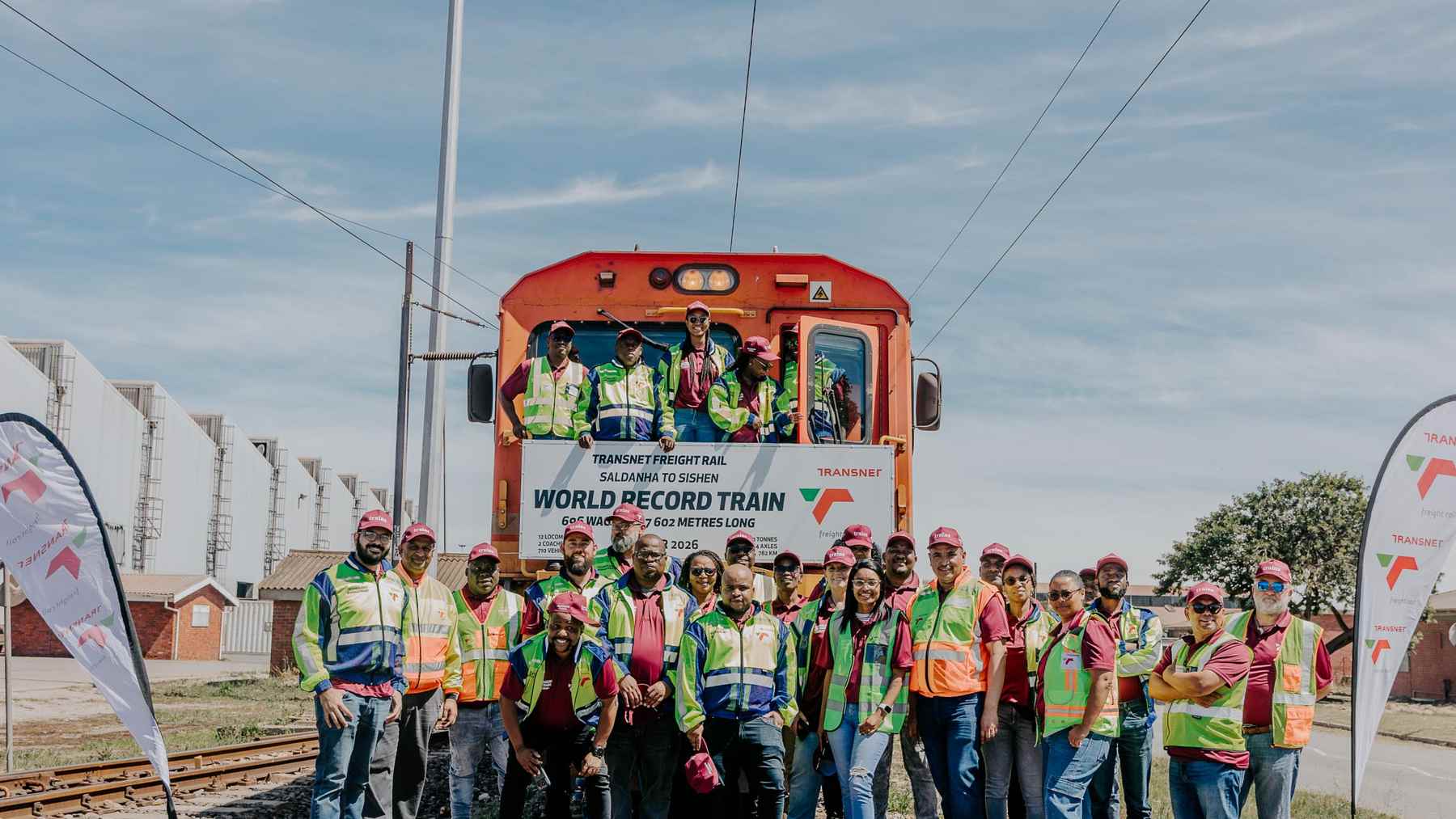
On Oct. 18, Transnet Freight Rail finished running a 4.7-mile train of 696 empty ore cars up the country’s iron ore export line, which links the Sishen mine in the Northern Cape with the port of Saldanha Bay on the west coast. The trip took two days and covered roughly 535 miles. Transnet says it’s a new world record for freight train length.
Guinness hasn’t signed off on it yet. A month later, its own page for the record still lists the old holder, and we’ll get to who that is.
You’ll see Transnet call them wagons, while most Americans would say ore cars or railcars. They’re the same thing with a different accent.
So how do you stop a train that’s 4.7 miles long?
You do it very carefully, it turns out, and mostly with radio.
On a conventional freight train, the locomotives sit up front and drag everything behind them. Which means the coupler right behind the last locomotive is pulling every car in the train, while the coupler on the last car is pulling just one. Braking has its own problem. Most freight cars use air brakes run by pressure in a pipe that goes the whole length of the train, and when the engineer drops that pressure, the change travels down the pipe like a wave. So the cars at the back start braking a beat after the cars at the front. Railroaders call the shoving and tugging that follows slack action, and it’s basically the train bumping into itself.
Now say you hung all 696 of those cars behind a block of locomotives at the head end. The first few couplers would be carrying the pull of a train more than four and a half miles long. And every time the engineer braked, miles of rolling steel at the back would keep shoving forward into cars that had already started to slow down.
That sounds like a pretty reliable way to break something expensive.
The locomotives take their orders by radio
The railroad’s fix is a setup it calls Radio Distributed Power. Instead of bunching every locomotive at the front, the railroad spread electric and diesel locomotives through the length of the train, and a radio link keeps them working as one synchronized unit. When the lead locomotive pulls or brakes, the ones down the train do the same thing at the same time. So the train gets several smaller pulls spread along its length instead of one huge one from the front, and the braking force gets shared out the same way.
According to Transnet’s release, that’s how it handles the longitudinal forces on a train this size, meaning the push and pull that runs from front to back. The railroad credits the system with steadier handling and less stress on the cars and the track.
The power came from Class 15E electric locomotives working alongside Class 43D diesel-electrics. That’s a bit of an odd couple if you’re used to American freight railroads, which run on diesel-electrics pretty much across the board. I couldn’t find a locomotive count anywhere in the release, though, and it doesn’t say how many of each class went where. Which is a slightly frustrating thing to leave out of an announcement that’s all about where you put your locomotives.
The cars were the railroad’s own CR13/14 ore wagons. All 696 of them ran empty, and I haven’t seen a published weight for the train.
Transnet ran the train on a computer first
Before anything moved, the railroad’s train design specialists modeled the train’s dynamics, where each locomotive should sit, whether the route was ready, how the train should be driven and how the radios would talk to each other. Some of those specialists then rode along to watch how the real thing handled. Transnet says it’ll compare the locomotive data from the run against the simulations to see whether its models held up. Transnet Engineering, the company’s rail infrastructure manager and the country’s Railway Safety Regulator were all in on it too. If you ask me, that comparison is arguably worth more to the railroad than the record itself.
So why run it empty?
The railroad hasn’t really explained that part. It calls the run a train evaluation program with two goals, chasing the record and learning more about train design, handling and performance. Transnet Freight Rail chief executive Russell Baatjies said “the real value lies in the technical knowledge” the exercise produced.
It’s probably safe to assume an empty train is the gentler way to learn how 4.7 miles of cars behave, since there’s far less weight shoving around inside it. Empty also matches the direction of travel. Saldanha Bay is the export port, so cars heading inland toward the mine would normally be running empty anyway.
The old record belongs to an Australian ore train
The train Transnet’s trying to knock off the top spot belongs to BHP. On June 21, 2001, the miner ran 682 loaded ore cars in Western Australia’s Pilbara region with eight diesel-electric locomotives, and Guinness World Records lists that train at 4.57 miles long. We covered that run, and the distributed power that made it possible, in our piece on Australia’s driverless ore trains.
Transnet’s train has 14 more cars than BHP’s, 696 against 682, and runs 4.7 miles against 4.57 miles. That puts it somewhere around 700 to 800 feet longer, depending on how you round.
BHP’s train still wins on weight by a mile. Loaded with ore, it came in at roughly 220 million pounds, or just under 110,000 short tons, which also makes it the heaviest freight train Guinness has on record. As far as I can tell, Transnet isn’t going after that one.
There’s a bit of history on the South African side, too. Transnet held the longest-train title on this same line before BHP took it, which is why South African outlets are framing this run as the railroad winning it back.
So the claim’s still waiting on paperwork. International Railway Journal noted that independent certification hasn’t been confirmed, and as of Nov. 21, Guinness’s longest-freight-train page still lists BHP’s 682-car train as the record holder.
 A 2,535-ton German boring machine 2,300 feet under the French Alps spent months inching through about 200 feet of coal seam, water and mud, then hit up to five concrete rings a day, roughly 33 feet of tunnel, before parking for scheduled maintenance until the new yearIndustry · 3 days ago
 A 400-ton generator at a South Dakota dam was taken apart for the first time in 70 years, its 275-ton rotor lifted out by two cranes working as one, and the first new turbine runner has now rolled into the powerhouse to take each unit up to 52 megawattsEnergy · 3 days ago
 A 13,500-ton American icebreaker that turned 50 in the Antarctic towed a 4,200-ton pier made of frozen seawater out of a McMurdo bay, cut a 7-mile channel through ice up to 8 feet thick, escorted a 600-foot tanker, freed a cruise ship in six hours and is already being readied to go backIndustry · 3 days ago