
Most of the effort that goes into making fusion on Earth comes down to one thing: babysitting a cloud of gas hotter than the Sun without letting it touch the walls. Tokamaks pen the plasma inside a cage of superconducting magnets. Laser machines hit a fuel pellet from every direction at once. Both are expensive, both are enormous, and both are very hard to turn into a power plant.
A Canadian company called General Fusion looked at that and went the other way. Instead of holding the plasma still, it hits it, slamming a wall of metal inward until the gas has nowhere to go and heats up from the squeeze alone.
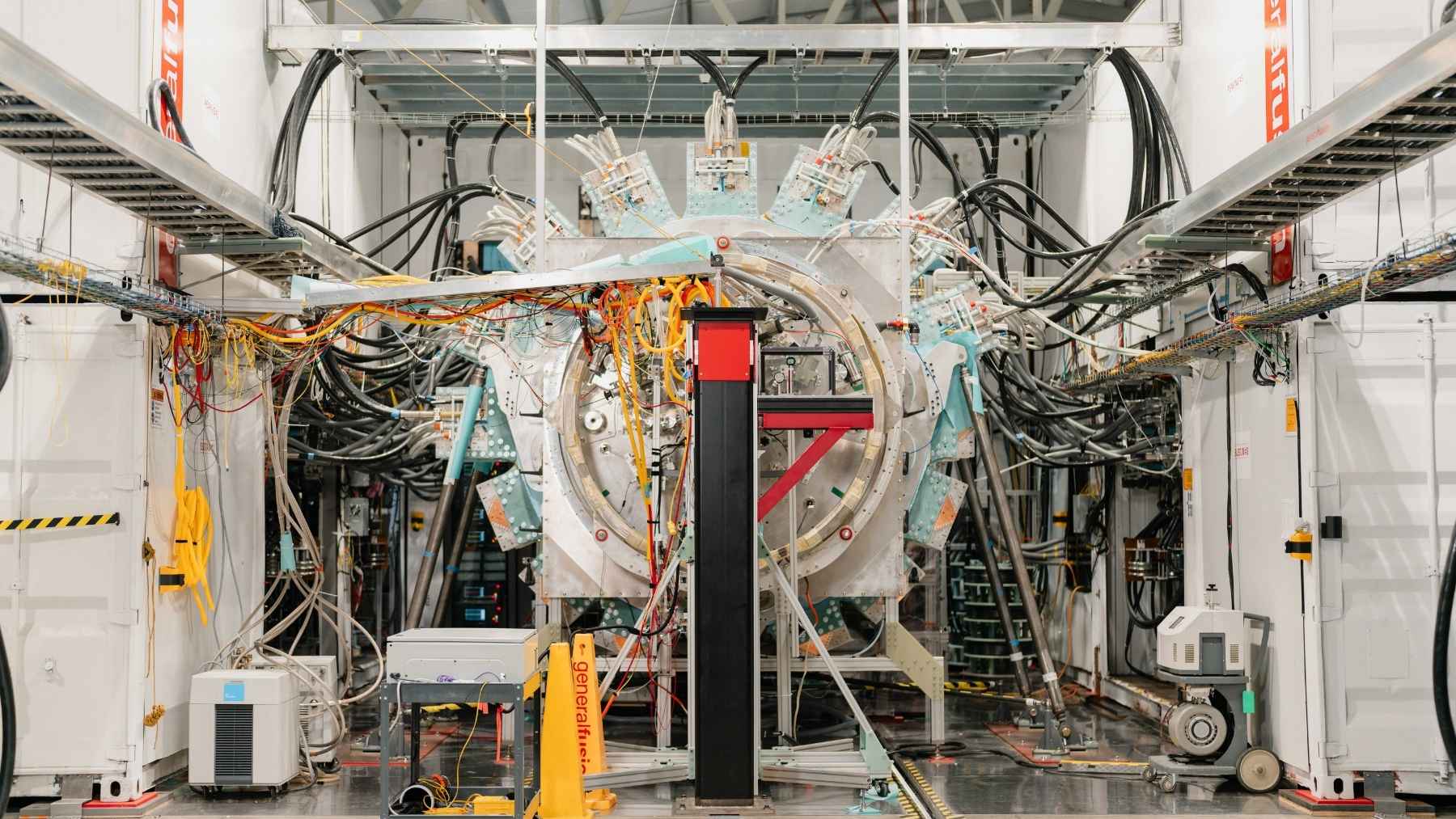
On June 22 the company said that approach just cleared a real bar. Its demonstration machine, Lawson Machine 26, more than tripled the temperature of its plasma during compression, reaching about 8.4 million degrees Celsius. No lasers. No superconducting magnets. Just a lithium liner getting crushed shut around the gas.
The squeeze is what heated it
The headline number is 8.4 million degrees Celsius, which fusion people write as 0.72 keV, give or take 0.08. On its own that sounds like a lot and also like nothing. The Sun’s core runs around 15 million, and a working fusion plant will eventually need to clear 100 million.
What makes it matter is the word “during.” General Fusion says the plasma’s electron temperature climbed more than threefold while the machine was physically compressing it, with the heat coming from the squeeze itself rather than any external source. That is the entire premise of the company’s approach getting a yes at large scale.
The temperature wasn’t the only thing that jumped. The plasma’s density and its poloidal magnetic field each climbed by roughly ten times during the compression. The machine stayed stable deep into the stroke, and the lithium liner didn’t significantly contaminate the plasma while it was being crushed. Junk getting into the gas from the liner has long been one of the obvious ways a design like this could fail, so a clean run matters more than it reads.
The diagnostics behind the number are Thomson scattering and an Absolute Extreme Ultraviolet system, and the team also saw neutron yield rise during compression, a sign that actual fusion reactions were happening in there.
One thing it is not: net energy. General Fusion didn’t produce more power than it put in, and the results are preliminary, posted for peer review rather than published. This is a checkpoint, not breakeven.
There are no lasers or giant magnets in here
So how do you crush a plasma? In LM26 the gas sits inside a solid lithium liner. Picture a metal can with the plasma held in the middle. A bank of magnets fires and drives that liner inward, collapsing it around the plasma in about five milliseconds. The plasma gets compressed to higher density and temperature, and the whole violent event is over faster than you can blink.
That is a very different machine from the ones most fusion headlines are about. As Interesting Engineering laid out, the approach skips both the magnetic confinement of a tokamak like ITER and the lasers used at the National Ignition Facility. The world’s largest fusion machine, Japan’s JT-60SA, is a building-sized donut that holds its plasma in place with magnets chilled colder than deep space. Commonwealth Fusion’s SPARC, the compact tokamak going together outside Boston, is betting on magnets strong enough to shrink the reactor around them. Both confine the plasma. General Fusion compresses it.
LM26 is also the first machine of its kind built at what the company calls a commercially relevant scale. Its diameter is about half that of a planned commercial plant, not a tabletop rig. And it came together fast: assembled in December 2024, first plasma in February 2025, first compression that April.
The pistons and the liquid metal come later
Here is where it is worth clearing up a thing that tends to get garbled. You will see General Fusion described as crushing its plasma with a piston of liquid metal. That is the commercial plant, not LM26.
In the power-plant design the company is working toward, an array of pistons slams a wall of liquid metal inward to do the compressing, and that liquid metal pulls triple duty. It shields the machine from the neutrons fusion throws off, it breeds the tritium fuel the plant needs to keep running, and it soaks up the heat, which gets pumped through a heat exchanger to make steam and spin an ordinary turbine. LM26, for now, swaps the pistons for magnets and the liquid wall for a solid lithium liner. It is proving the squeeze works before bolting on the rest.
None of this is a brand-new idea, either. Compressing magnetized plasma with a driver goes back to the U.S. Naval Research Laboratory in the 1970s. What killed it then was the lack of fine control over the compression, and General Fusion’s bet is that modern computers and real-time data can finally steer the slam precisely enough to be useful.
The reason to bother with any of it is cost. No superconducting magnets, no laser arrays, no exotic materials that need swapping out every time the neutrons chew them up. Just metal, pumps and steam. Whether that actually pencils out is the open question, but it is a genuinely different wager than everyone else’s.
The next number that matters is 1 keV
Reaching 8.4 million degrees gets the company to the doorstep of its first official milestone: 1 keV, or about 10 million degrees. After that the targets climb steeply, to 10 keV (100 million degrees), and then to the Lawson criterion, the combination of temperature, density and confinement that adds up to net energy. General Fusion wants to finish that program by mid-2028 and have a first-of-a-kind plant making power around 2035.
There is real money lining up behind the timeline. The company is going public through a merger with a blank-check firm, Spring Valley Acquisition Corp. III, with the combined business set to trade on Nasdaq under the ticker GFUZ. Greg Twinney, General Fusion’s chief executive, kept the framing plain, saying the company is “forging a new path in fusion with our uniquely practical MTF approach.” It is not the only unconventional swing out there, either; other outfits are pitching things like a containerized fusion reactor for cargo ships.
The honest caveats are the ones that haunt the whole field. The data is preliminary and hasn’t cleared peer review. A 50%-scale demonstration is not a power plant. And fusion has spent the better part of seventy years being a decade away.
What General Fusion has now is narrower than the dream and more useful than a slide. It built a large machine, crushed a plasma with it, watched the temperature more than triple from the squeeze, and didn’t wreck the run doing it. The principle it has been selling for two decades held up at scale.
The hard part is still ahead. The plasma has to get hotter, the compression has to get cleaner, and eventually a wall of liquid metal and a row of pistons have to do what magnets are doing in the demo. But there is a machine in Richmond, British Columbia actually doing the compressions, which is more than most of fusion’s promises ever come with.