- 3 MONTHS AGO · MILITARYA 6.5-pound drone thrown off a dock by hand sprints across the surface at 8 mph, stops, dives 197 feet straight down for a reading and pops back up, and the Navy spent two days in August watching pods of them hunt other underwater drones in a harbor
- 2 MONTHS AGO · MILITARYA 17-foot aluminum drone boat that weighs 1,450 pounds empty and 1,900 with everything aboard ran two straight weeks of a Navy electronic-warfare exercise in Michigan with its aerial drones sealed inside the hull, and one operator is trained to run it in three days
- 2 MONTHS AGO · MILITARYAn 18-foot Polish drone boat that weighs about 1,430 pounds, runs 24 hours on an outboard and tops out near 30 knots comes in two shapes, a tall one with radar and sonar on a mast and a low one cut down to stay out of sight for strike missions
- 1 MONTH AGO · MILITARYAn Australian ground drone built to haul a 20-foot shipping container clamped to its deck carries 22,000 pounds, nearly seven times the load of the biggest one Ukraine sends to the front, and can park beside a field hospital and keep it running off a 110-kilowatt-hour battery
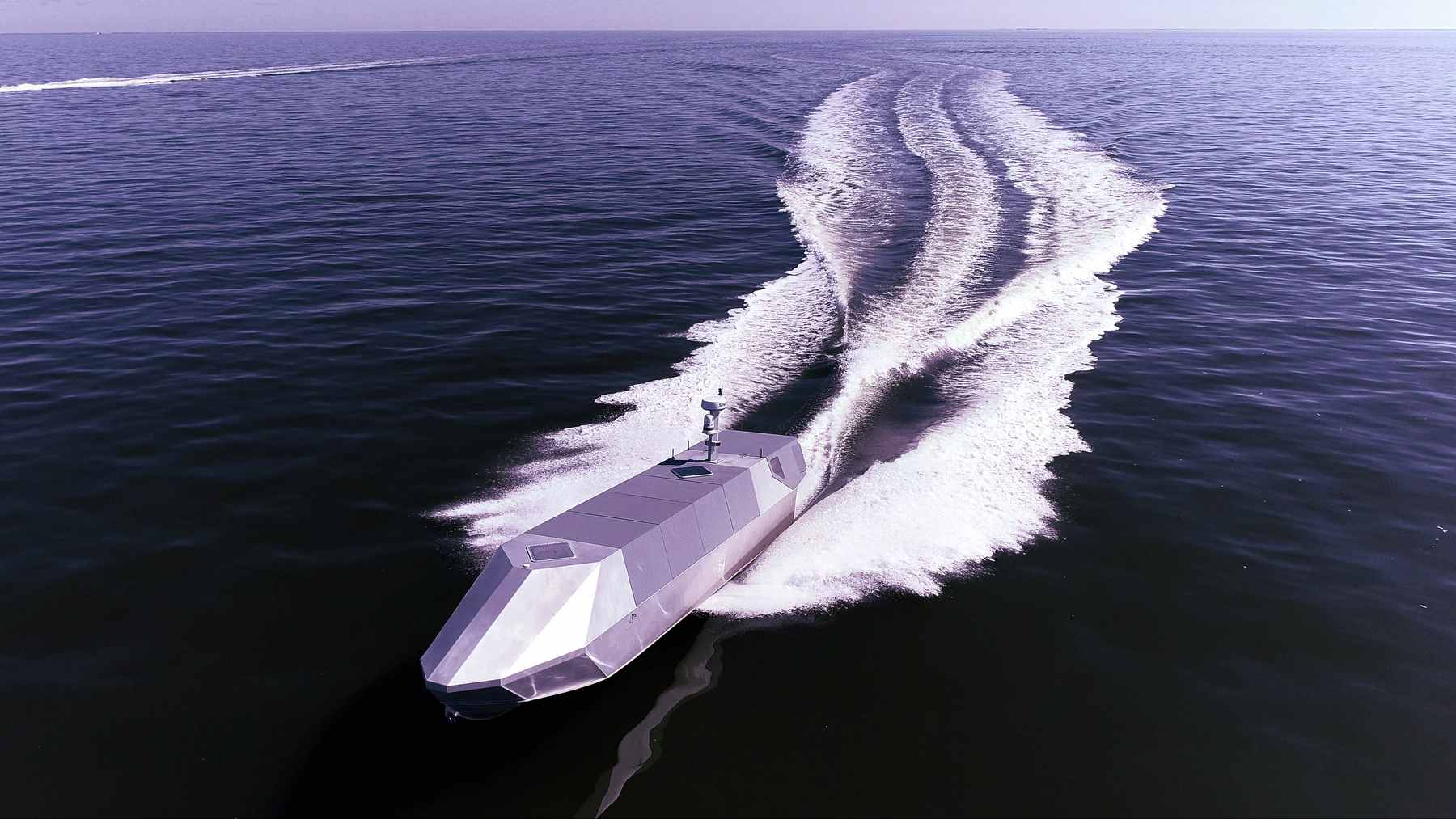
- TODAY · THIS ARTICLEA 37-foot drone boat that carries a third of its own weight in diesel can sit on station for up to 23 days on one 790-gallon tank, sprint at 40 knots and haul 2,000 pounds in an enclosed bay, and it’s meant to be built in under three months for about $1 million
Anyone who’s owned a boat knows the fuel dock is where the fun stops. A center console with a pair of big gas outboards can get through a tank a lot faster than you’d think if you keep the throttle down, and you can’t exactly pull onto the shoulder when the gauge hits empty.
So when Leidos says its Sea Archer drone boat can hang around one patch of ocean for up to 23 days on a single tank, it sounds a bit like a typo. It isn’t. And the way the company got there is pretty old-school.
Leidos Australia, the local arm of the Virginia-based defense contractor, has wrapped up harbor trials in Tasmania and open-ocean trials out of Darwin. Baird Maritime’s vessel review, published at the start of the month, has the most detailed spec sheet I’ve seen for it. We covered the trials themselves back in October, so this one’s about the hardware.
So how does a 37-foot boat stay out for three weeks?
Mostly by carrying a frankly ridiculous amount of fuel. Sea Archer’s aluminum hull is 36.7 feet long, and Leidos says about a third of the boat’s weight is diesel. EX2 puts it at roughly 19,800 pounds fully loaded.
The standard tank holds about 790 gallons. (Baird lists 660, which is the same tank measured in the bigger British gallon.) On that tank, Leidos says the boat cruises at 26 knots and has a range of 1,500 nautical miles, or about 1,700 miles. Do the math and you get about two and a half days of nonstop driving before the tank’s dry.
So where do the other 20-odd days go?
Loitering. In military-speak, loitering basically means hanging around one spot and watching. The boat isn’t trying to get anywhere. It just sits on a patch of water with its radar and cameras running, waiting for something to show up. Zoe Chadwick, who leads maritime engineering and technology work at Leidos Australia, told Baird the boat can sit out there for up to 23 days on the standard tank before it needs more fuel. What I couldn’t find is a breakdown of how it actually spends that time, whether it idles, drifts or creeps along at low speed, or how much fuel the electronics burn in a day.
Leidos also says you can trade some of the cargo for extra fuel and stretch the range by 20%. Baird doesn’t say whether that adds days on station too, but it’d be a bit odd if it didn’t.
Why diesel outboards?
Then you have the engines. Sea Archer runs on two Cox Marine 300 outboards, and each one’s a 4.4-liter twin-turbo V8 diesel rated at 300 horsepower at 4,000 rpm. Diesel outboards are pretty rare. If you walk around a marina in Florida, almost everything hanging off the transoms burns gasoline.
So why go diesel? According to Baird, Leidos picked it because diesel is what military supply lines already haul out to forward bases, so the boat can fill up from the same stock as the trucks and generators around it. Diesel engines also tend to get more distance out of a gallon than gas engines do, which helps with the whole 23-day thing. And diesel’s a lot harder to set on fire than gasoline. As far as I know, navies would rather not keep a tank of gas aboard if they can avoid it.
Leidos didn’t design its own outboards, either. Leidos Australia’s Kevin Quarderer told Baird the team went with commercial parts “so it can be built cheaply,” and said it makes repairs simpler too. I like that. If an outboard dies on a remote beach in the Northern Territory, you’d rather unbolt it and hang a new one than wait on a custom part.
The hull is basically a work boat
Gibbs & Cox, the naval architecture firm Leidos owns in the US, drew Sea Archer around a hull shape that’s been in use for 30 years. Oceans Rivers Lakes built the Australian hull in Toronto. That’s the Toronto north of Sydney, not the one in Canada. Leidos’ own announcement of the Australian build noted that a Sea Archer was already doing sea trials in the US at the time.
An old hull shape is arguably the smartest thing about this boat. Quarderer says 16 Australian boatbuilders have told Leidos they’re willing to build it, and an aluminum hull shape that’s been around for three decades is the kind of thing a regular boatyard can turn out without a naval shipyard holding its hand. Leidos is aiming for under three months and $1 million per boat. That’s a target. Nobody’s paid that price yet, since nobody’s bought one, but it’d be pretty cheap by military standards.
Sea Archer is also a lot bigger than most of the small drone boats we’ve written about. Seasats’ Quickfish is 17 feet long, less than half of Sea Archer’s 37 feet. Even so, it slides into a 40-foot high-cube shipping container, can be towed on a trailer to a civilian boat ramp and fits in a C-17 cargo plane.
What’s it carrying out there?
The enclosed bay holds about 2,000 pounds and takes swappable modules. Out of the box, Sea Archer does surveillance, electronic warfare and logistics. Electronic warfare basically means listening in on an enemy’s radio and radar signals and, when needed, jamming them. Chadwick says several of these boats can share that electronic picture across a network.
For sensors, there’s a Furuno radar, a Starlink satellite link and a mix of regular, infrared and pan-tilt-zoom cameras covering 360 degrees. AI software tracks people, buoys, other vessels and whales. That last one’s probably good news for the whales. For comparison, the Seasats drone boat that picked up a Chinese destroyer on radar from 10 miles out weighs 305 pounds, against roughly 19,800 for a fully loaded Sea Archer.
So who’s actually buying it?
Nobody, yet. Leidos has paid for the program itself and doesn’t have an Australian Defence Force contract. Quarderer also told Baird that Sea Archer doesn’t have a strike capability yet, and the weapons fits Leidos has pitched are still proposals.
Leidos says it’s talking to other navies in the Indo-Pacific and has pitched the boat for a planned Royal Australian Navy requirement for a large optionally crewed surface vessel. I’m not sure how a 37-foot boat slots into a program with “large” in its name, and Baird doesn’t spell it out. My guess is it’d sit at the small, cheap end of whatever the Navy ends up buying, but that’s a guess.
Leidos and Havoc plan to plug Havoc’s software, which gets several drones working as a team, into LAVA, the Leidos system that already drives Sea Archer, and they’ve got a joint test with uncrewed boats and aerial drones scheduled for the fourth quarter, so before the end of the year.
 A 41-foot drone boat ran the Strait of Hormuz with two Coast Guard cutters while an Iranian drone and a Revolutionary Guard attack boat watched it pass, and months later it went through again out in front of a destroyer carrying the region’s top American generalMilitary · 3 days ago
 A 43-foot-wide nuclear attack submarine, about 9 feet fatter than the boats it is meant to replace, is being drawn as a mothership that launches, catches and recharges its own underwater drones without tying up its torpedo tubes, and each one could cost about $9 billionMilitary · 21 hours ago
 An 8.8-ton drone submarine that fits inside a shipping container runs on hydrogen fuel cells adapted from space launches, can cover 3,100 miles or stay out 45 days, and five NATO allies have bought it while the navy back home has about 20 drones for 151,000 miles of coastMilitary · 1 day ago