
Every pump you’ve ever used, from a shop vac to a bike pump to the Dyson in the closet, does the same basic thing. It grabs air and shoves it somewhere else. So when I read that the pumps built to empty the world’s biggest fusion reactor don’t push anything anywhere, I had to go find out what they do instead.
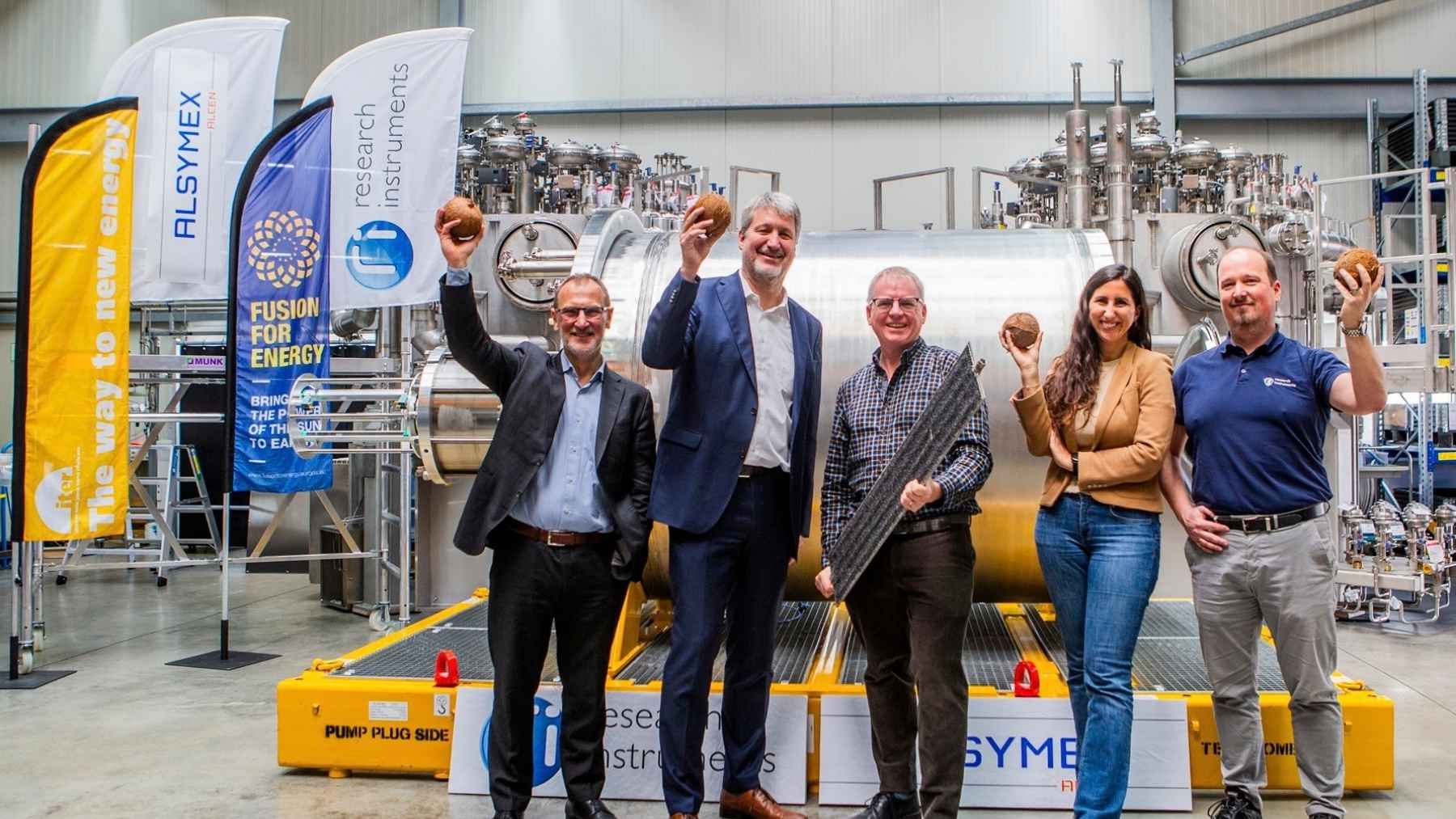
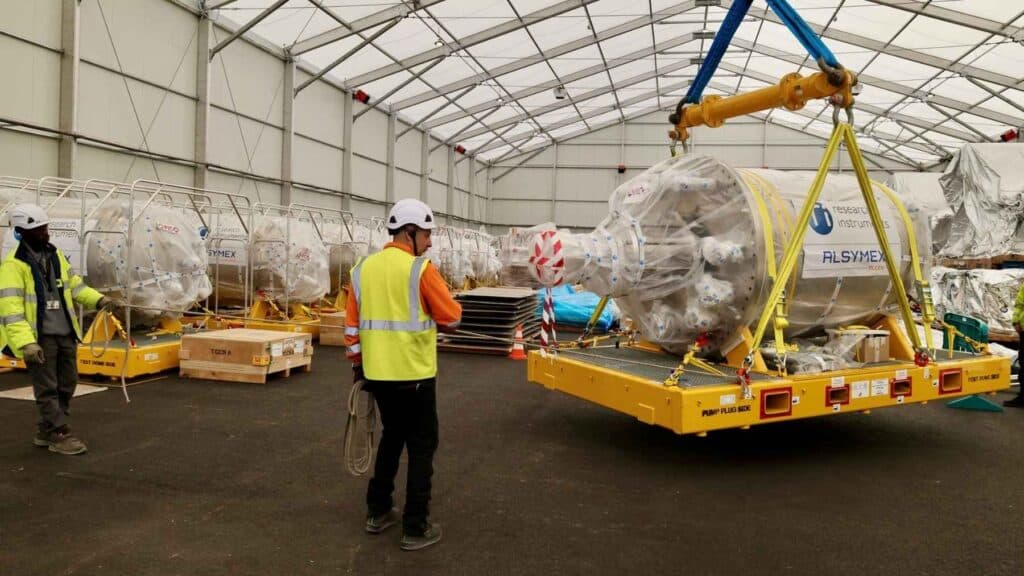
Turns out they freeze the gas in place. Each pump’s a steel can about 11.5 feet long, a little over 5 feet across and roughly 17,600 pounds, and inside it are 28 panels coated in charcoal ground from coconut shells. Chill those panels to within a few degrees of absolute zero and gas molecules that touch them basically stop moving and stay put. Warm them back up and the gas lets go. That’s the whole trick, and it’s frankly a strange thing to find at the heart of a machine this expensive.
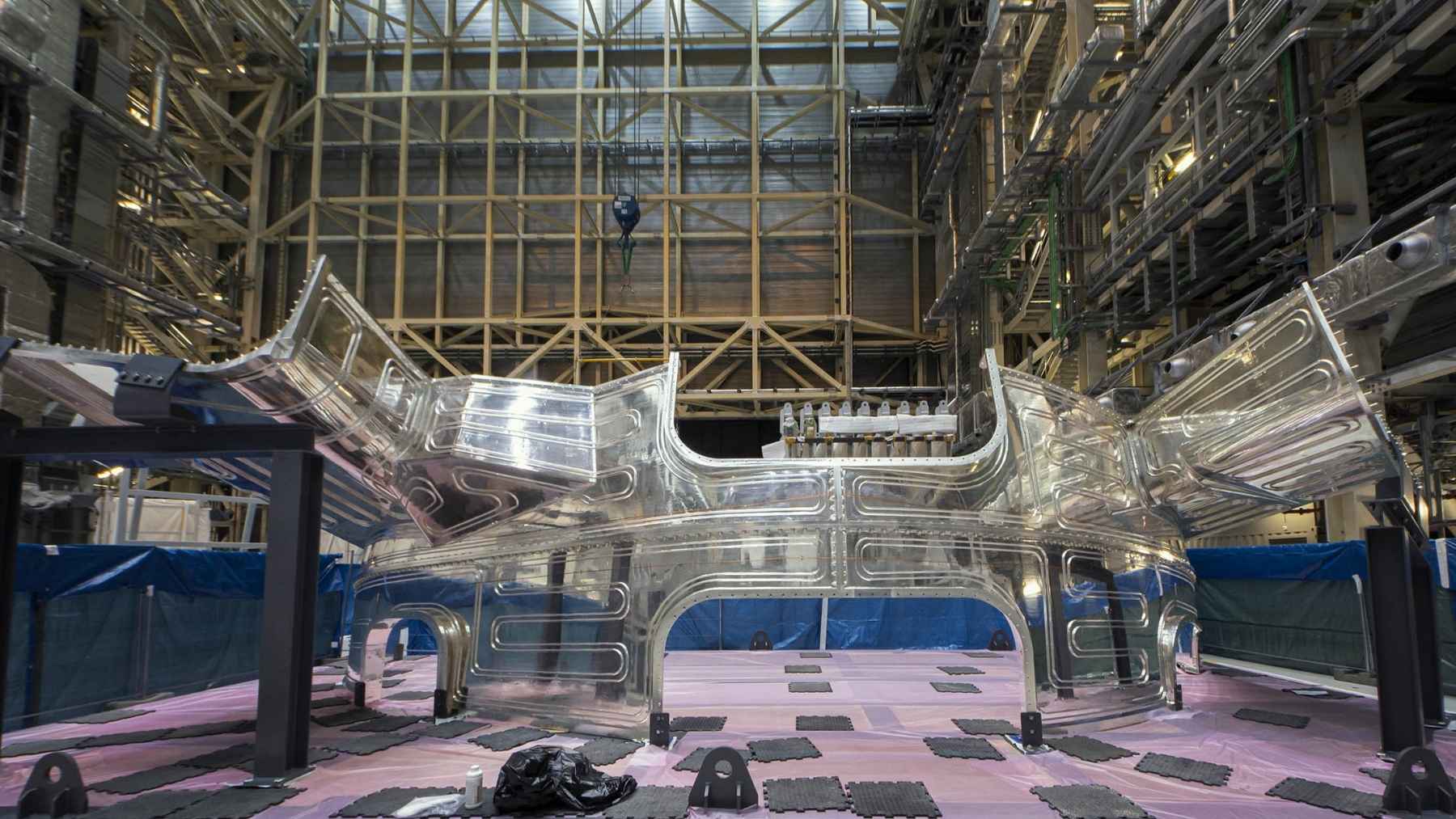
The reactor is ITER, the international fusion experiment in southern France that we covered a few days ago when the ninth and last slice of its plasma chamber rolled through the gate. The chamber is what everyone photographs. The pumps that have to empty it have been sitting in storage on the same site for about a year and a half, and the last of the plumbing that will feed them cold helium arrived this summer.
So how do you pump with cold?
A fusion plasma can’t tolerate stray air. ITER’s chamber holds about 49,000 cubic feet, and before anything gets heated the pressure inside has to come down to around a millionth of what you’re breathing right now. Ordinary mechanical pumps handle the early stage. They can’t finish it, because at those pressures there’s so little gas left that a blade or a piston barely has anything to grab.
This is where cold comes in. If you’ve ever opened a chest freezer that hasn’t been defrosted in a while, you’ve seen the principle: moisture in the air hits a cold surface and stays there as frost. A cryopump does the same thing with the gases in the chamber, on panels run at 4 to 4.5 kelvin. That’s around minus 452 degrees Fahrenheit. (Kelvin’s just the temperature scale that starts at absolute zero, so 4.5 kelvin means 4.5 degrees above the coldest anything can get.)
So why the coconut?
Helium, mostly. A fusion reaction burning deuterium and tritium leaves helium behind as its exhaust, and helium is apparently the one gas that flat-out refuses to freeze onto a cold plate at those temperatures. It just bounces off. What it’ll do is wander into a pore and get stuck, so you give it a sponge, and the best sponge anyone’s found is activated charcoal made from coconut shells. It’s the same family of material you’ll find in a lot of water filters. ITER says the internal surface runs to at least 1,200 square meters per gram, which comes to about 12,900 square feet, a decent suburban lot, folded up inside something that weighs as much as a paper clip.
Each of the six pumps that ring the chamber carries 28 of those panels, about 3 feet long and 8 inches wide, and ITER says that works out to about 15 pounds of ground charcoal in each pump. Decades of research into fancier synthetic sorbents, and the winner is still, more or less, a product you can buy by the bag.
The pump is mostly a very large valve
The charcoal’s the clever idea here, but the engineering’s in the steel around it. The whole thing has to hold a vacuum at both ends of an enormous temperature range, and it has to seal itself off from the chamber whenever it’s time to warm up. So each pump carries what ITER describes as the biggest all-metal high-vacuum valve ever built: a head about 31 inches across that weighs about 176 pounds, rides a 16-inch stroke, and has to land within 0.1 millimeter, about four thousandths of an inch, to make its metal-on-metal seal.
Fusion for Energy, the EU agency that handles Europe’s share of ITER, paid for the pumps. A German firm, Research Instruments, and a French one, Alsymex, built them as a consortium, with ITER counting more than 20 European companies in the supply chain, and all eight are already on site. Two of the eight are a slightly different animal. They don’t pump the plasma chamber at all but the cryostat, the giant thermos around the whole reactor that keeps the superconducting magnets insulated from the outside world.
Has anyone actually run one cold?
Yes, once, and it went well. ITER built a test rig inside its cryoplant, basically a big cylindrical vacuum chamber a pump can be slid into and hooked up to the plant’s cold helium. On August 1, 2025, the team cooled the pre-production unit, a prototype ITER says could also go into the reactor itself, down to about 5 kelvin and started pumping. They fed it helium, the real exhaust gas, and neon, which behaves enough like deuterium and tritium to stand in for them. That’s convenient, since tritium is radioactive and no one hands it out for practice runs.
“Performance was even better than we expected,” said Alessandra Iannetti, who runs the facility, in ITER’s own account. The same write-up singles out Robert Pearce, who’s spent more than three decades on cryopump design, and I’d imagine that was a good day for him.
The catch is that the prototype is one pump, and the eight production units still have to prove they behave the same way. ITER said the rig could handle about two of them a year starting this past February, because the same cryoplant also has to feed the facility built to cold-test the reactor’s giant magnets, and the plan is to put at least half of them through before installation. I can’t find a published result from any production-pump test yet, so take two a year as the plan rather than the track record.
Then you have to let the gas back out
A cryopump fills up. Everything it’s caught is still sitting on the panels, so the six torus pumps are designed to work in rotation, some pumping while others regenerate. Regenerating means shutting the big valve, warming the panels to around 100 kelvin (roughly minus 280 degrees Fahrenheit) so the hydrogen fuel lets go, and hauling that gas off with a conventional pump to a plant that cleans the unburned deuterium and tritium for reuse. For a full clean-out the design goes all the way up to 470 kelvin, about 386 degrees Fahrenheit. That range is arguably what makes these things so difficult to build, and it’s why ITER calls them some of the most complex components on the site.
Feeding helium at exactly the right temperature to eight pumps that are each at a different point in that cycle is a plumbing problem, and that plumbing is what finished arriving this summer. Fusion for Energy announced on August 11 that the last of what it calls the Front-End Cryopump Distribution System was on site: eight cold valve boxes for the torus and cryostat pumps, three more for the neutral beam injectors (the particle guns that heat the plasma, and they need their own cryopumps), a single warm regeneration box, the cryolines that tie it all together, and the controls to run it. Some of the lines are flexible jumpers with detachable connections so a robot can swap them, since people won’t be going in there once the machine is running.
That took nine years of work and nine separate contracts with industry, for what’s essentially pipe. I get it, though. A pipe that has to carry fluid colder than minus 450 degrees one day and feed equipment baking at nearly 400 the next, without leaking or tearing itself apart, isn’t really a pipe in the hardware-store sense.
What you shouldn’t take from any of this is that the pumps are doing their job on a fusion reaction today. They aren’t. The chamber they’ll bolt onto only got its ninth and last sector delivered on October 2, and the one pump that’s run cold did it on a test bench with bottled gas. From the looks of things, that’s still years away.
Fusion for Energy says the final truckload, the cryolines feeding the neutral beam pumps, rolled in during August 2026 from Criotec, a small Italian cryogenics shop, and ITER’s own schedule has at least four of those eight pumps going through the cold test rig at about two a year before any of them is bolted onto the machine.