
- 2 MONTHS AGO · ENERGYA 30-gallon drum too radioactive to handle by hand rode from South Carolina to a salt bed 2,150 feet under New Mexico, the first of its kind out of the plant in over a decade, sealed in an inch of lead with 19 more loaded and 150 being packed behind it
- 1 MONTH AGO · ENERGYA 390-megawatt nuclear plant would burn natural gas before its reactors ever split an atom, with the turbines built and selling power while two molten salt cores still wait on a license, and each of them gets pulled out and replaced every seven years
- 3 WEEKS AGO · ENERGYSix pump-turbines with rotors weighing up to 507 tons can put 1,320 megawatts on the grid in 12 seconds from inside a Welsh mountain, and the first two are coming out after four decades while the other four keep spinning in the same 590-foot cavern
- 2 WEEKS AGO · ENERGYA 308-foot dam in Arizona just let out about 60,000 cubic feet of water a second, the most its operator believes it has sent downstream in 33 years, and the Salt River through Phoenix, a dry bed most of the year, is expected to keep running for days if not weeks
- TODAY · THIS ARTICLEA salt cavern 1,500 feet under Alabama was built to hold 19.8 million cubic feet of compressed air, pumped in over about 40 hours and let out through a 110-megawatt turbine for up to 26 hours, and the plant on top has been the only one of its kind in the country for 35 years
Ask most people what grid storage looks like and you’ll probably get a description of a gravel lot full of white shipping containers, each one stuffed with lithium-ion cells. That’s a pretty fair answer these days. I mean, it’s better than whatever I could come up with.
But one of the country’s oldest storage plants doesn’t have a single cell in it. You can’t really see the storage part either, because it’s a hole in a salt dome under McIntosh, a small town in southwest Alabama. And it’s full of air.
PowerSouth Energy Cooperative, which sells wholesale power to member co-ops in Alabama and northwest Florida, started pumping compressed air in and out of that hole in 1991. No one in the US has built another utility-scale one since. It’s also a stranger machine than you’d probably expect, and it hasn’t had the easiest few years.
So how do you store electricity in a hole?
You don’t… Not exactly. You store air.
When demand is low and power is cheap, the McIntosh plant uses grid electricity to run compressors that shove air down into a cavern 1,500 feet underground with room for 19.8 million cubic feet of it, according to Baldwin EMC, one of PowerSouth’s member cooperatives. When demand peaks, the air returns, is heated by burning natural gas, and spins a 110-megawatt turbine.
The cavern is what’s called “solution-mined.” Basically, someone drilled a well into the salt, pumped water down to dissolve it, pulled the brine back out, and kept going until a huge cavity was left behind in solid salt.
Why salt? It doesn’t let air seep through the way many porous rocks do, and it’s strong. “Salt is a beautiful storage mechanism,” Lee Davis, who was managing the plant when Smithsonian magazine profiled it, told the magazine.
Baldwin EMC says the cavern is 50 times stronger than the highest air pressure the plant’s compressors can produce. A peer-reviewed survey of compressed-air plants puts McIntosh’s working range at 46 to 75 bar, or roughly 670 to 1,090 psi. That sounds like a pretty generous safety margin, though the co-op doesn’t explain how it arrived at the 50 figure.
Then there’s the timing. Refilling the cavern takes about 40 hours, according to an industry analysis in Renewable Energy World. Once it’s full, the turbine is built to run at its full 110 megawatts for 26 hours, which Baldwin EMC says covers the demand of 11,000 homes for that stretch. The Department of Energy’s National Energy Technology Laboratory gives the same 26 hours at full power.
So why does it take longer to fill than to empty?
Mostly because the compressors are smaller than the turbine. A Siemens Energy presentation at a Department of Energy workshop listed the McIntosh compressor at 49 megawatts and the expander, which is the turbine side of the machine, at 110. So the plant draws power slowly for a long time and releases it all at once.
Yes, it burns natural gas
Here’s where it gets a little less tidy. When you squeeze air, it heats up. You’ve felt that if you’ve ever pumped up a bike tire and grabbed the pump afterward. When compressed air expands again, it does the opposite and gets very cold, which isn’t great news for a turbine.
McIntosh is an older “diabatic” design, which means it doesn’t save the heat it makes during compression. Instead, it reheats the air with natural gas on the way out. That’s also why the plant can produce more electricity than its compressors consume. The gas is doing some of the work.
Baldwin EMC says the unit uses roughly a third as much gas per kilowatt-hour as a conventional combustion turbine and emits about a third as much pollution. The co-op credits a recuperator, which recycles exhaust heat to warm the incoming air, with cutting fuel use by 25 percent. So this isn’t a clean battery. It’s frankly more honest to call it a gas turbine with a very large air tank underneath.
That gas burner is exactly what a Canadian company called Hydrostor says it’s designed out of its Willow Rock project in Kern County, California, which keeps the heat from compression and uses water pressure to hold the air in place.
In its latest updates, Hydrostor had a roughly $31 million early site-work contract with Granite and said it would break ground later this year.
Is it actually running right now?
Honestly, it’s hard to tell from the outside. If you’ve seen McIntosh described as running nonstop since 1991, that’s not quite right.
Siemens Energy now owns Dresser-Rand, the company that built the plant’s machinery. In a reference sheet on the job, Siemens says PowerSouth ran the compressed-air unit until 2022, when a low-pressure expander failed. It says the unit needs repairs and an upgrade to return to its full 110 megawatts, and the work includes repairing the rotor and supplying an additional new one.
Federal plant data, as listed by GridInfo, still shows the compressed-air generator as operating, with a 110-megawatt nameplate but summer and winter ratings of 25 megawatts. I couldn’t find a public date for when it’ll be back at full power, and PowerSouth hasn’t posted one that I can see.
So why is there only one?
Utility Dive noted in 2020 that McIntosh was the first plant of its kind in the US, that no other utility-scale plant like it was operating here, and that Baldwin EMC still calls it the nation’s only compressed-air energy storage unit. The only older one is in Huntorf, Germany, which dates to 1978. China has since built much bigger ones in salt caverns, including a 300-megawatt plant in Hubei Province.
Utility Dive pointed to two reasons we haven’t seen more here: suitable salt caverns are only found in certain places, and the plants are expensive. I’d argue the geology is the bigger problem of the two. You can order more lithium cells from pretty much anywhere, but you can’t order a salt dome, which makes “only one in the country for 35 years” a strange record to hold.
Siemens Energy’s 2025 reference sheet says the goal of the rebuild is to restart the McIntosh unit and keep it operating for another 30 years.
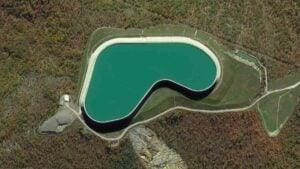 A 100-foot wall around a lake on top of a Missouri mountain was overfilled by its own pumps before dawn, split open along 720 feet and let go of a billion gallons in 12 minutes, and the power plant under it now runs on a rebuilt bowl of 3 million cubic yards of concreteEnergy · 1 hour ago
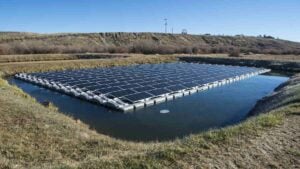 208 solar panels have floated since their first winter on a pond 8,100 feet up in the Colorado Rockies, in a town that has seen 47 below zero and two feet of snow in a day, and the first freeze locked their mooring lines into the ice without puncturing a single floatEnergy · 3 hours ago
 A 12-foot British drone submarine was put in the water from a quay in Shetland, swam 81 miles out to a dead North Sea oil field by itself, photographed the seabed from 16 feet up while sniffing for leaking oil, and came back to the same harbor to recharge for the next fieldEnergy · 4 hours ago