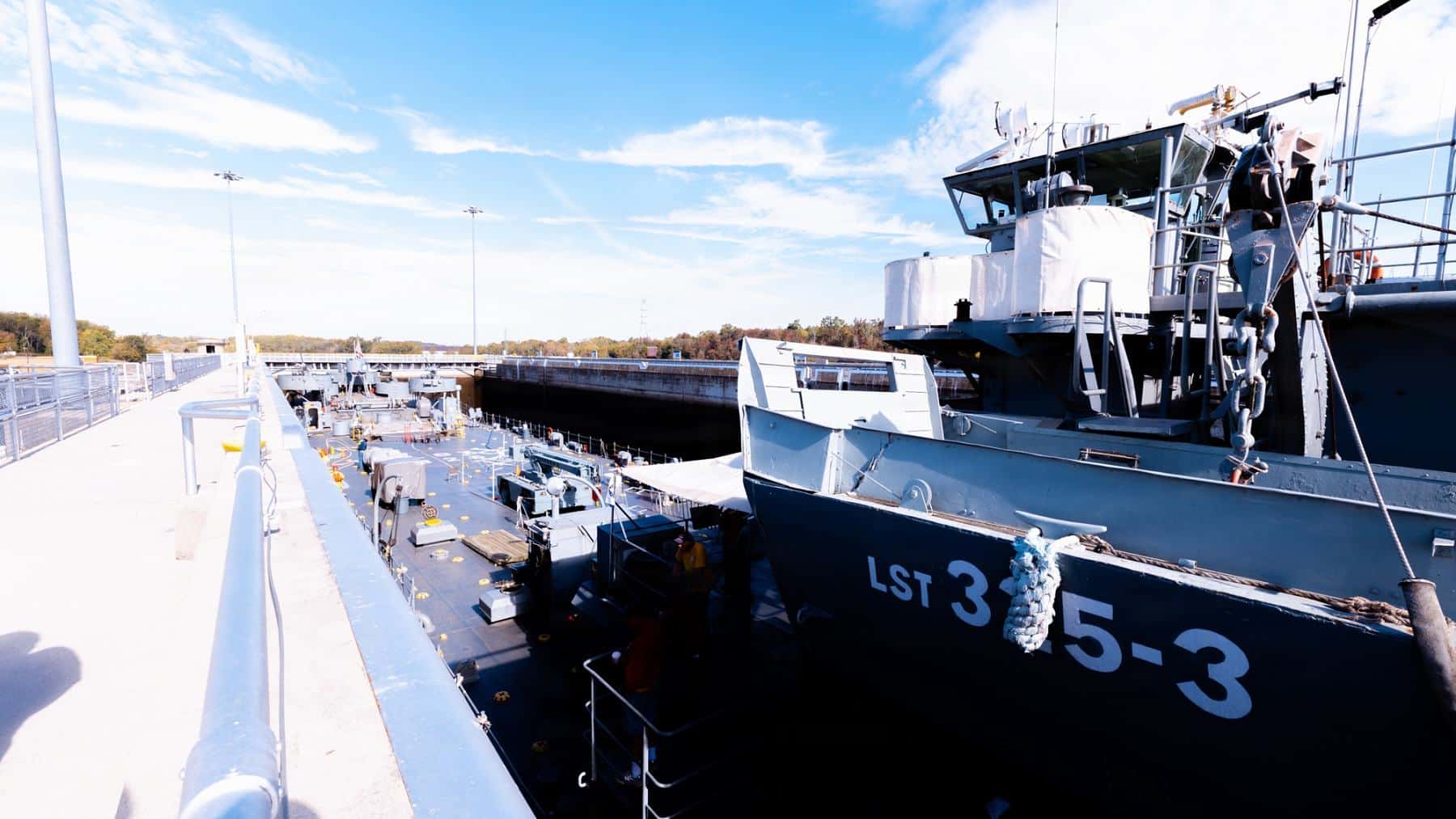

A decent car’ll go a couple hundred thousand miles if you look after it. A phone gets maybe four years before the battery gives up. In 1942 the Navy designed a 328-foot landing ship to roughly the lifespan of your phone, built 1,051 of them, and fully expected to scrap the lot once the war was won. One of them spent the last month running up and down the Cumberland River in Tennessee on the same two diesels it was launched with, and it came home to Indiana with an attendance record.
The ship is USS LST-325, and she’s the odd one out among the old warships we’ve covered lately. The battleship Wisconsin needed tugboats and a year of planning to move four feet in Norfolk. Britain’s only ice patrol ship came home at the end of a tow line. LST-325 drives herself.
She left her dock in Evansville at 9 a.m. on September 19, according to the museum’s own cruise page, and spent three and a half weeks working her way around three Tennessee river towns: Hendersonville, on Old Hickory Lake, from September 23 to 29, then Ashland City from October 1 to 6, then Clarksville from October 8 to 12. The Hendersonville stop was a first. Don Miller, president of the USS LST Ship Memorial, told WSMV the ship had been to Nashville years ago but never to the lake, and that the lake’s social media lit up pretty much the minute she cleared the lock.
So how’d it go?
By the museum’s count, better than any cruise before it. LST leaders told WFIE that more than 44,000 people came aboard over the trip, which the museum called record-breaking, and ship director Mike Donahue said people were “waiting in line for hours” once word got around. Two years ago the same cruise drew 35,000, and the museum told the same station back then that a full year of tours at home in Evansville brings in about 12,000. So one month on the road is worth roughly three and a half years of staying put, which is why they bother. Ken Rupp, the ship’s cruise director, put it more bluntly in a write-up by the Army Corps of Engineers: “Evansville isn’t a big enough draw to support this.”
So what is an LST, exactly?
LST stands for Landing Ship, Tank, and the whole idea’s in the name. It’s a ship with a flat bottom that runs straight up onto a beach, swings open two big doors in the bow, drops a ramp, and lets tanks and trucks drive out onto the sand. Which meant the Army could land its armor on any beach with the right slope instead of fighting its way into a harbor first.
The design came out of Dunkirk. The British Army left its tanks on the beach there in 1940, Churchill took the problem to Roosevelt, and American designers came back with a hull whose bottom rises one foot for every 50 feet of length, about the slope of an average beach. On a landing run she draws about three and a half feet of water at the bow. There’s also a 3,000-pound anchor that goes over the stern on the way in, with 900 feet of cable behind it, and that’s what winches her back off the sand once she’s empty. It’s a pretty elegant piece of design for something that was meant to be junk by 1947.
LST-325 is 328 feet long and 50 feet wide, and she displaces about 1,650 tons empty and 4,080 tons fully loaded, per her National Register of Historic Places nomination. Two General Motors 12-567 diesels of 900 horsepower each turn two propellers, and flat out she does 12 knots, which is about 14 mph. If that engine designation rings a bell, it should. The 567 is the same family of two-stroke diesel that GM’s Electro-Motive division put in the locomotives that hauled American freight for decades after the war, and the ship still runs on the pair she was built with, according to that same nomination. Her keel went down at the Philadelphia Navy Yard on August 10, 1942, she hit the water 48 days later, and she was commissioned on February 1, 1943. At Normandy she unloaded 59 vehicles and more than 400 men at Omaha Beach on June 7, the day after D-Day, and went on to make 43 trips across the English Channel through April 1945, according to Clarksville Online’s history of the ship.
How do you get a 328-foot warship up a river?
Through the locks, one at a time, and the Army Corps of Engineers’ Nashville District was pleased enough with the show that it wrote the trip up itself. The Cumberland’s only navigable for a ship this size because of the dams and locks the Corps runs on it, and getting from the Ohio River up to Hendersonville means stepping through Barkley, Cheatham and Old Hickory in turn.
If you’ve never watched a lock work, it’s basically a bathtub with a door at each end. The ship pulls in, the gate closes behind her, and the chamber fills or drains until the water inside matches the level on the far side, then the far gate opens and she drives out. At Cheatham, according to Tadd Potter, who manages the lake’s recreation areas for the Corps, the parking lots next to the lock filled up and people parked along the road to watch a flat-bottomed warship ease into the chamber. That’s a fairly good day for a lock.
The Corps’ write-up also has the two numbers I’d have asked about. She burns roughly 7 gallons of fuel per mile, and the crew doesn’t run her the way they’d run her at sea. Out on the ocean she rides heavy, with her ballast tanks full, so she can punch through waves. On the shallow rivers they pump the tanks dry and let her ride as high as she’ll float. I couldn’t find a published figure for how much water she draws with the tanks pumped out, and the Corps doesn’t give one, so I’ll leave that to the crew. For comparison, the destroyer Kidd in Baton Rouge has been stuck at a shipyard for a year because the Mississippi hasn’t risen high enough to float her back into her cradle, and she only needs to move once.
The trip home from Greece was the sketchy part
So how does a D-Day ship wind up giving tours in Tennessee? Via Crete, and it came pretty close to not happening. After the war she was mothballed in Florida, brought back in the 1950s with a reinforced bow to haul supplies for the Arctic radar stations of the Distant Early Warning Line, and in 1964 handed to Greece, which renamed her Syros and kept her working until 1999. She served the Greeks longer than she’d served the US Navy, which I find a little funny given who built her.
By the 1990s there wasn’t a single World War II LST left in the United States for veterans to visit, so a group of them went and got one. The Greek government agreed to hand Syros over, and in 2000 a crew of World War II and Korean War veterans spent about three and a half months in the Cretan heat making her seaworthy, Clarksville Online reports. The Coast Guard formally recommended against the crossing. They went anyway, on November 14, 2000. Miller told WSMV the storms had her leaning 27 degrees at points. Clarksville Online adds that an injector failed about 1,000 miles into the Atlantic and burned out a cylinder, so the crew shut it down and ran that engine on the remaining 11 for the next 3,000 miles, into headwinds the whole way. They reached Mobile, Alabama, on January 10, 2001, on a trip the museum puts at 6,500 miles, and it took an act of Congress to let a former Navy ship come home as private property. Evansville’s been her home port since October 2005.
Miller’s line on all this, to WSMV: the ship was built for a three- or four-year life. “It was disposable.” And here they are 80-odd years on, still keeping it together.
Who’s driving?
Since January, a towboat captain, which is frankly the right résumé for the job. John Vaughn of Galena, Illinois, took command on January 10, 25 years to the day after the veterans brought her into Mobile, and he still captains a Marquette Transportation towboat on the Mississippi full-time, according to Clarksville Online. He’s the third captain since she came home from Greece. The crew under him is around 50 volunteers, about half of them veterans, each of whom has to log 80 hours a year to keep sailing with her, and that’s against the 110 or so sailors she carried in the war. Vaughn doesn’t think the people who built her ever imagined she “would still be running 84 years later.”
She’s the only LST still afloat in her wartime configuration and able to sail under her own power in US waters, by the museum’s description, and the Corps calls her the last fully operational one, period. The others that survive are static displays. I’d say that makes the annual cruise arguably the best deal in the museum-ship business: the exhibit comes to you, and the ticket’s $20.
LST leaders told WFIE on October 13 that more than 44,000 people had come up her ramp in three and a half weeks, and the museum’s own calendar had her tied up back at her dock on NW Riverside Drive in Evansville the next afternoon, October 14, where it lists tours Tuesday through Sunday, 10 a.m. to 4 p.m.