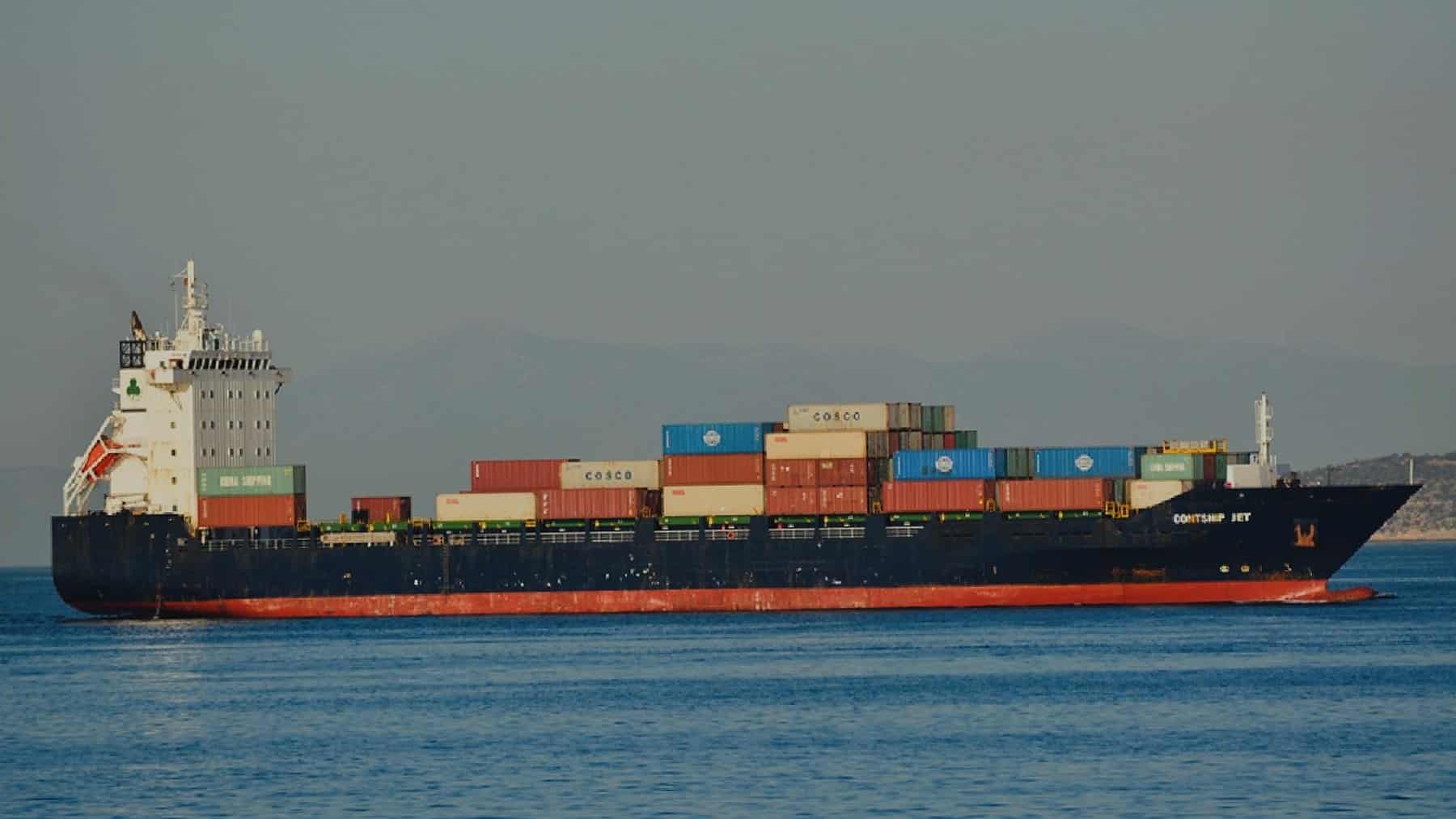

Container ships are built to be boring. They shuttle between the same ports on the same schedule, they’re stacked with stuff you’ll never see until it lands on a store shelf, and on a normal day the biggest thing the crew worries about is the weather. So there was nothing special about the Contship Jet working its way up Bulgaria’s Black Sea coast around noon on October 28, headed from Haifa, Israel, to the Romanian port of Constanta with 421 containers aboard.
Then drone boats hit it three times. Bulgaria’s defense minister, Dimitar Stoyanov, put the ship about 21 nautical miles southeast of the coastal town of Shabla. That’s outside Bulgarian territorial waters but inside the country’s exclusive economic zone, and that distinction ends up mattering a lot (more on that in a minute). All 18 sailors aboard got off alive, but the ship didn’t make it through the night.
It was also the fifth merchant ship hit by drones in Bulgaria’s exclusive economic zone since early October, according to the Bulgarian state news agency BTA. And the Contship Jet wasn’t even coming from or going to Ukraine. It was a Liberian-flagged feeder ship run by a Greek manager, chartered by Israeli carrier ZIM, carrying cargo to a NATO port. That’s a pretty unsettling detail if you’re in the business of moving boxes around the Black Sea.
The crew was off in 12 minutes
Bulgaria’s Ministry of Transport and Communications published a timeline the same afternoon, and frankly it reads like a crew that had rehearsed this. The alert reached Bulgaria from Romania’s maritime rescue center in Constanta at 12:01 p.m. local time. At 12:13, the 18 sailors abandoned ship.
The Bulgarian Navy sent the corvette Reshitelni, the rescue vessel Proteo and a fast boat with hull number 223, according to Navy commander Rear Adm. Kiril Mihaylov. A Border Police ship headed out too. By 12:53, eight sailors were aboard a Navy boat, and the other ten were riding it out in the ship’s own lifeboat.
Everyone made it. The crew was 14 Filipinos and four Ukrainians, nobody was hurt, and a Navy ship carried them to the port of Varna, where Border Police and medical teams were waiting.
The Contship Jet wasn’t so lucky. Mihaylov said that evening that 20 of its containers had already gone over the side. The ship sank around midnight, roughly 12 hours after the first hit, according to Prime Minister Rumen Radev and the Varna regional administration, and Bulgarian maritime authorities confirmed the sinking on October 29.
If you’re picturing one of the monsters that call at Long Beach, scale it way down. The Contship Jet was 524 feet long and 81 feet wide, rated for 1,267 standard 20-foot containers, and built in Spain nearly 20 years ago. Its deadweight was about 19,960 tons. Deadweight is basically everything a ship can carry before it sits too low in the water, so cargo, fuel, water and supplies all count. It isn’t what the steel hull weighs, which is a pretty common mix-up.
So what was in those boxes? According to the ship’s manifest, as described by Bulgaria’s Environment Ministry, a fairly ugly mix: lithium-ion batteries, acids and other corrosives, ethanol and other flammable liquids, household chemicals, plastics, food, building supplies, lumber and machinery parts. The ship itself ran on marine gas oil, a light fuel that evaporates fairly fast, and the Maritime Administration said it doesn’t expect a spill to reach the Bulgarian coast. Crews still took seawater samples at five spots along the shore to make sure.
Why didn’t Bulgaria just stop the drones?
Here’s where it gets a bit maddening, because Bulgaria saw them coming. A French maritime patrol plane working the western part of the Black Sea picked up the drone boats and warned the Bulgarian Navy’s operations center, according to the Bulgarian Defense Ministry. The Navy’s own coastal surveillance system watched the attack too, and between the two of them they logged all three hits. Radev later said the French crew had the drones in sight at least half an hour before the strike, Bulgarian media reported.
So why did nobody intervene?
It comes down to a line on a map. A country’s territorial waters run 12 nautical miles out from its coast, and inside that line it can treat a hostile boat pretty much the way it would treat an intruder on land. Out in the exclusive economic zone, Bulgaria gets the rights to the fish and the seabed, but it doesn’t get to start shooting.
Radev was fairly blunt about it on October 29. He said L-39 jets based at Balchik were ready to fire on the drones if they’d crossed into territorial waters, and that legally Bulgaria can’t operate outside them. At 21 nautical miles out, the Contship Jet was about nine nautical miles on the wrong side of that line.
I get why that rule exists. Nobody wants every navy on Earth claiming the right to blow things up 50 miles offshore. But it’s a tough rule to live with when you’re watching a drone boat line up on a freighter and you can’t touch it.
Western navies have been rehearsing this kind of threat for a while, including a NATO exercise this fall where more than 60 drone boats and aircraft staged a night attack on a frigate. Rehearsing it and being allowed to do something about it 21 nautical miles off your own beach are, unfortunately, two different things.
So who sent them?
Officially, nobody knows. Bulgaria hasn’t named an attacker, a military investigator has opened a case, and Radev said that if the drones’ origin is proven, the foreign minister will summon that country’s ambassador and hand over a formal protest.
Unofficially, the analysts are leaning hard in one direction. A crew member filmed the attack, and the footage, published by the Bulgarian site Maritime.bg and checked by Reuters, shows a matte-black drone boat somewhere around 16 to 20 feet long running alongside the ship before swinging into its side. Tomas Alexa, a senior analyst at maritime risk firm Ambrey, told Reuters the boat is likely a version of Russia’s Murena-300S or something built off that design. He also said its maneuvers suggest someone was steering it remotely, not that it was finding its own way in.
The Murena-300S was unveiled two summers ago at Russia’s Army arms show, built by a design bureau in Tula called the Center for Unmanned Systems. On paper it’s 18 feet long and about 5 feet wide, cruises at around 28 mph and can haul up to roughly 1,100 pounds over about 310 miles, according to figures the developer shared at its debut. It’s about the same size as Ukraine’s Magura V5, and Ukrainian drone boats have spent years chasing Russian warships around this same sea, to the point where one of the newer ones, the Sargan-3000, now launches interceptor drones from a box on its deck.
That similarity is exactly why a lookalike hull isn’t proof. Andriy Ryzhenko, a former senior Ukrainian naval officer, told Reuters the boat in the video doesn’t resemble any Ukrainian naval drone he knows of. Moscow has denied any link to the attacks on merchant ships off Bulgaria and hasn’t commented on the Contship Jet specifically. From the looks of things, a positive ID will have to come from wreckage or intelligence, not from a phone video.
There’s also a smaller question I couldn’t get a straight answer on. Stoyanov talked about three drones, while the Defense Ministry’s statement describes a surface drone and three hits. I couldn’t find anything official saying whether that means three separate boats or fewer boats making more than one run.
The Contship Jet was the fifth ship in 22 days
The drone attacks off Bulgaria have come in waves. Here’s how October went in the country’s exclusive economic zone, based on statements from Bulgarian officials:
And that’s before you get to Romania, where a cargo ship sank about 13 nautical miles off Constanta on October 23 after a suspected drone strike. There’s an almost darkly funny bit of timing here, too. Stoyanov broke the news about the Contship Jet in Sofia on the same day he was hosting the defense ministers of Romania and Turkey for talks on, of all things, Black Sea security.
The three countries condemned the attacks afterward and agreed to share more intelligence and early warning in the Black Sea. If you’re a shipowner, that’s arguably the most useful outcome of the week, since the French patrol plane already showed that spotting these boats early is possible.
Then there’s the cleanup. Twenty containers went into the water before the Contship Jet sank, and boxes like that are a real hazard for smaller boats, because a waterlogged container can ride just under the surface where you won’t see it until you hit it. Bulgarian officials haven’t tied any of the boxes floating out there now to a specific ship.
On Sunday, November 1, Bulgaria’s VTMIS ship-traffic system spotted four containers at four different points east of Burgas Bay and issued a navigation warning telling ships in the area to pass with extra care.