
- 2 MONTHS AGO · MILITARYA 26-foot Turkish drone boat that carries 551 pounds of explosive in its bow and hits by ramming went into the water for the first time at a naval yard on the Sea of Marmara, does 50 knots on a gasoline waterjet, and 40 of them are already on order
- 1 MONTH AGO · MILITARYAn 18-foot drone boat ran into a surface target off Turkey and set off a live 220-pound warhead for the first time, after trials with an inert lump bolted in where the bomb goes, and the target was picked out for it by a drone aircraft flying its own first navy exercise
- 1 MONTH AGO · MILITARYA 15,800-ton, 453-foot French submarine pushed a ballistic missile weighing more than 110,000 pounds out of one of its 16 tubes from under the Atlantic off Brittany after 18 months in dry dock, and the only other flight of this version took off from a pad on land
- 3 DAYS AGO · MILITARYAn underwater combat drone weighing more than 11 tons and over 30 feet long was just put under contract for the French Navy, designed to fly in on a cargo plane, slip off a pier or a warship and run long missions on its own under human supervision, and only one is on order
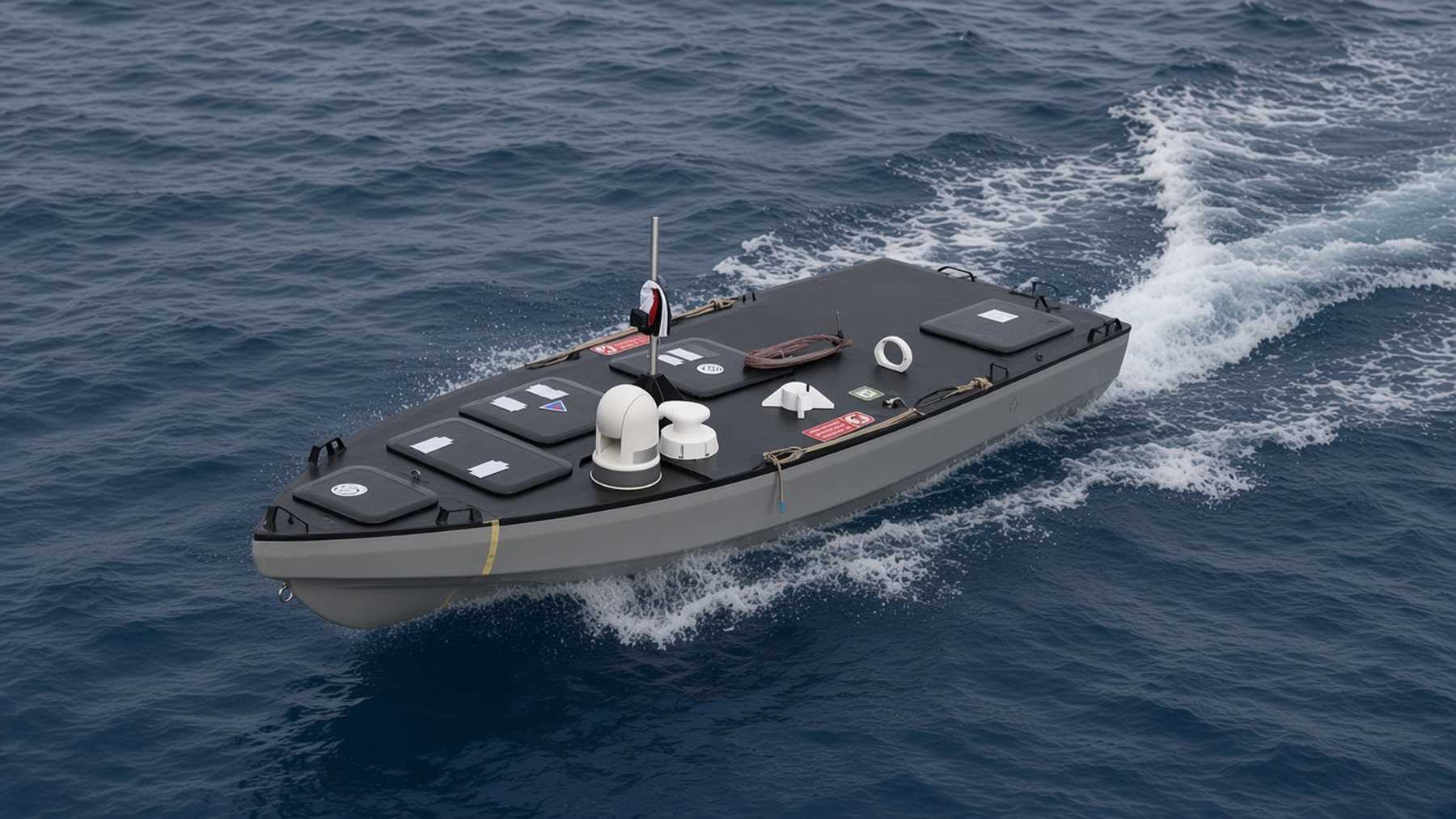
- TODAY · THIS ARTICLEA 16-foot kamikaze drone boat weighing about 1,100 pounds went from first sketch to sea trials in six months, designed by the French government’s own engineers at a lab that normally builds scale models of warships, and because the state owns the plans, any shipyard can now be handed them
Western governments don’t really build their own weapons anymore. The usual routine goes something like this: the navy writes down what it wants, the procurement office turns that into a contract, a defense company spends a few years building it, and everyone argues about the bill.
France’s defense procurement agency, the DGA, just skipped most of that. Its own engineers took a small explosive drone boat from an idea to testing at sea in about six months, according to Naval News, and then put it on display at Euronaval, the big naval trade show that ran in Paris from November 3 to 6.
It’s called SMOKERS. And before you ask, it isn’t the 16-foot solar drone boat from the Gulf of Maine we covered last month. That one’s a quiet solar boat. This one’s built to blow up.
So what is SMOKERS?
A kamikaze drone boat is pretty much what it sounds like. It’s a small boat with nobody on board, packed with explosives, that an operator steers into a target, and it doesn’t come back. Ukraine has made boats like this a lot more familiar over the last few years, and the DGA says lessons from Ukraine and the Arabian Gulf fed straight into this one.
The name is an acronym, and it only really works in French. The full title is Système Maritime Opérationnel Kamikaze Évolutif en Réalisation Souveraine, which roughly means a scalable kamikaze sea system built under sovereign control. In English the letters don’t spell anything, which is a little funny for a weapon that’s designed to be easy to copy.
The V1 version on display in Paris is about 16 feet long and weighs roughly 1,100 pounds, according to Army Recognition. Here’s the rest of the spec sheet.
For comparison, SMOKERS tops out at 40 knots, while the Royal Navy’s 28-foot drone boats out of Portsmouth can hit 55 knots. They’re also about 12 feet longer, so it’s not exactly a fair fight.
Under the hood, so to speak, it’s a fairly ordinary boat. The hulls are a resin and fiberglass composite, and the motors are the same kind of outboard you’d find on a rigid inflatable, all picked to keep costs and complexity down. Even the pyrotechnic system is 3D-printed. The DGA is aiming for a unit cost of a few tens of thousands of euros, which is frankly cheap for something that’s meant to go after warships.
Then there’s the explosive side of things. According to Naval News, the charge is meant to be big enough to seriously damage a first-rate enemy warship, but the DGA hasn’t said how much explosive that actually is, and I can’t find a weight anywhere in what’s been published so far. A person also stays in the control loop the whole time. That basically means someone’s watching the camera feed and making the call to strike, rather than the boat picking its own targets.
So who actually built it?
Well, the French government did, which is a pretty unusual way to get a weapon.
Project management sat with CERDAN, the DGA’s naval drone expert center in Toulon, which was only set up in June. France’s Defense Innovation Agency put up the early backing. The DGA Naval Techniques team in Toulon was in charge of the first prototype, called V0, and developed what the DGA calls its dronization package, which is the electronics and software that turn a regular boat into a drone.
The upgraded V1.0 came out of DGA Hydrodynamic Techniques, a center in Val-de-Reuil, in Normandy, that handled the hydrodynamic design and the navigation control software. Its usual specialty is scale models of French Navy ships, used to check how the real ones will maneuver and behave at sea. So the people who normally work with miniature warships helped design a small, very real boat that’s built to hit full-size ones. You’ve got to admit that’s a pretty neat bit of recycling.
It’s already been to sea a few times
SMOKERS has been through more than four sea-trial campaigns off Toulon and Cherbourg, Naval News reports, and some of those tested how easily French Navy ships’ own sensors can spot it. Which is basically the Navy pointing its own gear at the boat to see how much warning a real target might get.
The biggest outing so far was Wildfire, a French fleet exercise built around countering drones, which ran off Toulon from September 28 to October 2. Three prototypes went out that week, and each one was launched from a different ship: the amphibious assault ship Tonnerre, the air-defense destroyer Chevalier Paul and the replenishment ship Jacques Stosskopf. One SMOKERS was even painted white and stripped down to play the target.
I’d guess getting a small boat off a big amphibious ship isn’t quite the same job as getting it off a destroyer, so trying three very different decks seems smart if you want sailors to use it from whatever ship is nearby. Army Recognition says a live-fire campaign against targets at sea is planned, but I haven’t seen a date for it yet.
The French government owns the blueprints
I’d argue this matters more than the boat itself. When a defense company designs a weapon, it usually keeps the design, and the government ends up going back to that same company for every new boat and every upgrade. Because the DGA designed SMOKERS itself, it owns the blueprints and the intellectual property. That means it can hand the production specs to whichever shipyard it wants. The DGA told Naval News it kept the design simple on purpose, so small yards along the French coast, including companies that normally build leisure boats, could make it. In its own words, “This opens the door to all types of shipyards.”
That’s a pretty big deal if you run a small boatyard.
It’s also a different route from the one France is taking with its 11-ton underwater combat drone, where Naval Group holds the contract for a demonstrator. And the DGA keeps talking about mass production, which you don’t hear very often about a naval weapon.
So when does anyone get to build one?
Soon-ish. On October 29, the DGA published a procurement notice inviting manufacturers to take over production of the V1, and it’s open to civilian and military yards, big or small. The French Ministry of the Armed Forces laid out its wider plan the same day, and it puts industrializing SMOKERS in the first stage of the French Navy’s drone program, due to get going in mid-2027.
The DGA isn’t asking for huge quantities, at least not yet. It wants about 10 boats a year in peacetime and the ability to ramp up to 50 a year if the situation calls for it, according to Army Recognition. Whoever wins the job could also sell the design abroad later, as long as the French government signs off.
So if you run a small yard on the French coast and want to try your hand at building kamikaze drones, you’ve got until December 4 to apply, and the DGA expects to pick a manufacturer in 2027.
 A 6,900-ton nuclear attack submarine at Norfolk pushed a 19-pound underwater drone out of a flooded 21-inch torpedo tube so sailors could run underwater inspections from inside the boat, using a 3D-printed resin housing instead of a temporary alteration that costs 200 times as muchMilitary · 1 day ago
 A 1,123-foot aircraft carrier with eight defueled reactors is under tow from Newport News to Mobile, where a scrapyard will cut the hulk apart around those reactors over the next four years while a 100-yard safety zone moves with herMilitary · 2 days ago
 A 13-foot-wide US Navy nuclear mini-sub rolled across the seabed off Scotland on wheels, found an F-14 upside down in fishing nets nearly 1,900 feet down and brought its secret Phoenix missile up with a Soviet spy trawler watching, after a month of sonar ships had come up emptyMilitary · 2 days ago