
- 1 MONTH AGO · MILITARYAn 18-foot drone boat ran into a surface target off Turkey and set off a live 220-pound warhead for the first time, after trials with an inert lump bolted in where the bomb goes, and the target was picked out for it by a drone aircraft flying its own first navy exercise
- 1 MONTH AGO · MILITARYA 23-foot drone boat fired a winged kamikaze drone out of a launcher on its deck at a NATO exercise, the aircraft popped its wings open and streamed live video into the Spanish fleet’s combat software on the way to its target, and nobody was aboard the boat or the aircraft
- 3 WEEKS AGO · MILITARYA drone submarine built for the Australian navy surfaced, slid its top doors open and raised a rack of 12 angled tubes that fired an American aerial drone with a 275-mile range, a second rack sat folded beside it, and the whole hull ships inside a standard container
- 8 HOURS AGO · MILITARYA 16-foot kamikaze drone boat weighing about 1,100 pounds went from first sketch to sea trials in six months, designed by the French government’s own engineers at a lab that normally builds scale models of warships, and because the state owns the plans, any shipyard can now be handed them
- TODAY · THIS ARTICLEA 600-ton drone warship slid into the water at a Korean shipyard on Thursday, built to scout and watch at sea, and after trials in local waters it is due in the United States early next year for more testing aimed at the Navy’s growing unmanned fleet
If you’ve ever watched a warship launch, you know how it usually goes. There’s a ceremony, a big steel hull slides into the water, and somewhere in the crowd are the sailors who’ll eventually live on board.
The ship HD Hyundai and Anduril Industries launched in South Korea on Thursday skips that last bit. Nobody’s ever supposed to live on it.
According to Yonhap, the two companies held a launching ceremony for a 600-ton autonomous surface vessel, or ASV, at HD Hyundai Heavy Industries’ shipyard in Ulsan, about 190 miles southeast of Seoul. It’s built for reconnaissance, surveillance and gathering intelligence at sea, all without a crew. Next up are sea trials off Ulsan. After that, the ship is headed to the U.S. early next year for more testing, mainly so the companies can gather data on how it actually operates.
As of midday Thursday Eastern time, I couldn’t find a press release about the launch from either company, so most of what’s public right now comes from that Yonhap report. Yonhap calls it a “600-ton” ship and doesn’t break that figure down, so you can’t tell from the report whether it’s metric or short tons, or a full-load number.
So what did they actually put in the water?
An autonomous surface vessel is basically a ship that steers, navigates and keeps its own machinery running with nobody on board. People can still keep an eye on it from a control room on land, which is exactly how these two companies ran a demo in California last month.
This one runs two pieces of software. VAone comes from HD Korea Shipbuilding & Offshore Engineering, HD Hyundai’s shipbuilding holding company, and it looks after the ship itself: navigation, plus watching the engines and reacting when something breaks or gets damaged. Lattice is Anduril’s mission software, which decides what the ship is actually doing out there. Roughly speaking, one keeps the ship alive and the other gives it a job.
If you were hoping for a full spec sheet, there isn’t one yet. Yonhap didn’t publish a length, beam, speed or range for this hull.
The closest thing to a size I’ve found comes from Seapower Magazine, which described Anduril’s ASV in April as a vessel about 197 feet long and more than 500 tons. But Seapower didn’t say that figure belongs to this specific hull, and Seapower’s figure of more than 500 tons doesn’t line up neatly with Yonhap’s 600. Designs do tend to change between a trade-show briefing and a launch, so I wouldn’t treat the gap as a red flag. I wouldn’t treat 197 feet as confirmed, either.
Anduril’s own description of the design, from when the partnership was announced last November, is a steel hull with a big central superstructure that gives it a 360-degree view, plus swappable payloads for intelligence, surveillance, strike or electronic warfare. Steel’s a pretty sensible pick, frankly. Anduril pitched it as easy to weld and repair with the supply base that’s already in the U.S.
The California boat was a different ship
It’s easy to mix this hull up with the boat HD Hyundai and Anduril showed off last month, so here’s the difference.
On October 14, off the Port of Long Beach, the companies ran a modified 368-ton test ship that the Navy had previously operated. The demo lasted about three and a half hours and was relayed to a control station on shore. Around 40 people watched it there, from the Navy, the Coast Guard, the American Bureau of Shipping (the outfit that certifies ships, among other things), South Korea’s navy and DAPA, its defense procurement agency. HD Hyundai said it was the first time a South Korean company had demonstrated an unmanned surface vessel in U.S. waters.
That boat was an older hull converted to prove the two software packages work together. Thursday’s ship is new, the first hull of the class the two companies designed together. We looked at the Ulsan build back in August, when it was still steel in a dock. Now it’s actually floating.
The schedule slipped a bit
Anduril was fairly confident back in April. In a statement reported by Defense News, the company said the ship was “on track to be in the water and tested by the end of this year.” Cory Emmons, general manager of Anduril’s surface dominance division, said at the time it’d hit the water in October, and that Anduril would take ownership of it for testing off the U.S. coast by the end of 2026.
So the launch came about a month late, and the U.S. testing has moved into 2027. On a brand-new class of warship, that’s honestly a pretty modest slip.
Korean press reports from October had also talked about trials off the U.S. coast following a November launch. Thursday’s version puts sea trials off Ulsan first.
Anduril wouldn’t talk about what the ship costs when it was asked in April, and I haven’t seen a price for it since. That’s the figure I’d most like to see, given what the Navy’s paying for its other drone ships.
So is the Navy buying it?
Not this one. At least not yet.
On September 29, the Navy said it would buy 30 medium unmanned surface vessels, 10 apiece from Galliano Marine Services, HII and Saronic, at an average of $40 million per ship. The first ones are due before the end of fiscal 2027. If you’re wondering when that is, the federal fiscal year ends on September 30, so the deadline is September 30, 2027. This Korean-built hull isn’t part of that order, and HD Hyundai and Anduril aren’t among the three builders. We covered that deal when the Navy ordered its 30 drone ships.
What the two companies want is a way into that market. Yonhap framed Thursday’s launch as part of HD Hyundai’s push into the U.S. market for unmanned naval vessels, and Anduril said in April that it plans to compete for the Navy’s medium unmanned surface vessel work. Anduril’s plan is to prototype in Korea and build later ships in the U.S., at the former Foss Shipyard in Seattle and with Edison Chouest Offshore. That’s arguably the smartest part of the setup. A Korean yard with decades of practice works out the first hull, and the American yards inherit a design that’s already been in the water.
The Navy’s already sailing crewless ships with its fleet, too. Leidos’ 145-ton Seahawk has been crossing the Pacific with the USS Theodore Roosevelt’s carrier strike group. So a newcomer has to show it can keep up over long stretches at sea, and it’s safe to assume the Navy will want to see a lot more than a three-and-a-half-hour demo before it gets interested.
According to Yonhap, HD Hyundai plans to run the new 600-ton ship through sea trials off Ulsan first. If those go to plan, it’ll head to the United States early next year for its next round of testing.
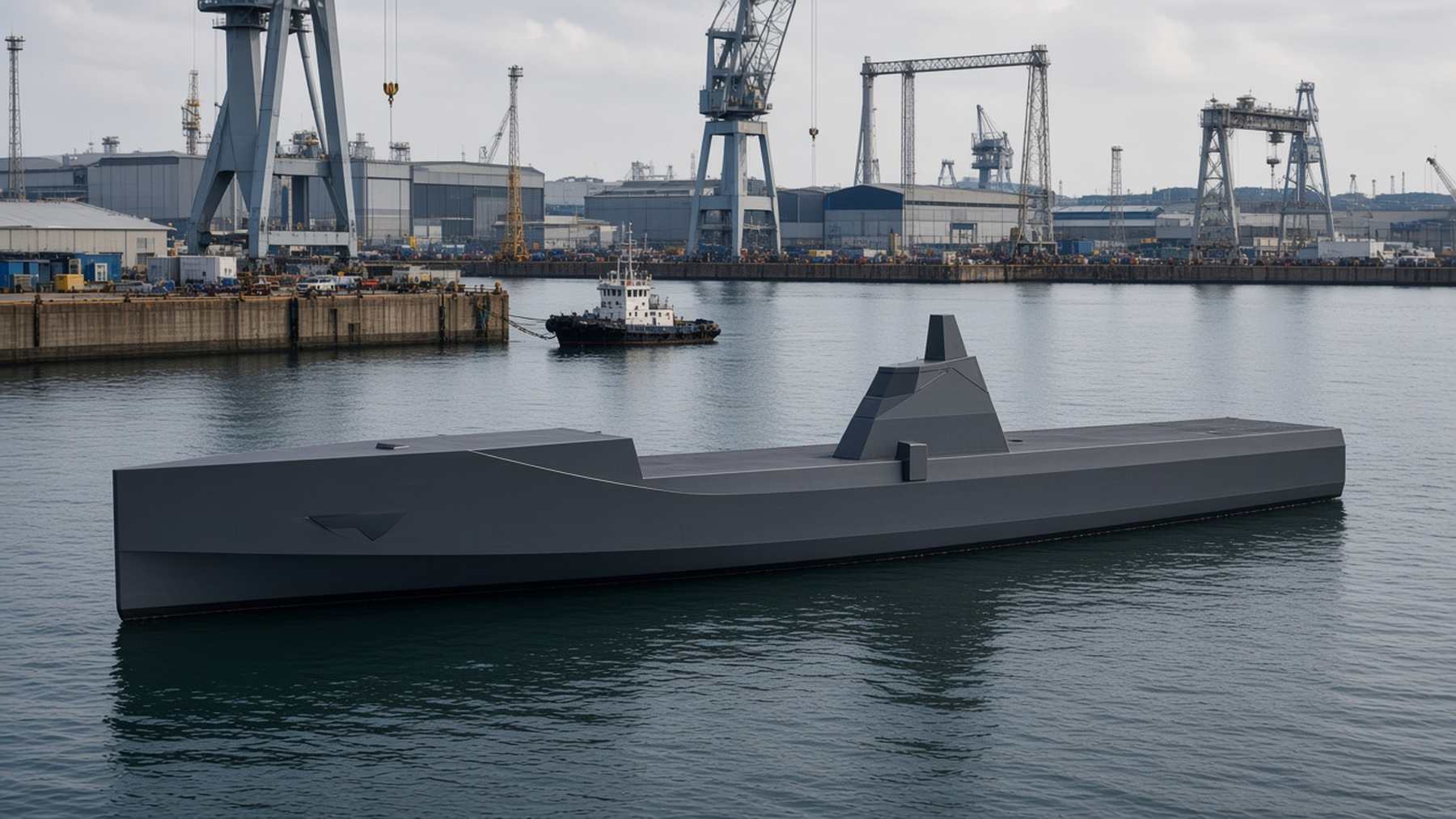
Note: The featured image is an AI-generated recreation based on official Anduril design images. It is not an actual photo of the vessel launched in Ulsan.
 A 243-foot missile corvette armed with eight vertical launch cells for cruise missiles was struck by drones in the Gulf of Finland, Ukraine’s security service said, as the same overnight raid set oil tanks on fire at a Baltic export portMilitary · 5 hours ago
 A 6,900-ton nuclear attack submarine at Norfolk pushed a 19-pound underwater drone out of a flooded 21-inch torpedo tube so sailors could run underwater inspections from inside the boat, using a 3D-printed resin housing instead of a temporary alteration that costs 200 times as muchMilitary · 1 day ago
 A 1,123-foot aircraft carrier with eight defueled reactors is under tow from Newport News to Mobile, where a scrapyard will cut the hulk apart around those reactors over the next four years while a 100-yard safety zone moves with herMilitary · 2 days ago