
If you’ve ever stood on the beach at Sheerness, a small town on the English side of the Thames Estuary (and I’m guessing most of you haven’t), you’d have seen three rusty poles sticking out of the water about a mile and a half offshore, with a sign on them telling you to keep away. For 82 years those poles were the only part of an American ship anyone could see without a dive suit. Last month a crew from Fort Lauderdale cut them off.
The ship is the SS Richard Montgomery, a Liberty ship built in Jacksonville, Florida, in 1943, and she’s still sitting on the sandbank she hit in August 1944 with about 1,400 tons of World War II munitions in her forward holds. The U.S. government still owns her. The British government has been paying to keep an eye on her for decades, and this year it paid a Florida salvage company called Resolve Marine, the same outfit that cleared the wreckage of the Francis Scott Key Bridge out of Baltimore harbor, $12.7 million (£9.5 million) to take the masts off before they fell onto the cargo.
So why would you spend that kind of money on three poles?
Basically because the poles were the heaviest thing left standing on a ship that’s been slowly folding in on itself since before most of our parents were born. We’ll get to that in a minute.
So what’s a Liberty ship doing full of bombs off England?
Quick refresher, because it’s been a while since high school. The Liberty ship was the cheap, slow, mass-produced cargo hull the U.S. built by the thousands during the war, around 2,700 of them, to haul everything from tanks to canned meat across the Atlantic faster than German submarines could sink them. The Richard Montgomery was one of those, a little over 440 feet long, and in August 1944 she showed up off the Thames with roughly 7,000 tons of munitions on board, bound for the Allied armies that had landed in Normandy two months earlier.
The harbor master sent her to an anchorage that turned out to be too shallow for a ship loaded that deep. On August 20, 1944, she dragged her anchor, grounded on a sandbank and started to break her back.
Salvage crews got roughly half the cargo out before the hull cracked in two and the rest went down with her. The inquiry afterward blamed the anchorage, not the captain, and had him back at work within a week.
The 1,400 tons that stayed behind are still there, and nobody’s planning to go get them. The British Department for Transport, which is the agency stuck with the wreck, surveys it every year, and as far as I can tell every review has come back with the same answer: moving 82-year-old explosives is riskier than leaving them where they are. I’d probably make the same call, frankly.
How do you saw a mast off a bomb?
Very carefully is the short answer. The longer one is more interesting.
Each mast was about 82 feet tall and had been standing in salt water since 1944, which means the steel at the base was in rough shape. The job was to cut them off below the waterline and lift them out without shaking the wreck.
Resolve’s naval architect on the project, Nolan Conway, told CBS News that some of the munitions are believed to carry pressure fuses, so an impact is exactly the kind of thing you don’t want. His framing of the problem was simple: “How can you cut off that mast without vibrating or impacting the wreck?”
So Resolve didn’t send a diver down with a torch. It used a remotely operated diamond-wire saw, which is a loop of cable studded with industrial diamonds that clamps around the mast with hydraulic arms and grinds through the steel while the people running it stay dry.
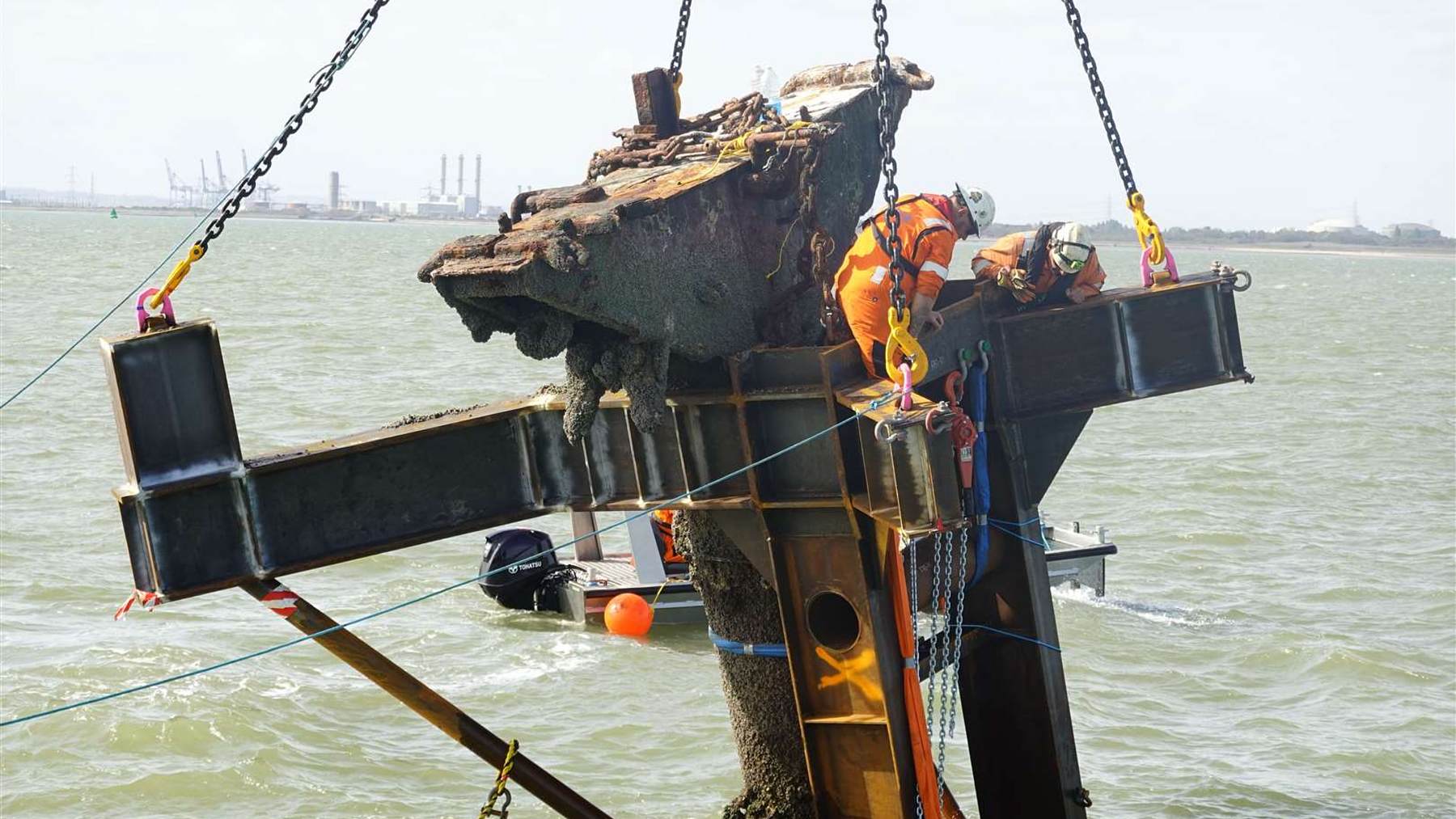
Nobody was in the water for the actual cut. Before the saw went to work, workers were lowered down the side of the barge in a cage by crane to bolt a large steel bracket onto each mast, so that when the wire went through, the mast was already hanging from a custom lifting frame instead of swinging loose on a hook.
That frame is the clever bit, in my opinion. An 82-foot steel pole with a wet, rotten base doesn’t come off cleanly, and if it swings on the way up it can easily hit the deck it just left. Resolve says the frame was designed specifically to keep the mast from swaying as it came free.
The lifting was done from a 213-foot crane barge called the Neptune, one of four vessels on site, and the hands-on work was handled by a team of seven dive engineers, five of them former military, led by a dive supervisor named Jason Murphy. Work started on September 15.
The first mast came off on September 20, the second on September 24 and the last one on September 30, so three masts in 15 days from the day the barge showed up. A local guy named Robin Nixon put a telescope camera on his house a mile and a half away and streamed the whole thing to a few hundred viewers, which tells you how big a deal this was in Kent.
What I can’t tell you is how much each mast weighed, or how big a crane the Neptune carries, because neither Resolve nor the British government has published those numbers. Given the custom frame and the pace of the job, it’s safe to assume they weren’t light.
Why cut them at all?
You may be thinking the masts were the least dangerous part of a ship full of bombs, and in a sense you’d be right. They weren’t going to blow up.
The problem was the load. Three 82-foot steel masts standing on deck plating that’s been corroding for eight decades put a lot of weight on a structure that Conway describes as visibly leaning, and an expert advisory group told the British government that the sensible move was to take them off before the deck gave way and dropped them onto the holds.
Resolve got the contract in April after what the Department for Transport describes as six years of planning and annual surveys of the wreck. A British firm called Waves Group advised the government and commissioned a geophysical survey of the seabed around the ship, which is the kind of thing you do when you’d rather not park a barge leg on a loose shell.
Officials still rate the odds of an explosion as low. The masts were just the one risk they could actually do something about.
Which, if you ask me, is a pretty reasonable way to handle a problem you can’t fix. It’s the same logic as moving a 45,000-ton battleship four feet to swap two rubber fenders: a small, precise job on a huge object nobody wants to touch any more than they have to.
So what happens to three rusty masts now?
They’re in a museum. Sort of.
All three masts, plus the warning sign that read “Unexploded ammunition, do not approach or board this wreck”, were delivered to the Historic Dockyard Chatham, a maritime museum up the River Medway, where conservators are assessing them. The government says they’ll go on display locally.
Where exactly is apparently still up in the air. A dockyard spokesperson told KentOnline: “We do not know if the masts will stay at the Dockyard.” The local member of Parliament, Kevin McKenna, is campaigning to get at least one of them back to Sheerness, where people have been looking at them from the beach for three generations.
The part that makes this an American story is that the masts don’t belong to the museum, or to Kevin McKenna, or to Britain. The wreck is still the property of the U.S. government. The masts are on loan from Washington to Chatham, the U.S. ambassador in London wrote to McKenna earlier this year backing the idea of keeping them in Kent, and the British transport ministry worked with the United States Maritime Administration on the whole project.
It’s a strange thing to own, a broken ship full of your own bombs on somebody else’s sandbank, and the U.S. has owned it for 82 years without ever having to pay for it. Compare that with the 4,080-ton landing ship that still runs on her original diesels and you get a sense of how differently two ships from the same war can age.
Keir Mather, the British maritime minister, told the House of Commons on October 19 that the project finished ahead of schedule and below forecast costs, which isn’t a sentence you read about a government salvage job very often. The exclusion zone around the Richard Montgomery stays in place, the flying ban over it stays in place, and the annual surveys continue. The ship herself is still right where she stopped on August 20, 1944, with about 1,400 tons of cargo in her, and now you can’t see any of her at all.