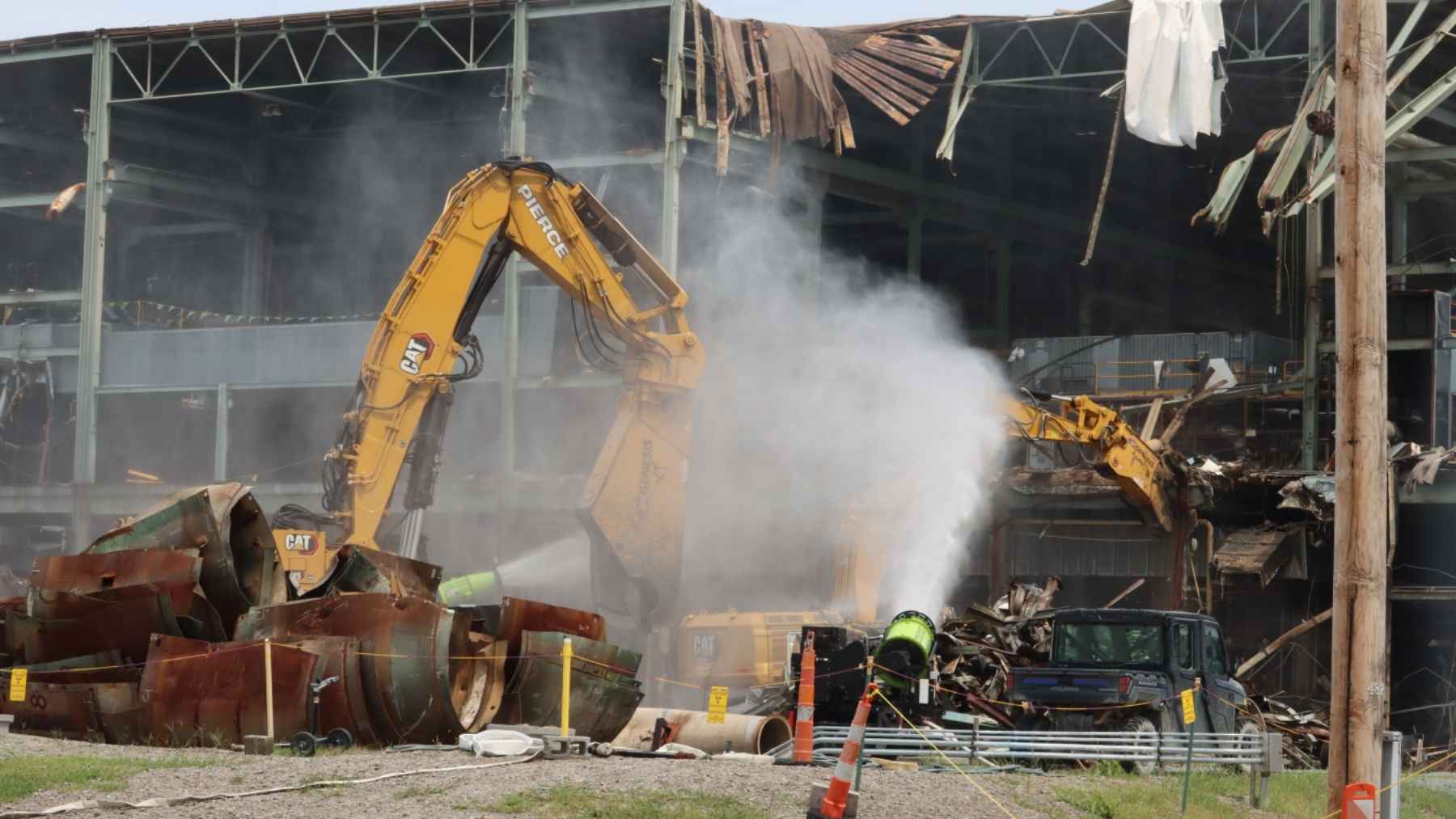

Have you ever used a pair of bolt cutters on a rusted padlock? If you scale that action up, you get the idea behind a machine called the Empress. Used by crews in southern Ohio, the Empress essentially closes two hardened jaws on a piece of metal. And the metal loses.
The Empress works at a scale that’s frankly hard to picture. It’s a modified excavator that weighs about 240 tons, according to the Department of Energy (DOE). We’re a car place, so here’s a good comparison: The Ford F-150 can be up to 3 tons when you have all the bells and whistles. The Empress is basically eight Ford F-150 with full payloads. The shears hanging off the end of its arm weigh more than 56,000 pounds on their own.
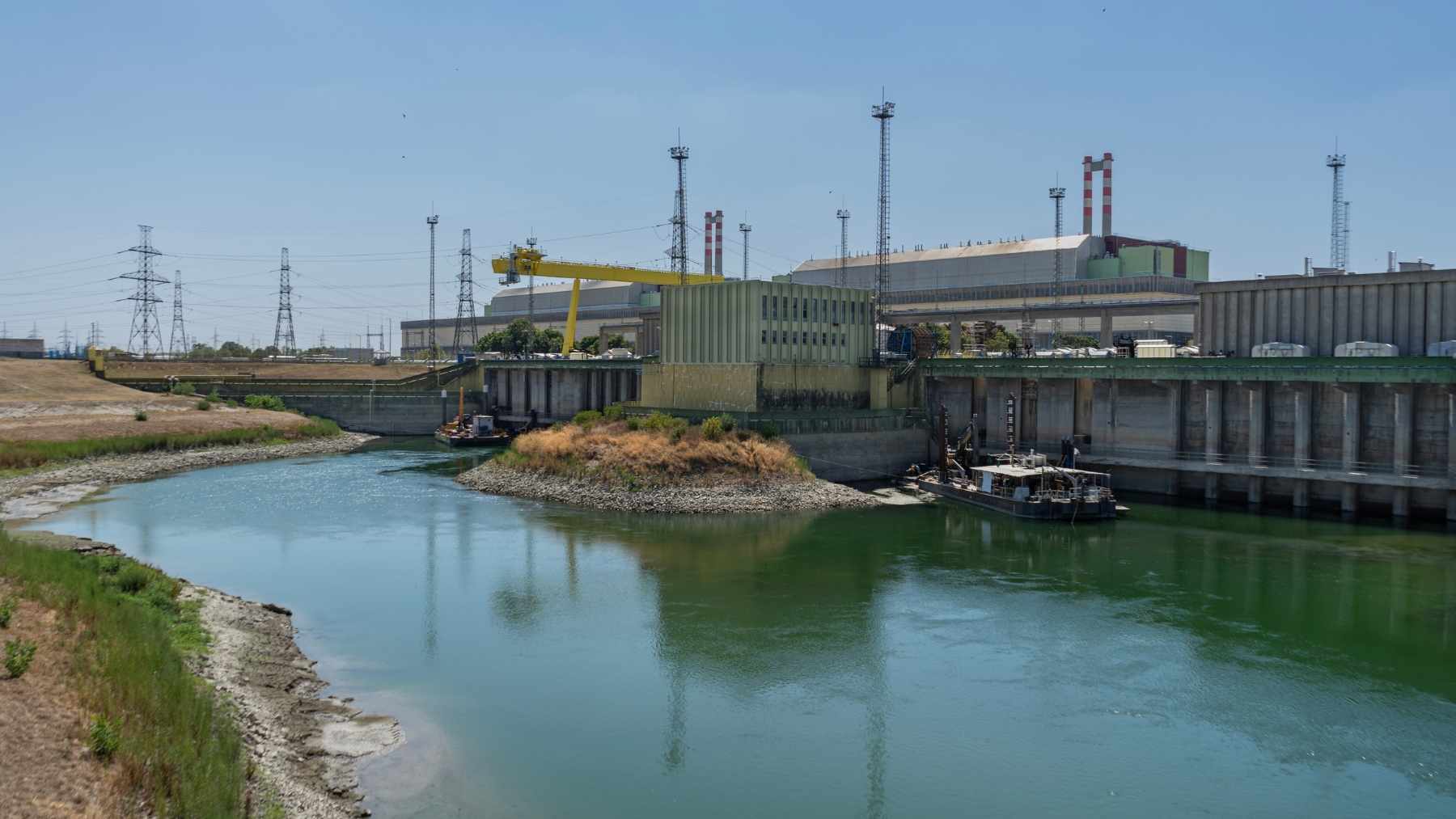
Its job is to take apart X-333, the biggest building at DOE’s Portsmouth Site, a former uranium enrichment plant near Piketon.
And apparently, it’s doing that faster than anyone planned.
On September 22, DOE announced that crews had taken down the building’s 66,000-square-foot southwest corner more than a month ahead of their target. Carl Williams, the X-333 deputy director at Southern Ohio Cleanup Company (SOCCo), the contractor handling the cleanup, said the Empress had “outperformed initial productivity assumptions.”
I’ll admit that’s not a phrase you see in many federal cleanup updates.
So what is the Empress?
Basically, it’s an excavator that got rebuilt around the tool on the end of its arm. DOE says a standard excavator couldn’t safely lift these shears, and the problem gets worse once the boom’s stretched out. So the machines built to carry them got a wider, reinforced undercarriage to handle a longer reach. Joe Saltsman, SOCCo’s director of demolition and balance of plant, said in March that there aren’t any other machines like them anywhere in the world.
If you’ve ever carried a heavy grocery bag, you know it’s a lot easier to hold it against your chest than out at arm’s length. An excavator has that problem too, except its arm is a steel boom and the bag weighs more than 28 tons. That’s a lot of grams of protein. The farther out that weight sits, the harder it tries to tip the whole machine forward, so the base underneath has to get wider and stronger to keep everything planted.
The shears are 25 feet long and 9.5 feet wide, the jaws open about 54 inches, and the arm can reach all the way up the 82-foot building. DOE compared them to four African bush elephants and an orca when they showed up at the site. I appreciate the effort, but I’m going to stick with feet and pounds.
DOE puts the Empress’s cutting force at 3,300 tons. Cutting force is how hard the jaws squeeze once they close on something, so think about the grip you’d get from a pair of pliers compared with your bare hand. Construction manager David Lipinski said in DOE’s May update on the Empress that the machine can cut an I-beam in two, even when the beam’s flanges are three inches thick. (The flanges are the flat plates across the top and bottom of the “I.”)
Why does a uranium plant need jaws this big?
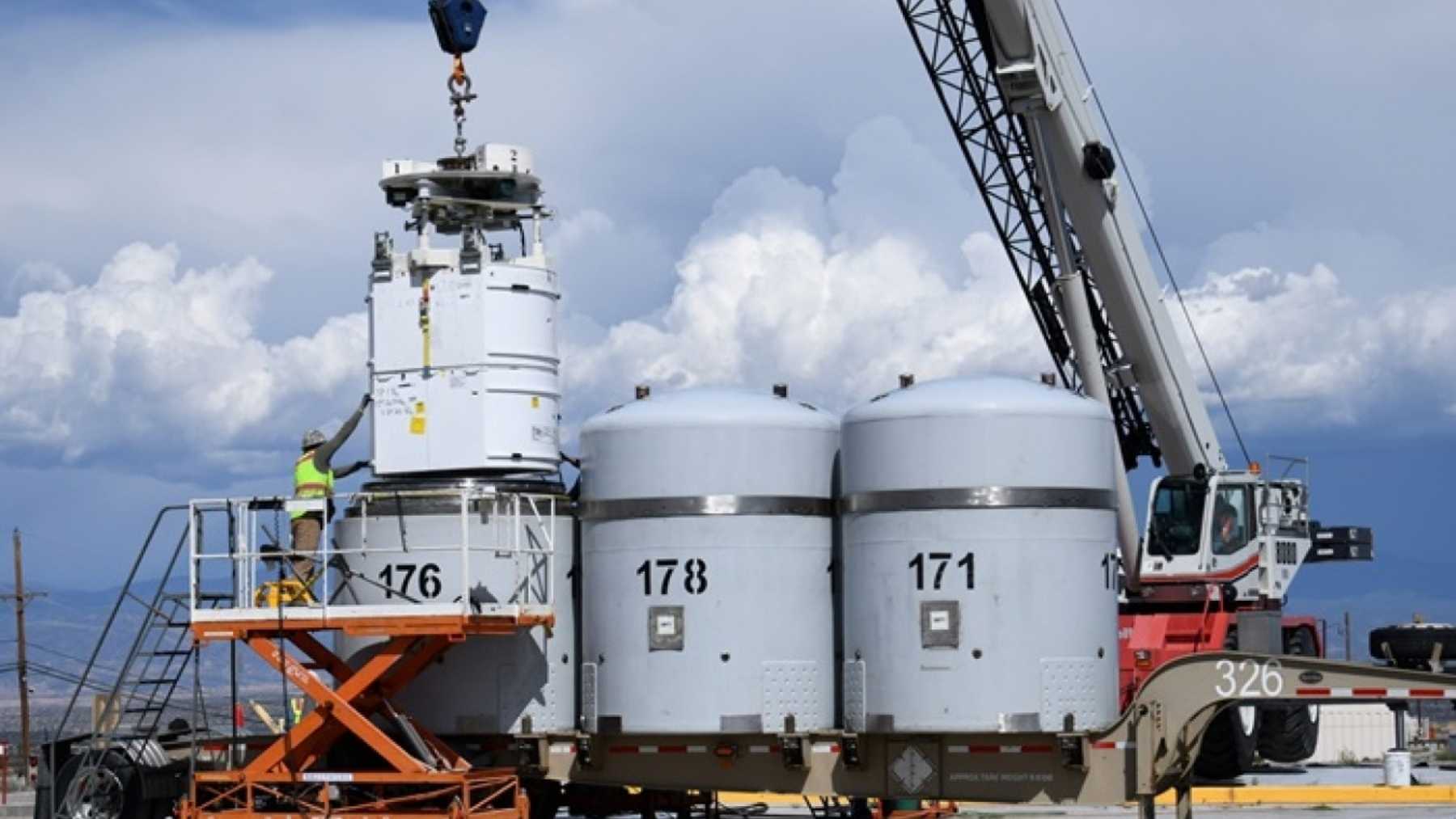
X-333 was one of three process buildings at Portsmouth that enriched uranium through gaseous diffusion. The process works by repeatedly pushing uranium gas through porous barriers. Each pass sends slightly more of the lighter, more useful uranium through to the other side. X-333 sat at the start of that chain, where feed material entered before it headed to the plant’s other two process buildings, according to the DOE. So its equipment ended up bigger than anything else on the site, and some of its converters, the big units the gas was pushed through, tipped the scales at up to 66,000 pounds each.
Federal Project Director Christy Brown said back in March that the gear for tearing X-333 down had to be sized to match. The building’s as oversized as the gear it used to hold. X-333 runs 1,456 feet from end to end, it’s 970 feet across and 82 feet tall, and it covers 33 acres. The floor space under its roof adds up to 66 acres, twice the footprint, since it’s a two-story building.
So yes, it’s big.
X-333 is the second of Portsmouth’s three process buildings to come down. Once the work’s done, DOE wants the land ready for a new industry, and it mentions AI infrastructure and nuclear energy as options. Those Piketon grounds already house a hall of centrifuges making advanced reactor fuel. And DOE’s cleanup office has other jobs like this going at once. We’ve covered an Oak Ridge reactor building in Tennessee that’s getting stripped from the inside before the excavators show up.
X-333 is a little smaller now
The southwest corner covers 66,000 square feet and accounts for 4.55% of the building’s total structural demolition. So if you’re doing the math at home, a little more than 95% of the structure is still standing. There’s still a lot of X-333 left. Taking the corner down also left close to 10,000 cubic yards of scrap and rubble, all of it cut down to size for Portsmouth’s On-Site Waste Disposal Facility.
Why start there? Well, DOE says clearing that corner first gave crews a place to store and stage the large process gas valves that’ll come out as the rest of X-333 comes down. That way, handling the specialized stuff won’t stall the demolition later. It’s pretty sensible planning, if not exactly glamorous.
Williams also spread the credit around. He pointed to the planning, the teamwork, and the people running the gear, and DOE’s own photos show grapple-equipped machines sorting debris and loading it into trucks. Brown said there haven’t been any recordable injuries on the project so far.
DOE said in May that the Empress was one of two specially rebuilt excavators bound for X-333, and that the second one wasn’t far behind. I haven’t been able to find an update confirming it’s arrived.
Even 56,000-pound jaws wear out
A week after the milestone, DOE published an update on a new equipment-tracking database at Portsmouth, and it includes arguably the most relatable detail in this whole story. DOE says the cutting blades on the big shears should last 40 to 80 hours. That’s somewhere between one and two regular work weeks.
So crews check the shears every four to eight hours, and they’re logging each inspection. DOE says rotating the blades before they get damaged can extend their lifespan by up to four times. It’s basically like rotating the tires on your car, just with a lot more steel.
DOE doesn’t say whether those numbers apply to the Empress’s shears or to every set working on X-333. Brown put the equipment budget for the demolition at $108 million. SOCCo construction supervisor Jessica Hurd said the database helps the team stay ahead of schedule, and DOE says it tracks spare parts, so machines spend less time idle.
According to Williams, the early corner gives the team a solid start on its next round of demolition, which falls in the federal fiscal year that began on October 1. DOE says its team will keep looking for ways to speed things up, but the official plan still has the last of X-333 coming down in 2031.