
- 3 MONTHS AGO · MILITARYA 6.5-pound drone thrown off a dock by hand sprints across the surface at 8 mph, stops, dives 197 feet straight down for a reading and pops back up, and the Navy spent two days in August watching pods of them hunt other underwater drones in a harbor
- 2 MONTHS AGO · MILITARYNineteen 154-pound underwater drone gliders with no propellers flew at once off Portugal in NATO’s biggest uncrewed naval exercise, hunting submarines by listening, and a bigger 377-pound glider dragged a line of hydrophones through the water behind it
- 2 MONTHS AGO · MILITARYA 38-pound underwater drone holds still against the current on seven thrusters, fires a demolition charge into a sea mine hard enough to stick, then backs away paying out the firing line — everything comes home except the charge, and Ukraine has already used it in combat
- 1 WEEK AGO · MILITARYA 30-foot underwater drone, a compact experimental hull much smaller than the fiber-optic boat from the same yard, went into the water for the first time at a Taiwanese harbor on Wednesday, with no prior official announcement, to test autonomous navigation and modular payloads
- TODAY · THIS ARTICLEA 20-foot German drone submarine just came off a production line for the first time with its tail planes rebuilt into an X, two propellers turning against each other and dive planes on its motor pods, and the first hulls go to European governments before the year is out
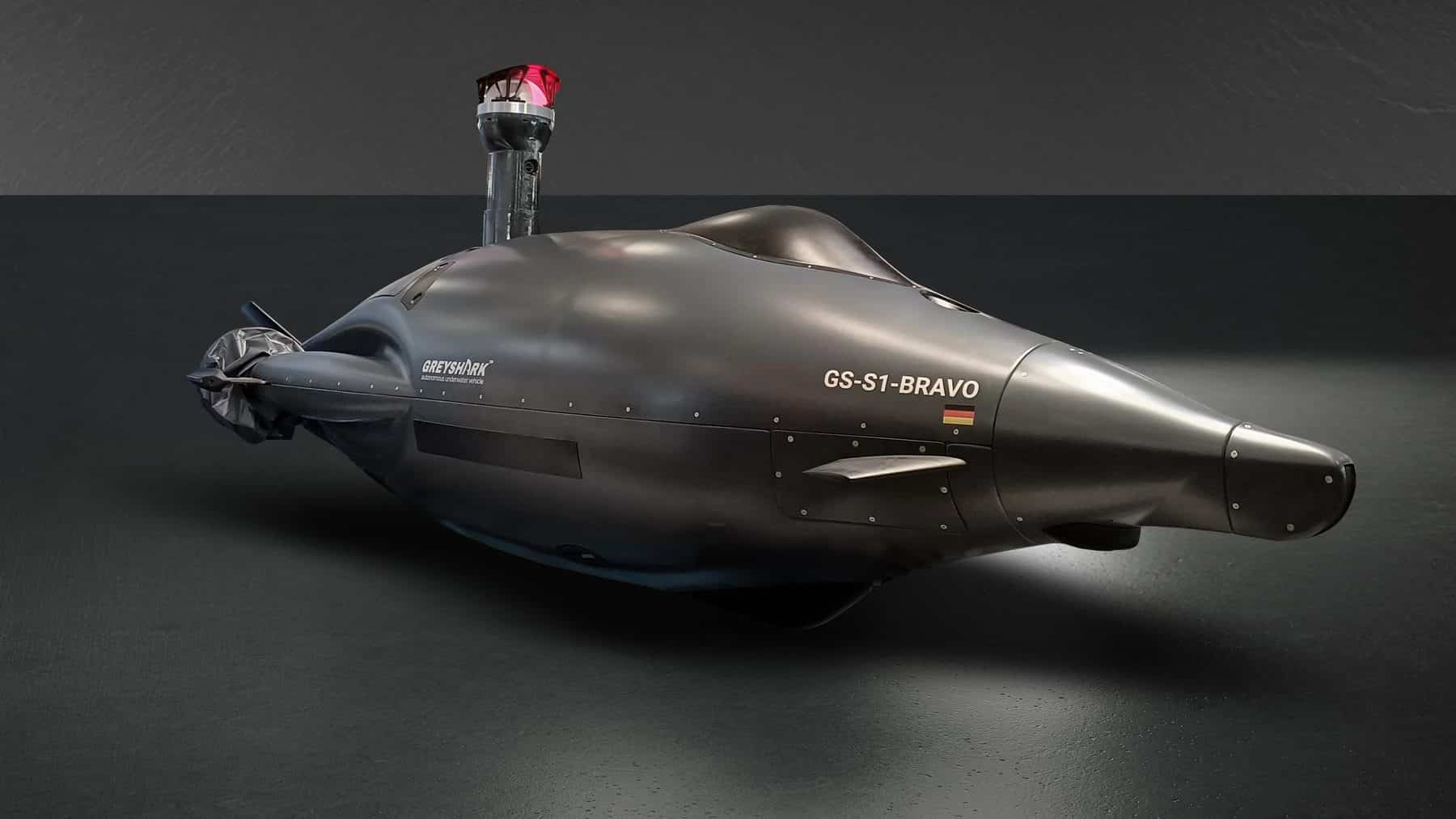
If you’ve seen a Greyshark at a defense show over the last couple of years, the one Euroatlas had on its stand in Paris this month might throw you a little. The hull’s shape is pretty much the same. The back end has basically been rebuilt, though, and that’s what I want to get into here.
This is the first Greyshark to come out of series production. Euroatlas, which is based in Bremen, and its Berlin partner EvoLogics unveiled it at Euronaval, the naval trade show that ran in Paris from November 3 to 6. According to the announcement carried by Ocean News, orders have already come in from European government customers, and the first deliveries are scheduled before the end of the year.
The two companies haven’t said which governments are buying or how many drones are on order. That’s fairly standard for defense customers, who’d usually rather not advertise their shopping lists.
“The start of series production is a crucial milestone for us,” said Fabian Bannasch, managing director of EvoLogics. His counterpart at Euroatlas, Eugen Ciemnyjewski, says getting from prototype to series production took about two years.
If you haven’t come across it before, the Greyshark is an autonomous underwater vehicle, or AUV. Basically, it’s a drone submarine. Nobody’s on board and it isn’t on a tether, so once it’s in the water it runs its mission on its own.
The production model is about 20 feet long. Euroatlas hasn’t published a weight for it, and the closest figure I can find is about 7,700 pounds, which Janes reported for the prototype last year. That prototype was a little longer, at about 21 feet, so treat the number as a ballpark.
So what changed on the production model?
The biggest change is propulsion. The prototype pushed itself along with a single shrouded propeller at the tail, and according to EDR Magazine, that propeller was nearly as wide as the hull. The production version gets two motor pods instead, one on each side, each with a smaller propeller. And the two spin in opposite directions.
Why bother?
Well, a single big propeller tends to twist whatever it’s attached to the other way, kind of like the way a drill tries to twist out of your hand when it binds. Two propellers turning against each other cancel that out. Run one faster than the other and you can turn the drone without touching a rudder, which is the same trick twin-engine boats use when they’re docking. According to EDR, that’s how the production model handles yaw, and Euroatlas went with the setup for better stability, maneuverability and more precise control. The company kept the new propellers under canvas on the show floor, though, so you’ll have to take its word on what they look like.
The tail has changed too. The prototype had a conventional set of fins, one vertical pair and one horizontal pair, like a plus sign. The production model swaps those for X-shaped fins at the rear and adds dive planes up front and on the motor pods.
With an X tail, every fin does a bit of the steering and a bit of the diving, and a computer mixes all four at once. Submarine designers like it because you can fit bigger fins without them sticking out past the hull, and losing one fin isn’t the end of the world. Germany’s own Type 212 submarines use one.
Frankly, that’s a pretty serious redesign for a drone two years out from its debut. It’s arguably the clearest sign this thing has spent time in the water rather than just on show stands.
So what is it for?
Euroatlas pitches the Greyshark for three jobs: intelligence and surveillance, mine countermeasures, and keeping an eye on underwater infrastructure like data cables and pipelines.
It’s also built to work in groups. Several Greysharks can link up into an underwater network, share what they’re seeing in real time and split tasks between themselves, like sending one drone in for a closer look at a suspicious object. They do it with sound, over EvoLogics’ encrypted acoustic links. Radio barely makes it through seawater, so if you want two submerged drones to talk to each other, sound is pretty much the only practical option.
Now, about mines. According to a Warsight report republished by defence-network, the Greyshark’s job here is finding them. It picks up anomalies on the seabed with sonar, then checks them with sonar or laser imaging, still photos or live video. Carrying devices to get rid of mines is listed as a possible future add-on.
Keep that in mind when you hear the Strait of Hormuz claim. Euroatlas executive Verineia Codrean has said six Greysharks run by a single operator could map the strait in under 24 hours. That’s the company’s own math, and it covers mapping the strait. When we covered the hydrogen version back in June, we lined that claim up against the Navy’s estimate for clearing the strait. To be fair to the Navy, mapping is only the first half of that job.
Still, finding the mines is arguably the step everything else waits on. Getting rid of them is a separate job for something like Raytheon’s Barracuda mine-killing drone.
Where does the hydrogen version fit in?
The drone in Paris was the S1-Bravo, the battery version. Its sibling, the S1-Foxtrot, runs on a hydrogen fuel cell. A fuel cell turns hydrogen and oxygen into electricity without burning anything, so there’s no engine in there, and it’s quieter and cooler than a combustion setup would be.
The Foxtrot is the bigger of the two at about 26 feet, and Euroatlas says it can stay submerged for up to 16 weeks at 4 knots. It went into the water for the first time the week of April 6 off Damp, near Kiel, according to Janes, then moved to a seabed security test center off Rostock the following week. Euroatlas also told Janes it’s rated to about 13,100 feet deep. Defence-network says it’s now in its final prototype phase and being prepared for series production.
One thing I can’t pin down is the Foxtrot’s range. Janes quoted about 8,000 nautical miles at 4 knots, while other reports carry 10,700, which is what you get if you run at 4 knots for 16 weeks straight. I haven’t seen Euroatlas settle which one it stands behind.
How many can they build?
The November announcement doesn’t give a production rate. Back in March, when the two companies presented the Foxtrot, they talked about a capacity of 150 units a year with room to scale to 500, according to the German defense site ESUT. For comparison, Anduril’s 19-foot Dive-LD is being built in Rhode Island at a plant designed for up to 200 a year. So the two drones are pretty close in size and in ambition, at least on paper.
Euroatlas and EvoLogics say the first production Greysharks are due with their European government customers before the end of the year, which gives them about six weeks from today.
Credit: Euroatlas
 A 6,500-nautical-mile drone submarine built to lay mines with nobody aboard is about to reach the Navy as the third of three prototypes, nine years after the program began, and the officer running it says the plan now is to find out what it really does well and what it doesn’tMilitary · 3 days ago
 A 27,100-ton aircraft carrier once moved just 15 feet when six tugboats pulled on her with 30,000 horsepower after 24 years at a Manhattan pier, because her four 16-foot propellers had dug into the river mud, and freeing her took three weeks of dredging nearly 40,000 cubic yardsMilitary · 4 hours ago
 A 9,700-pound cache of primer explosive in 68 barrels that have sat more than 20 years at an Iowa ammunition plant, now too degraded to move after their water bath partly evaporated, has until Monday to be blown up in place before a forecast cold snap makes the material worseMilitary · 4 hours ago