
Every few weeks now, another advanced reactor makes the news. Bill Gates has a sodium-cooled machine going up in Wyoming. Oklo is building a compact one in Idaho with its own fuel plant next door. This summer, America ran three brand-new reactors critical in thirty days. The pitch is always the same: clean, around-the-clock power for a grid that AI data centers are draining faster than anyone planned for.
There’s one detail those announcements tend to skip. Most of these reactors run on a fuel that, in the Western world, barely exists yet.
It’s called HALEU, high-assay low-enriched uranium, and for years the only outfit selling it in commercial quantities was Russia’s state enricher. The entire American-made supply comes out of one building in Piketon, Ohio, from a cascade of sixteen centrifuges.
On July 1, those sixteen machines stopped being a government science experiment and started selling to whoever will pay.
Sixteen machines are the whole American answer
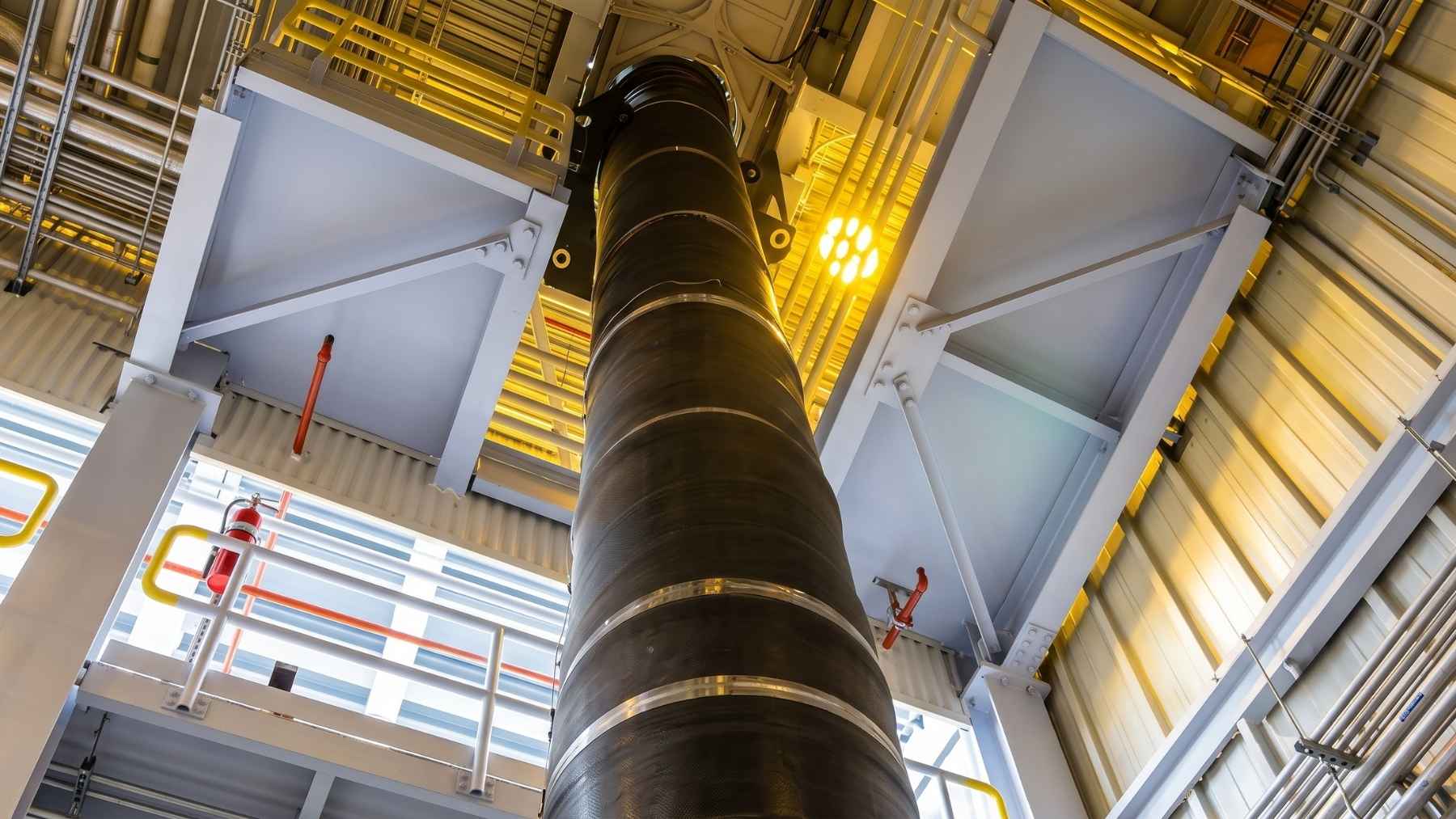
The plant sits on the old gaseous-diffusion grounds in Piketon, where the government tried and failed to stand up a full commercial enrichment plant more than a decade ago. What survived is modest: a single cascade of sixteen AC100M centrifuges, large gas machines spun up from a design that traces back to Oak Ridge in the 1980s.
They make roughly 900 kilograms of HALEU a year. That’s it. That is the sum total of American-made high-assay fuel.
By design, this cascade was never meant to be big. It was a demonstration, proof that the country could still enrich uranium with its own hardware after letting the capability lapse for a generation. The last U.S.-owned enrichment plant of any real size was built in the 1950s and shut for good in 2013.
HALEU is enriched to between 5 and 20 percent uranium-235, richer than the roughly 5 percent that feeds today’s reactors but well short of the levels used in weapons or Navy propulsion. Centrus runs the only plant in the country licensed by the NRC to make it, and by the company’s own reckoning, the only source of HALEU enrichment anywhere in the Western world.
When the cascade started up in 2023, it became the first U.S.-owned, U.S.-technology enrichment plant to begin producing in about seventy years. Seventy years of American enrichment history, and it fits in one hall.
The contract is signed. “Commercial” is still a plan.
Here’s what actually happened on July 1. Centrus signed a contract finalizing a $900 million task order it had already won back in January, under the Department of Energy’s $2.7 billion program to rebuild domestic enrichment.
The company’s subsidiary, American Centrifuge Operating, put its name on the fixed-price deal on June 30. The $900 million base gets paid out as the company hits milestones. Two options held by the DOE, each for five metric tons of HALEU at $17 million per ton, could push the total to $1.07 billion, POWER Magazine reported. In exchange, Centrus has to build real commercial-scale capacity and deliver its first metric ton of new HALEU by March 2032. Finish the job, and it takes ownership of the capacity it puts up.
“Today’s announcement marks another milestone in our expansion,” said Centrus President and CEO Amir Vexler.
Read the announcement closely, though, and the word doing the heavy lifting is “intends.” Centrus plans to run the existing cascade commercially, but only once it settles a stack of agreements with the government, chief among them a long-term lease extension for the Piketon plant, which the company rents from the DOE. A three-month, $15 million storage deal bridges the gap while the lawyers work.
The demonstration side, at least, is finished. Centrus wrapped the last 900 kilograms the old contract called for in mid-June, two weeks early, pushing lifetime output past 1,900 kilograms. The science project is done. The business is still being papered.
The reactors are already waiting on it
HALEU is not a niche request. It’s the fuel of choice for most of the advanced reactor designs the DOE, the Pentagon, and Silicon Valley are betting on.
The appeal is straightforward. Pack the fuel with more fissile material and a reactor can run smaller, go longer between refuelings, and leave less waste behind. That’s exactly what the compact, factory-built reactors now in vogue are counting on.
TerraPower’s Natrium plant in Wyoming needs something like 15 to 20 metric tons for a single first core, and it already lost roughly two years when it cut ties with its Russian fuel supplier after the invasion of Ukraine. Oklo’s Aurora, X-energy’s Xe-100, and a growing list of microreactors are all lined up behind the same fuel.
Then there’s the money nobody planned for. The hyperscalers chasing nuclear for their data centers, Meta among them, are pushing to lock in fuel before their projects reach a final investment decision, because unproven fuel supply is not the kind of risk you want on the books while raising billions. Vexler told analysts this spring that reactor customers are finally moving from licensing paperwork to serious, committed fuel buys.
Which is the whole problem in one sentence. The demand is real and arriving now. The supply is sixteen machines and 900 kilograms a year.
Centrus has company, and a deadline
To be fair, Centrus is not the only name Washington is funding. That January round split three $900 million awards: one to Centrus and one to General Matter, both for HALEU, and one to Orano for low-enriched uranium on old Manhattan Project land in Tennessee. Urenco’s plant in New Mexico is still the only commercial enrichment plant actually operating in the country, though it makes ordinary reactor fuel and answers to European owners.
None of that changes the near-term math. Centrus doesn’t expect its first new capacity online until 2029, and the full build-out, twelve metric tons of HALEU a year plus enough LEU capacity to work down a $2.4 billion backlog, gets added in modular chunks as customers sign.
To move faster, the company has pulled in engineering giant Fluor, data outfit Palantir, and an Ohio construction firm, and says those partnerships have already found around $300 million in savings.
It’s also exploring a joint venture with Oklo to handle deconversion, turning HALEU gas into the oxide and metal forms reactors actually load. That capability, Centrus says, doesn’t exist commercially yet either. Add it next to enrichment, and the company would control two links of a supply chain that currently has almost none.
As it stands, the whole American-made HALEU supply is still those sixteen centrifuges in southern Ohio, still turning out about 900 kilograms a year. The July 1 contract flips them from a government experiment to a paying business. It doesn’t add a single machine.
Everything bigger, the twelve metric tons, the thousands of jobs, the 2029 capacity, hangs on a lease that isn’t signed yet, customer demand that has to show up on schedule, and money that hasn’t all been raised. The fuel every glossy reactor rendering quietly depends on comes down to one room in Piketon finally being allowed to sell what it makes. Those reactors had better hope the paperwork clears.