
- 3 MONTHS AGO · MILITARYA 6.5-pound drone thrown off a dock by hand sprints across the surface at 8 mph, stops, dives 197 feet straight down for a reading and pops back up, and the Navy spent two days in August watching pods of them hunt other underwater drones in a harbor
- 1 MONTH AGO · MILITARYA force of more than 60 drone boats and aircraft staged a simulated attack on a 3,660-ton frigate at night, while 20–30 uncrewed escorts defended it and nine separate command systems shared a network for coordinating the exercise
- 2 WEEKS AGO · MILITARYA 28-foot drone boat that hits 55 knots was steered around Portsmouth harbor from a control hub as the Royal Navy commissioned its first autonomous squadron, about 180 sailors split into two watches to keep uncrewed boats running around the clock
- 1 WEEK AGO · MILITARYA 13-foot-wide US Navy nuclear mini-sub rolled across the seabed off Scotland on wheels, found an F-14 upside down in fishing nets nearly 1,900 feet down and brought its secret Phoenix missile up with a Soviet spy trawler watching, after a month of sonar ships had come up empty
- TODAY · THIS ARTICLEA German box that opens in under 30 seconds, throws a drone into the air and catches it again on a deck moving at 15 knots just passed its acceptance tests at sea and was handed to a navy that will run it from a crewless boat, watching over the cables and pipelines on the seabed
Plenty of the hardware that turns up at naval trade shows never gets much further than the booth. You get a slick video, a press release calling it a world first, and then the thing sort of fades away while the company goes looking for a buyer.
So it’s a pretty good sign when one of them actually ends up on a customer’s crewless boat.
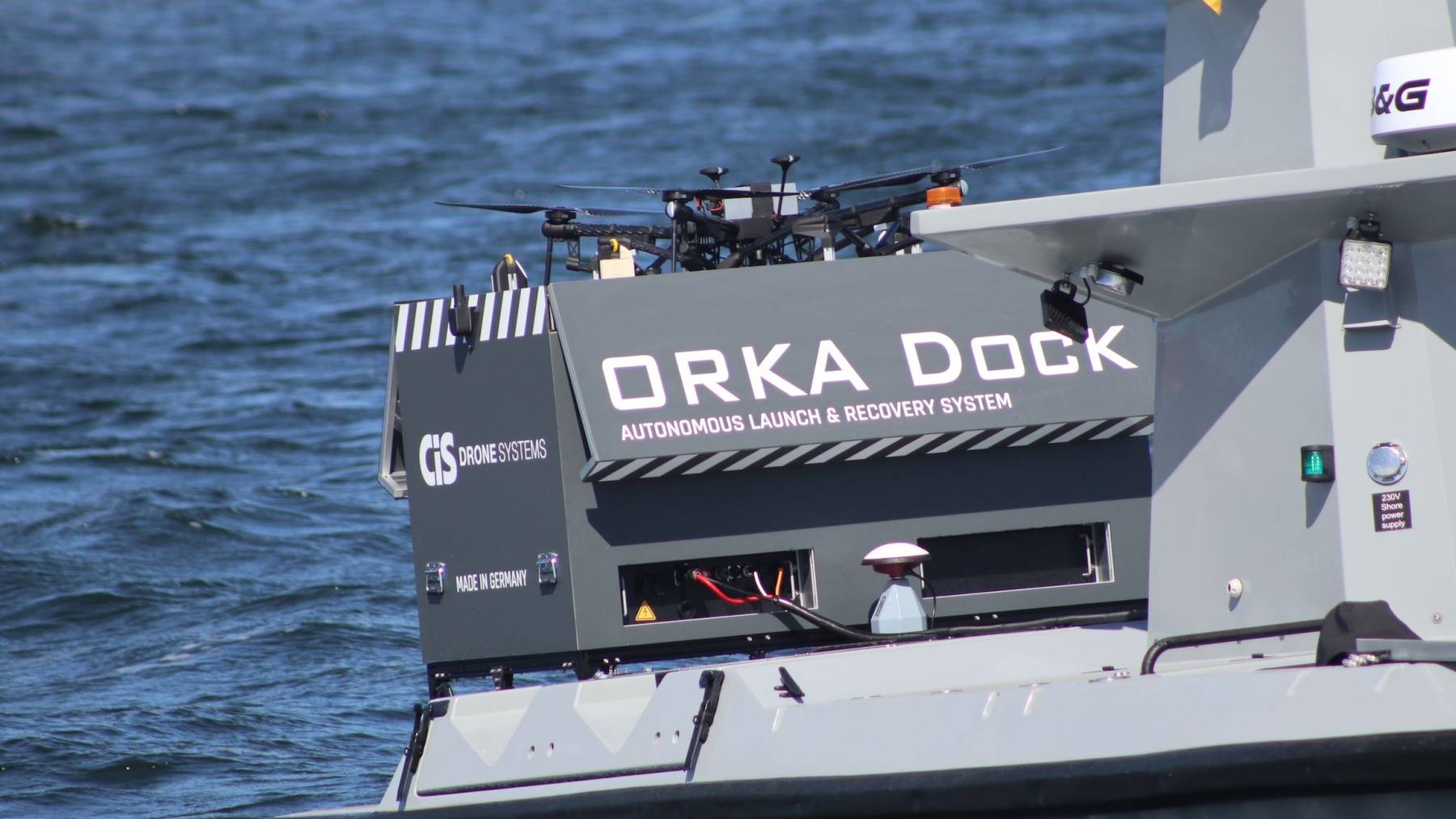
That’s what’s happened to the ORKA Dock, the sealed German hangar that launches, catches and recharges a drone on a moving deck without anyone touching a controller. We covered it back in July, when its maker, a Rostock company called CiS, had a two-week exercise on a 24-foot drone boat under its belt and no named buyer. On November 17, CiS said it had handed the dock over to a defense customer and put it into service, once the box had passed its acceptance trials at sea on a ship with a crew aboard.
The customer will run it from an uncrewed surface vessel (a drone boat, basically) with the ORKA drone it already owns. CiS says the main jobs are surveillance and protecting critical underwater infrastructure.
If you haven’t run into that phrase before, it’s defense-speak for the stuff on the seabed that a country really doesn’t want anyone cutting: power cables, internet cables and gas pipelines. A small drone boat with an aircraft on its back is arguably a much cheaper way to keep an eye on them than parking a crewed warship on top of them.
So who bought it?
CiS isn’t saying. EDR Magazine’s headline calls the buyer a naval customer, while the release itself just refers to a defense customer and an undisclosed organization. Ocean News & Technology reports that the customer’s name, the boats it’ll use and where it plans to deploy them weren’t disclosed either. I also can’t find anything in the announcement saying this is the first dock CiS has handed over, so I’m not going to call it that.
The one real clue is that the customer already flies the ORKA. It’s safe to assume whoever this is liked the drone enough to come back for the box.
What’s a sea acceptance test, anyway?
It’s the buyer’s checklist, run on open water before they sign for the hardware. The trade show demo shows the thing can work, and the acceptance test shows it works the way the customer needs it to, with the customer watching.
According to CiS founder and CEO Tom Kaufmann, the test boat got thrown around quite a bit, with the waves rolling and pitching it hard. He says “the system handled the movement without issue.” CiS also says launch and recovery have been tested at up to 15 knots (about 17 mph) heading into the wind, by day or night.
That into-the-wind part matters more than it sounds like it does. A boat doing 15 knots into a headwind has air rushing across the deck even faster than the boat is moving, and the deck’s heaving up and down at the same time. Try landing a toy drone on the hood of a moving pickup in a gusty parking lot and you’ll get the idea.
There are no moving parts in the landing cradle
Then there’s the cradle the drone actually lands on. CiS says there’s nothing in it that moves, and it doesn’t need to be stabilized against the boat’s motion, which the company argues means fewer things to break and simpler maintenance. The obvious fix for a rolling deck would be a pad that tilts to stay level, and CiS has gone the other way. It leaves the hard work to its Precision Landing System, which, according to DroneXL, locks onto the moving deck instead of aiming at a fixed GPS coordinate.
Frankly, that’s the bit I like most. Anyone who’s owned a boat knows salt water eventually eats anything with a motor and a hinge. The box still has a lid that opens, of course, so it isn’t completely free of moving parts.
For the rest of the specs, CiS describes the dock as a fully enclosed, climate-controlled hangar that stores and recharges the drone, and it opens and gets the drone airborne in under 30 seconds. The ORKA itself tops out at about 62 mph and stays up for as long as 75 minutes, carrying up to 11 pounds of sensors. What CiS still hasn’t published is how much the full-size dock weighs or how much deck space it takes up, which is a slightly odd thing to leave out for a product you have to bolt onto a small boat.
The 31-inch version is built for pickup trucks
Then you have the ORKA Dock Mini, which CiS finished validating on September 15. It measures 80 by 80 centimeters, or about 31 inches on each side, and it’s meant for places the big dock won’t fit: small drone boats, uncrewed ground vehicles and the bed of a regular pickup truck. CiS ran the last flight tests at night, and it says the Mini works whether the vehicle under it is parked or on the move, including at sea.
The company rates it for sea states up to 5. That’s the scale sailors use to describe how choppy the water is, and 5 is where it officially counts as rough, the kind of water that has most people on a small boat reconsidering lunch. There’s also a tether option that plugs the drone into an external power supply through the dock, so it can stay up indefinitely as long as you’re fine with it flying on a leash.
Honestly, the Mini is probably the more interesting product for a lot of buyers. There are a lot more pickup trucks in the world than drone boats.
In September, CiS said the first Mini was headed to an undisclosed naval customer. It hasn’t said whether that’s the same customer that just got the full-size dock, and I haven’t seen an announcement confirming the Mini has shipped yet. CiS isn’t the only company putting a drone in a box on a boat, either. We’ve also looked at a French box that flies a drone off a boat.
Can a 30-person factory keep up?
That’s the other question hanging over all this. Back in July, DroneXL reported that CiS employs about 30 people at its factory in Bentwisch, just outside Rostock, and hand-builds roughly 100 drones a year. Kaufmann, who’s 25, told the regional daily Nordkurier that inquiries from around Europe were already outrunning what the factory could build. Inquiries aren’t orders, of course. But a box that’s passed a defense customer’s acceptance test is a lot closer to a real order than an email asking for a brochure.
CiS announced the delivery from Rostock on November 17, and Marine Technology News reports the full-size ORKA Dock is now in full production at the company’s factory there.
Credit: CiS
 A 324-foot covered barge with a roof that slides open was built to hide the giant claw that reached for a sunken Soviet submarine, later hid the Navy’s stealth ship while it was built and tested, and today works as a floating dry dock at a commercial shipyard on San Francisco BayMilitary · 17 hours ago
 A 41-foot drone boat ran the Strait of Hormuz with two Coast Guard cutters while an Iranian drone and a Revolutionary Guard attack boat watched it pass, and months later it went through again out in front of a destroyer carrying the region’s top American generalMilitary · 1 day ago
 A 2,583-ton ship that can be run from a control room on shore went through the Royal Navy’s trials early this year for a net to track Russian submarines between Greenland, Iceland and Britain, and its 8,100-square-foot open deck is rated for 1,050 tonsMilitary · 2 days ago