
- 2 MONTHS AGO · MILITARYA 1,092-foot nuclear aircraft carrier moved from her pier in Norfolk to the shipyard that built her, starting a five-year overhaul where the yard cuts through the hull to swap the reactor cores, the only refueling she gets in a service life built to run past 50 years
- 3 WEEKS AGO · MILITARYA 145-ton drone trimaran sailing with an aircraft carrier took fuel over a destroyer’s stern with sailors climbing aboard to hook up the hose, because no ship in the strike group can lift it, and the Navy has to top it up at sea for the rest of the cruise
- 2 WEEKS AGO · MILITARYA 2,200-ton destroyer that lost 32 sailors off Okinawa will be towed to the other side of her South Carolina pier, because every dry dock trip from the old berth means ripping out 60 feet of roadway and closing the museum for two weeks, and the move makes that a one-time job
- 2 DAYS AGO · MILITARYA 1,526-ton World War II submarine with no propellers was towed 113 miles back across Lake Michigan in 15 hours by two tugboats and eased into her museum berth by 10 a.m., after a Wisconsin shipyard found only 10% of her hull steel had worn away in her first dry dock in 72 years
- TODAY · THIS ARTICLEA 27,100-ton aircraft carrier once moved just 15 feet when six tugboats pulled on her with 30,000 horsepower after 24 years at a Manhattan pier, because her four 16-foot propellers had dug into the river mud, and freeing her took three weeks of dredging nearly 40,000 cubic yards
Anyone who’s ever buried a pickup to the axles in a wet field knows mud doesn’t play fair. You can have all the torque in the world and the ground will still hang on to you like it’s personal.
Twenty years ago this month, a New York museum found out the same rule applies to aircraft carriers. It learned that with a retired rear admiral who’d commanded the ship in the early 1960s standing aboard as honorary commander for the day.
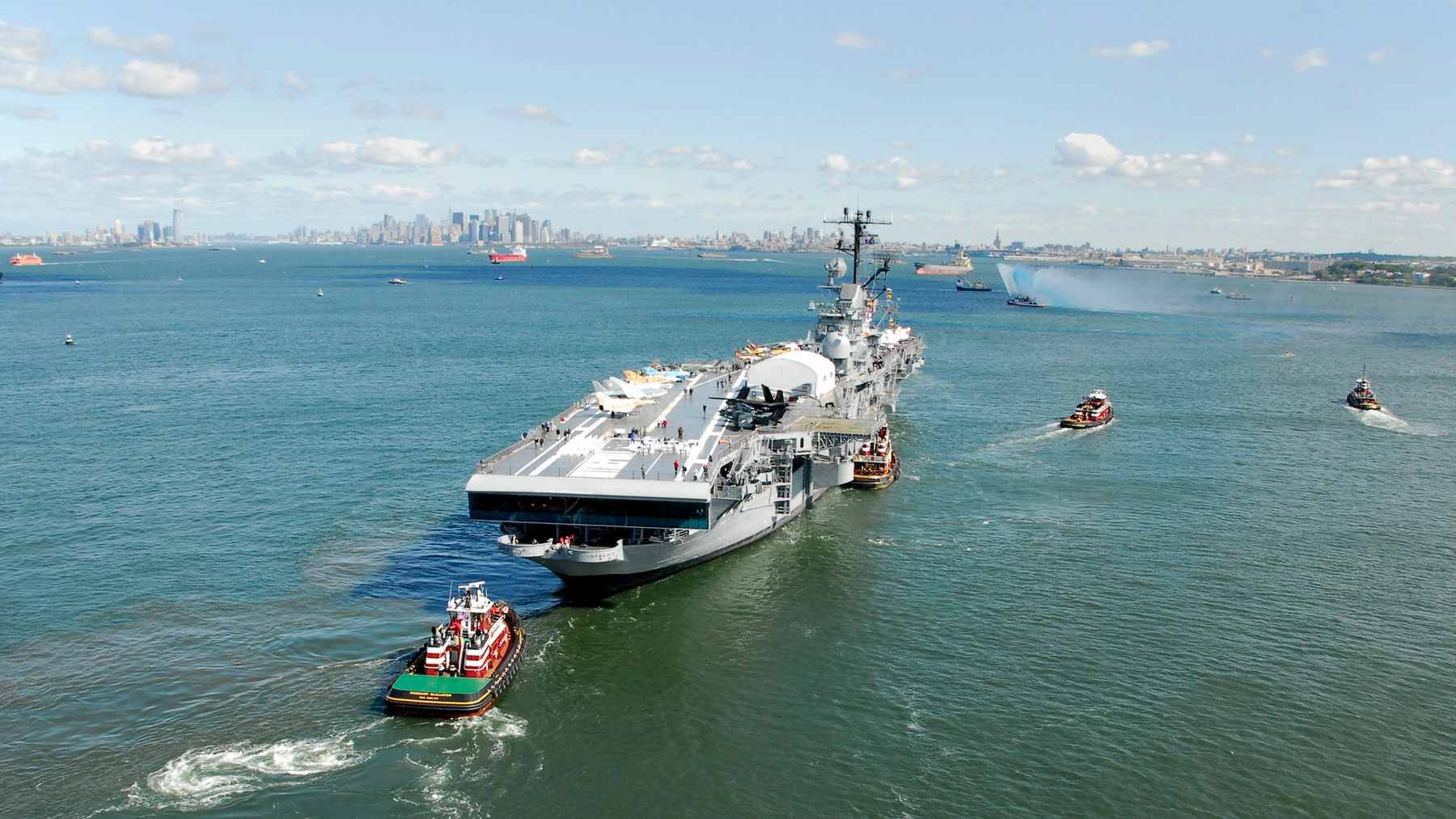
The ship was the USS Intrepid, the World War II carrier that opened as the Intrepid Sea, Air & Space Museum at Pier 86 on Manhattan’s West Side in August 1982. She displaces 27,100 tons at standard load. Those are long tons, the Navy’s 2,240-pound version, so you’re looking at roughly 60.7 million pounds of steel that hadn’t gone anywhere in 24 years.
So what happened on November 6?
The plan was pretty simple on paper. Tow the Intrepid about five miles down the Hudson to a dry dock in Bayonne, N.J., for an overhaul that the Associated Press put at $60 million at the time. About 15,000 cubic yards of river bottom had already been dredged out to give her a clear run to deeper water, and 600 tons of water came out of her ballast tanks so she’d sit a little higher.
Then six tugboats leaned on her with a combined 30,000 horsepower, according to the AP’s report from that day. The carrier backed out roughly 15 feet. And that was it.
“We were able to move her 15 feet, and then she came to a halt,” Jeffrey McAllister, the chief pilot running the tug operation, told the AP. Another tug was brought in and couldn’t free her either. Bill White, the museum’s president, called it a very disappointing day, which I’d argue is a pretty restrained way to describe watching your 872-foot ship lose a fight to river bottom.
It’s also a bit humbling for a ship that, per that AP story, survived seven bomb attacks, five kamikaze strikes and a torpedo hit in the Pacific.
Why would a ship with no engines get stuck by its propellers?
The Intrepid didn’t have working engines anymore, but she still had her four propellers. A writeup in the Army Corps of Engineers’ magazine puts each one at 16 feet across, while the AP said about 15.
A quick bit of ship anatomy helps here. On a big ship, the propellers hang below the back end of the hull, so they’re usually the deepest thing back there. If the riverbed rises up to meet them, they hit first and basically turn into anchors.
That’s what had happened. The Hudson carries a steady load of fine silt, and the calm water around a pier is exactly where it settles. Park a ship in one spot for 24 years and the bottom pretty much grows up toward her. The Army engineers describe a 17-foot mound of mud sitting under the stern, and as the Intrepid slid backward, her propellers dug straight into it.
I can’t tell you exactly how many tugs were on the lines that morning, either. The AP and Professional Mariner both say six with 30,000 horsepower, but the Army Corps writeup counts seven. Either way, it wasn’t enough.
So how do you unstick an aircraft carrier?
You call the Army, apparently. The Corps of Engineers’ New York District responded within two hours, according to its own account, and suggested getting Navy salvage people involved. A Navy salvage contractor team showed up the next day.
What followed was about three weeks of digging. Professional Mariner reported that the Navy pulled out another 39,000 cubic yards, at a cost of $3 million, and the Army engineers say the muck went away in 53 New York City Department of Sanitation barges. So the city’s garbage fleet ended up hauling away the thing that beat 30,000 horsepower. That $3 million is also arguably the priciest bill anyone’s ever paid for overstaying a parking spot in Manhattan, which is saying something.
The second try almost went the same way
On December 5, the tugs went back to work. And for a while it looked like a rerun. Twenty minutes in, she’d moved the same 15 feet or so and come to a stop again, according to Professional Mariner.
What got her moving was one tug changing jobs. The 4,000-horsepower Robert E. McAllister had been standing by to push on the port quarter. The chief docking pilot moved it into a pulling position instead, and it ran out 300 feet of line off its bow winch. Brian Fournier, the assistant pilot, told the trade magazine that turning the Robert from a pusher into a parallel puller is what finally broke her loose. It’s frankly a nice reminder that in towing, the angle you pull from can matter as much as how hard you pull.
The AP’s account of the second attempt has former crew members aboard yelling at the ship to move. One of them, 84-year-old Joe Cobert, joked that the old crew had pushed her out themselves. I’m not going to fact-check that one.
If you read about the battleship that tugboats pushed four feet off her Norfolk pier, this is basically the same act, except the first time around the mud won. Tugs are usually pretty good at moving museum ships, and they’ve hauled a World War II submarine back across Lake Michigan overnight. They just can’t argue with 24 years of silt.
Where did the Intrepid go after that?
She went to Bayonne for repairs and then to Staten Island for renovation. The $60 million figure didn’t survive the trip, either. The total later came to $120 million, with $55 million going to the ship and $65 million to a rebuilt Pier 86.
Tugs brought the Intrepid back to her spot on the Hudson on October 2, 2008, and the museum reopened to the public on November 8.
Credit: U.S. Coast Guard
 A 97,000-ton nuclear aircraft carrier has now spent 2,022 days at the Virginia shipyard that built her, getting a new mast and work on over 600 tanks, and Navy documents point to one more year of it, with her sister ship already there for a five-year overhaulMilitary · 2 days ago
 A 9,700-pound cache of primer explosive in 68 barrels that have sat more than 20 years at an Iowa ammunition plant, now too degraded to move after their water bath partly evaporated, has until Monday to be blown up in place before a forecast cold snap makes the material worseMilitary · 3 minutes ago
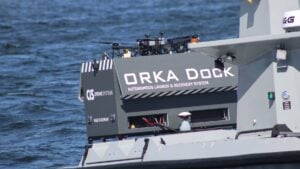 A German box that opens in under 30 seconds, throws a drone into the air and catches it again on a deck moving at 15 knots just passed its acceptance tests at sea and was handed to a navy that will run it from a crewless boat, watching over the cables and pipelines on the seabedMilitary · 2 hours ago