
Atom Ant was a Hanna-Barbera cartoon about a tiny ant with superhero strength. In Spanish he went by La Hormiga Atómica, and Spanish sailors apparently hung the same name on a class of small warships that carried a lot more firepower than you’d expect from something their size. I can’t prove that’s where the nickname came from, but I’d put money on it.
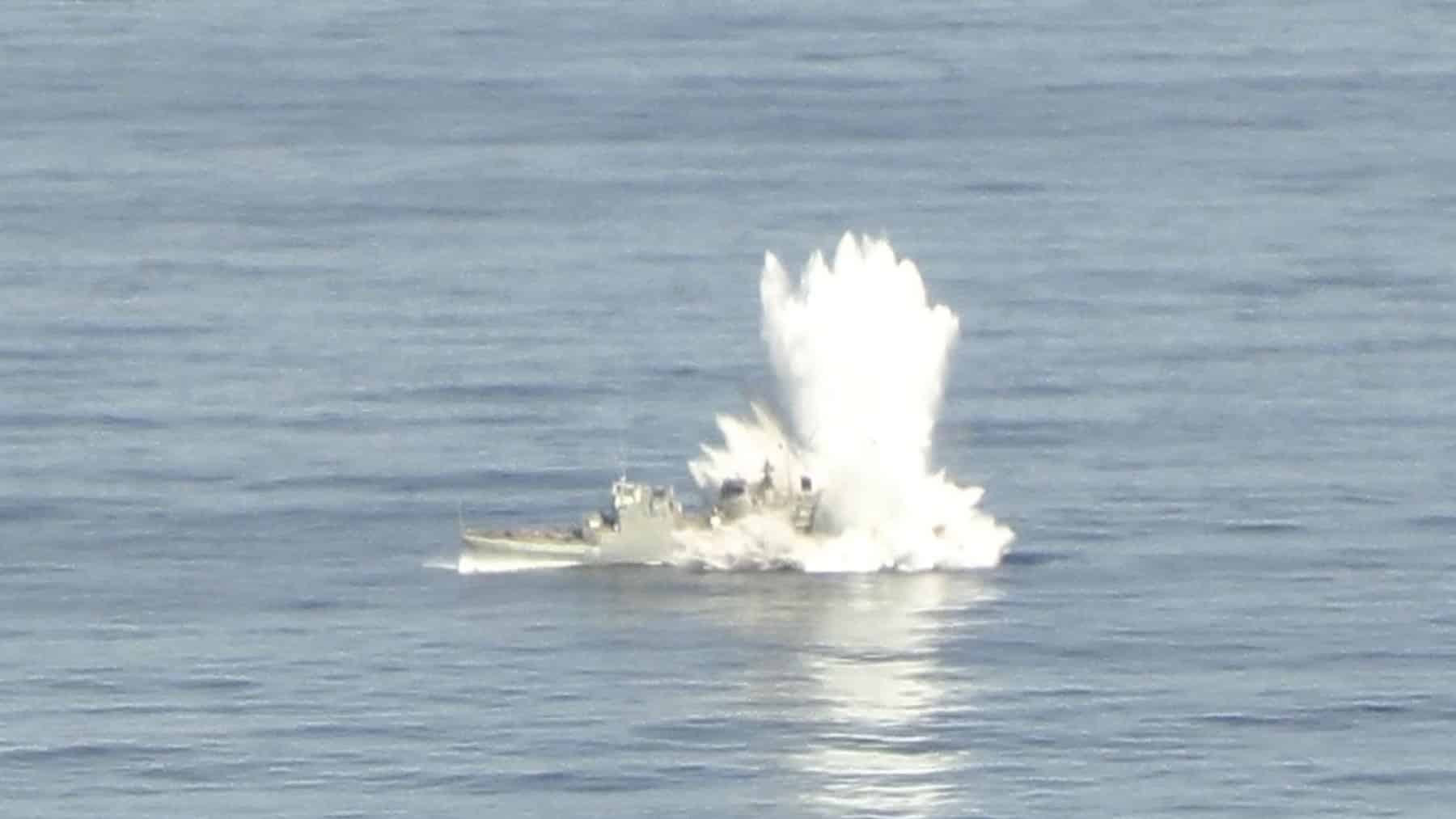
One of those ships, the Infanta Elena, just spent her last day as a target. The S-81 Isaac Peral, the first of Spain’s new S-80 submarines, put a single torpedo into her in the Atlantic near the Canary Islands, and she went to the bottom. The Spanish Navy announced it on November 4 as part of a live-fire exercise called SINKEX 26.
So why would a navy torpedo its own ship?
Because simulators can only tell you so much. SINKEX is navy shorthand for a sinking exercise. You take a retired hull, clean it out, tow it offshore and let your crews fire real weapons at it, and you find out what those weapons do to real steel and whether your people can pull it off.
Spain’s far from alone here. US and British forces sank the 4,100-ton frigate Klakring off Scotland in September, and a 4,800-pound drone boat blew a hole in a retired warship off Hawaii not long ago.
The Infanta Elena had a long career first
She went into service when Jimmy Carter was still president, as a corvette (basically a small frigate). About two dozen years later, the Navy converted her into an offshore patrol ship and took a lot of her weapons off. By the time she retired, she’d logged more than 730,000 miles and 4,200 days at sea, according to the Canary Islands broadcaster RTVC. That’s a navy count, so I’d assume nautical miles, which works out to more than one and a half round trips to the moon.
She was about 291 feet long. Her weight’s a little trickier, because a warship’s weight is really its displacement, meaning how much water the hull pushes out of the way, and there’s more than one way to count it. Spanish press figures for the class after that conversion work out to about 1,359 tons standard and 1,836 fully loaded.
I’m going with the lighter number, since standard displacement leaves out fuel and she didn’t have any left. I couldn’t get the Navy’s own spec page to load, so treat those figures as close rather than gospel.
The Navy retired her more than three and a half years ago, after almost 43 years of service, and she sat at a pier in the Cartagena naval base from then on, according to the blog Defense and Aviation. Vozpopuli reports that the multipurpose ship Carnota hauled her out to the Canaries.
Exactly where she ended up is a little fuzzy. The Navy’s release just says the Atlantic. Infodefensa says south of the Canaries, while Defensa.com says west of El Hierro, the westernmost island in the chain. Defensa.com also gives a date for the shot, Monday, November 2, which the release doesn’t. I haven’t seen anyone publish how deep the water is.
Why pull the fuel out of a ship you’re about to sink?
Because otherwise you’ve built yourself a very slow oil spill. The Navy says every bit of fuel and oil came out before the exercise, along with anything else likely to pollute. I’d have liked to see a number on how much that was, but the release doesn’t give one.
If you want to see the alternative, look at Pearl Harbor. The USS Arizona still leaks an estimated gallon or two of fuel oil a day, with about 600,000 gallons left inside her, and she’s been down there for almost 85 years.
The Navy also says it studied the hydrography and environment of the area first, which basically means it looked at the seabed and what lives around it. Then it ran a lookout protocol for whales, dolphins and other protected animals while the shooting was on. I’d guess some of that’s there to reassure people in the Canaries, where tourism is a big deal, but it’s pretty much the price of doing this anywhere these days.
So what did one torpedo do to her?
The Navy’s text doesn’t get into the damage, so most of what we know comes from its video. Defense and Aviation went through that footage and says the torpedo hit on the port side, close to the stern, then buckled the hull and took her down back end first. Euro Weekly News also puts the hit at the stern.
The same blog points out that her hull number was still readable as she listed to port, and that her bridge windows looked intact. So one explosion wrecked the back of a 291-foot ship and left the glass up front alone. I find that pretty wild.
The Navy doesn’t name the weapon, but Infodefensa and Defensa.com both say it was a DM2A4, a German heavyweight torpedo also sold as the SeaHake. Published specs for the export version, from Naval News and Janes, look like this:
It’s also wire-guided. The torpedo unspools a thin fiber-optic line behind it as it runs, so the crew can keep talking to it and steer it after it’s left the tube. If you’ve seen those fiber-optic FPV drones from Ukraine, it’s the same basic trick, just underwater and a whole lot bigger.
You may be wondering how one torpedo can do that to a steel ship. This one can go off on contact or when it senses a hull close by. A blast under a ship is especially nasty, because the gas bubble shoves the hull up and then lets it drop, and ships aren’t built to bend that way. I don’t know which happened here, though the descriptions I’ve seen point to a hit on the side.
I also wouldn’t read too much into the one-torpedo part. The Infanta Elena had no crew to close doors or run pumps, she wasn’t shooting back and, as far as I can tell, she wasn’t going anywhere. The Klakring took three missiles, bombs and a Mark 48 torpedo, but she weighed about 4,100 tons to the Infanta Elena’s 1,359, and the whole point of that exercise was to record each hit one at a time.
The S-81 has had a rough road
For Spain, this was arguably more about the shooter than the target. The Isaac Peral entered service more than 10 years behind schedule, according to Shephard, and she’s been billed as the first submarine Spain designed and built entirely on its own. She also isn’t nuclear, which makes her different from everything in the US submarine fleet. She’s diesel-electric, so she basically runs on batteries underwater and needs diesel generators to recharge them. As we’ve covered before, the class is getting a fuel cell that makes hydrogen from bioethanol to stretch her time under, but the Isaac Peral won’t get hers until a later overhaul.
The Navy says this exercise shows she’s ready to do her part for Spain and its allies, then gets a little poetic and says her real deterrent value lies in “the silent certainty of its presence.” That’s a nicer line than you usually get out of a defense ministry.
She isn’t new to firing torpedoes, either. Estrella Digital reports that she’d already launched some last year. Still, I’d say putting a real ship on the bottom on video carries a bit more weight than any of that. Her sister, the S-82 Narciso Monturiol, sailed alongside her for the first time in August, so the class is finally starting to look like a class.
The Spanish Navy brought plenty of company
The Isaac Peral didn’t have the ocean to herself. The Navy lists the frigates Cristóbal Colón and Navarra, the Carnota, the patrol ship Relámpago, a mine-clearance diving unit, a helicopter, a Scan Eagle drone, an Air Force patrol plane and three Harrier jump jets, the same basic type the US Marines have flown for decades. Captain Rafael Mira Calvo ran the show from the Navarra, a Spanish-built descendant of the American Perry-class frigate, which is the same family the Klakring came from.
Those Harriers leave me with a question I can’t fully answer. Defense and Aviation spotted GBU-12 laser-guided bombs hanging off them in the video, yet the same blog looks at the hull and figures the torpedo did all the work. So what were the bombs for? The release doesn’t get into it, and it’s entirely possible they were dropped somewhere else on the range or never dropped at all.
The Spanish Navy put out a second video on November 5, filmed aboard the Isaac Peral, so that’s the one to look up if you want to see all this from the submarine’s side.