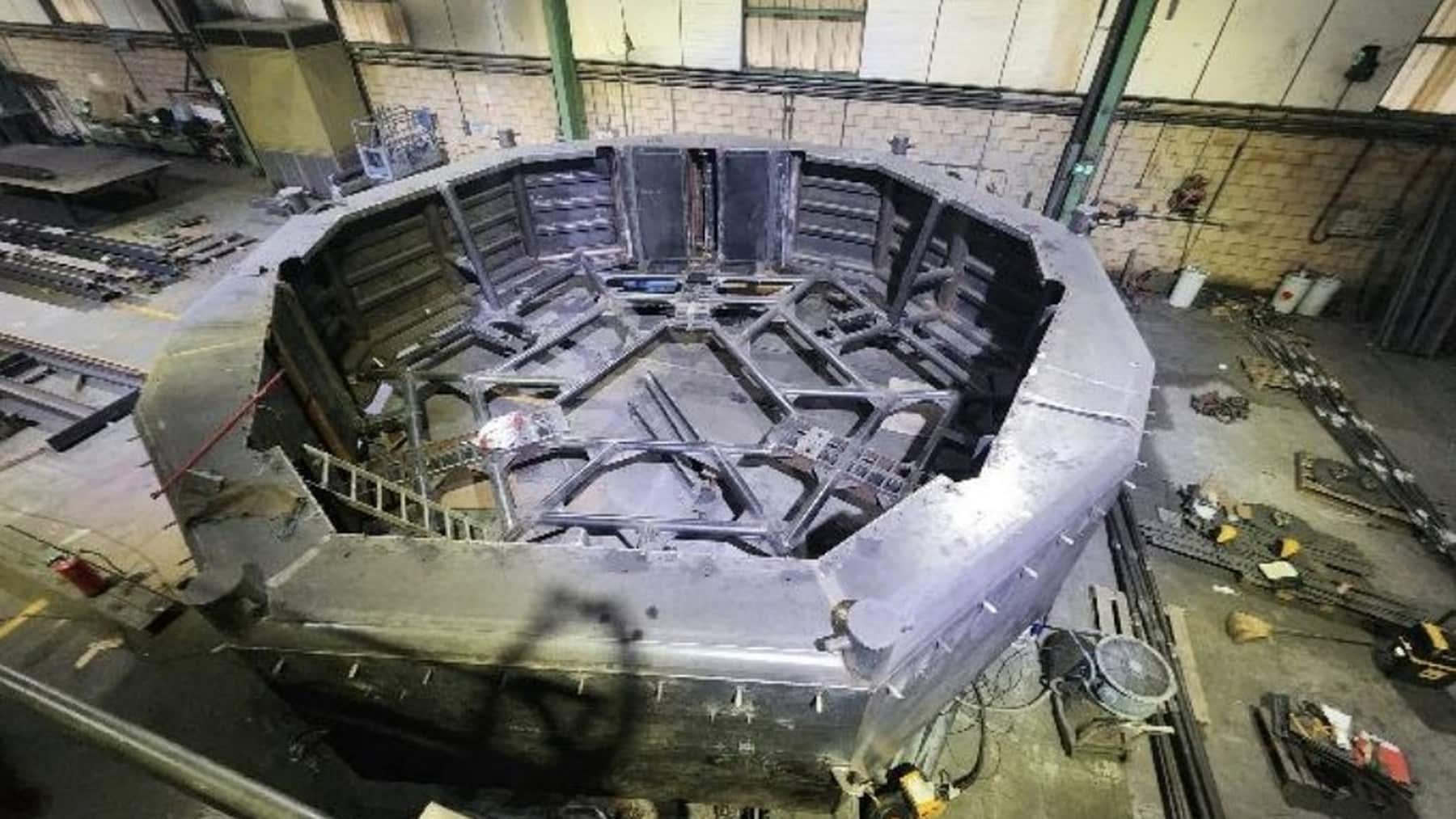

- 2 MONTHS AGO · ENERGYWhile the only new reactors finished in the United States in three decades are AP1000s, the Chinese copy of that design got its 1,100-ton steel dome craned on 33 months after the construction license, with everything underneath it still to install
- 4 WEEKS AGO · ENERGYA 459-foot wind turbine standing on a dike on the German North Sea coast caught fire 276 feet up at half past ten at night, and 60 firefighters drove out to it and stood on the ground watching it burn, because the tallest ladder they own reaches a little past 100 feet
- 3 WEEKS AGO · ENERGYA 75-year-old nuclear lab in South Carolina caught fire in one room and put a 310-square-mile federal site under emergency for more than four hours, with trains, barges and planes held off the area, and the Energy Department said the next day that nothing radioactive got out
- 2 WEEKS AGO · ENERGYA 100-foot earthen dam holding back a nearly 4,000-acre Michigan lake is one of 13 hydro plants up to 120 years old headed for a private buyer, and if state regulators kill the sale, the utility that owns them could tear them out and let the lakes drain
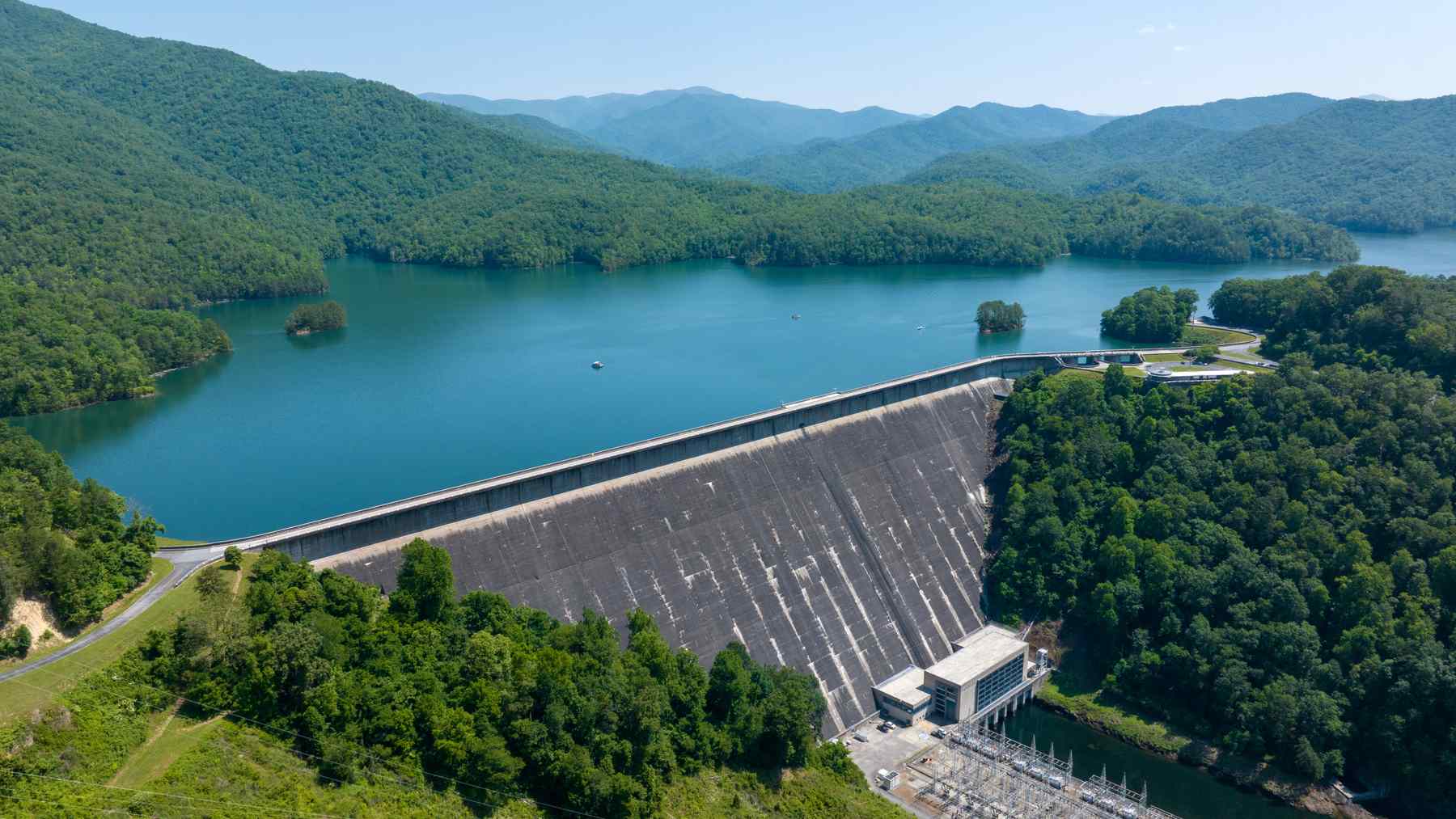
- TODAY · THIS ARTICLEA 480-foot concrete dam in North Carolina, the tallest in the eastern United States, has been swelling for decades, enough to crack itself where it curves, so about every five years the federal utility that owns it saws a slot through it with diamond wire to give it room
If you’ve ever walked down a sidewalk, you’ve stepped over the fix for one of concrete’s oldest habits. Those grooves every few feet are there because concrete shrinks as it dries, and it’s going to crack somewhere. Builders just pick the spot for it.
Fontana Dam has the opposite problem. The Tennessee Valley Authority calls it the highest dam east of the Rocky Mountains, and it’s been getting bigger for most of its life. So every four or five years, TVA gives it a groove of its own. This one goes all the way through the dam, and it’s cut with a loop of diamond wire.
Fontana is a pretty serious pile of concrete
Fontana sits on the Little Tennessee River in western North Carolina, and its lake runs along the edge of Great Smoky Mountains National Park. It’s a concrete gravity dam, which basically means it holds back its lake with nothing but its own weight. And there’s a lot of weight. TVA puts it at 480 feet tall and 2,365 feet across the river, and the agency’s original project report says it took just over 2.8 million cubic yards of concrete.
It went up fast, too. Work started in 1942 and the gates closed in November 1944, with the power apparently headed for the wartime aluminum plants in Alcoa, Tennessee. These days its three generators have a summer net dependable capacity of 304 megawatts. That’s what TVA can count on them delivering on a hot day. The Appalachian Trail runs right across the top.
So why is a dam growing?
Fontana’s concrete started acting up early. A Cornell University teaching module built around the dam says patterned cracking showed up in 1949, only a few years after it was finished. Then in 1972, inspectors found cracks in the drainage gallery, a tunnel that runs inside the dam near its foundation, right where the dam curves.
TVA’s first suspect was the sun. That’s a reasonable guess, since concrete swells a little in summer and shrinks back in winter. But the instruments showed something else riding on top of that seasonal swing: slow, steady growth that never went back. The movement was even making the spillway gates bind, according to Practical Engineering, the YouTube channel that spent time with TVA’s engineers for a video it posted in December 2025. I’d guess that got TVA’s attention pretty quickly.
Core samples settled it. Fontana has alkali-silica reaction, the same chemistry we covered in New Brunswick’s Mactaquac dam. Cement makes the water inside concrete very alkaline, and some rock used as aggregate carries silica that dissolves in that water and turns into a gel. The gel soaks up moisture and swells, and since it’s locked inside the concrete, the whole structure slowly pushes outward.
You need three things for it to happen: reactive rock, cement with plenty of alkali and a steady supply of water. A dam is never short on that last one.
Growing concrete would be less of a headache if it had somewhere to go. But Fontana is wedged between rock on each side of the valley, and rock doesn’t give. Cornell’s module says the analysis ruled out the foundation and found the rest of the dam expanding and shoving on the curved section.
Think of a shelf between two walls with one too many books jammed onto it. The books can’t push the walls apart. They bow in the middle.
So what did TVA do about it?
At first, it hosed the dam down. Crews sprayed cold water on the downstream face to cool the concrete, and the crack actually got narrower, which is a pretty low-tech fix for a 480-foot dam. TVA also post-tensioned the cracked area, stretching steel tendons across it and anchoring them on both sides so they’d pull the crack shut. It’s roughly the same idea as the 38 anchors Grant County PUD is drilling into the Priest Rapids Dam spillway on the Columbia River.
Then TVA sawed through it
Cold water and steel tendons buy you time, but they don’t stop chemistry. So in 1976, TVA sawed a relief slot clean through the dam, giving the concrete a gap to expand into. By 1983, according to Cornell, the slot had almost closed, and TVA recut it that same year. Frankly, seven years isn’t much breathing room.
The tool doesn’t look anything like a saw blade. Kristen Smith, TVA’s senior program manager for dam safety, compared it to a big necklace when she talked to Practical Engineering. “It is diamond wire, and it’s really neat,” she told the channel.
Here’s how it works. The wire is a little over half an inch thick and runs in a loop over pulleys mounted on the dam. A saw drags it around and keeps it pulled tight against the bottom of the cut, so the slot creeps downward as the diamonds grind through. On the lake side, crews seal a steel cofferdam against the face of the dam, a shell shaped like a pipe split lengthwise, so the reservoir stays put and the plant keeps making power.
Why not cut a wider gap and come back less often? Smith’s answer was pretty much common sense: TVA doesn’t want to leave a big hole in a dam. So the slots stay thin, and they’re recut instead.
TVA keeps coming back to Fontana
TVA’s River Neighbors newsletter covered the 2011 round that November. Crews cut two slots, one on each side of the spillway bays, and each was 5/8 inch wide. The first one ran 93 feet and took a week of around-the-clock sawing. The engineer leading the job described it as maintenance, done well before the growth could become a dam safety or spillway problem, and said Fontana would need it again. It did.
Wikipedia puts the most recent cuts in 2016, done by contractor Bluegrass Companies. I couldn’t find a public record of a Fontana cut after that, and TVA doesn’t seem to publish a yearly growth figure for the dam. So I can’t tell you how much Fontana gains in a year, only that it hasn’t stopped.
Fontana isn’t TVA’s only growing dam
TVA has two more dams with the same reaction, Hiwassee in North Carolina and Chickamauga in Chattanooga, according to the Chattanooga Times Free Press. Chickamauga probably gets the most attention since it sits right in the city. Its slot is about 5/8 inch wide, and TVA has cut it three times, in 1997, in 2008 and in a job that was set to wrap up in early 2021.
Chickamauga is a lot shorter, though, and the paper says it only needs a fresh cut every six to 12 years. Hiwassee got two vertical slots, each about as wide as the wire that cut them.
So when does the wire go back on Fontana? These days a computer helps make that call. Kristen Smith told Practical Engineering in December 2025 that TVA updates the finite element models for its concrete growth projects about every five years. Those models split a dam into thousands of small pieces, work out the stress on each one, and tell TVA when it’s time to recut.
Credit: VisitNC
 A 1,118-megawatt reactor on the California coast was once shut down by hand at 10:27 at night because salps, jellyfish-like animals 2 to 3 inches long, were packing its seawater screens, and with its twin down for refueling the whole 2,256-megawatt plant sat idle for more than two daysEnergy · 3 hours ago
 Two Virginia reactors of 903 and 972 megawatts once shut themselves down at 1:51 in the afternoon when a 5.8 earthquake struck 11 miles away, and out on the storage pad 25 of 27 spent-fuel casks, each 16 feet tall and 115 tons, slid as much as 4.5 inches across the concreteEnergy · 8 hours ago
 A 1,930-ton German boring machine was once 16 feet under one of Europe’s busiest freight railroads when the tracks above her sank 1.6 feet, so about 525 feet of tunnel was pumped full of concrete with her still inside and the main line stayed shut for 51 daysEnergy · 9 hours ago