
The wrecking ball is what most people still picture when they hear the word demolition. Steel sphere, long cable, building folds in on itself, cue the dust cloud.
The demolition industry mostly moved past it decades ago. Hydraulic shears and crushers bolted to an excavator arm do the same job with more control, less noise and far less chance of the ball ending up somewhere nobody wanted it.
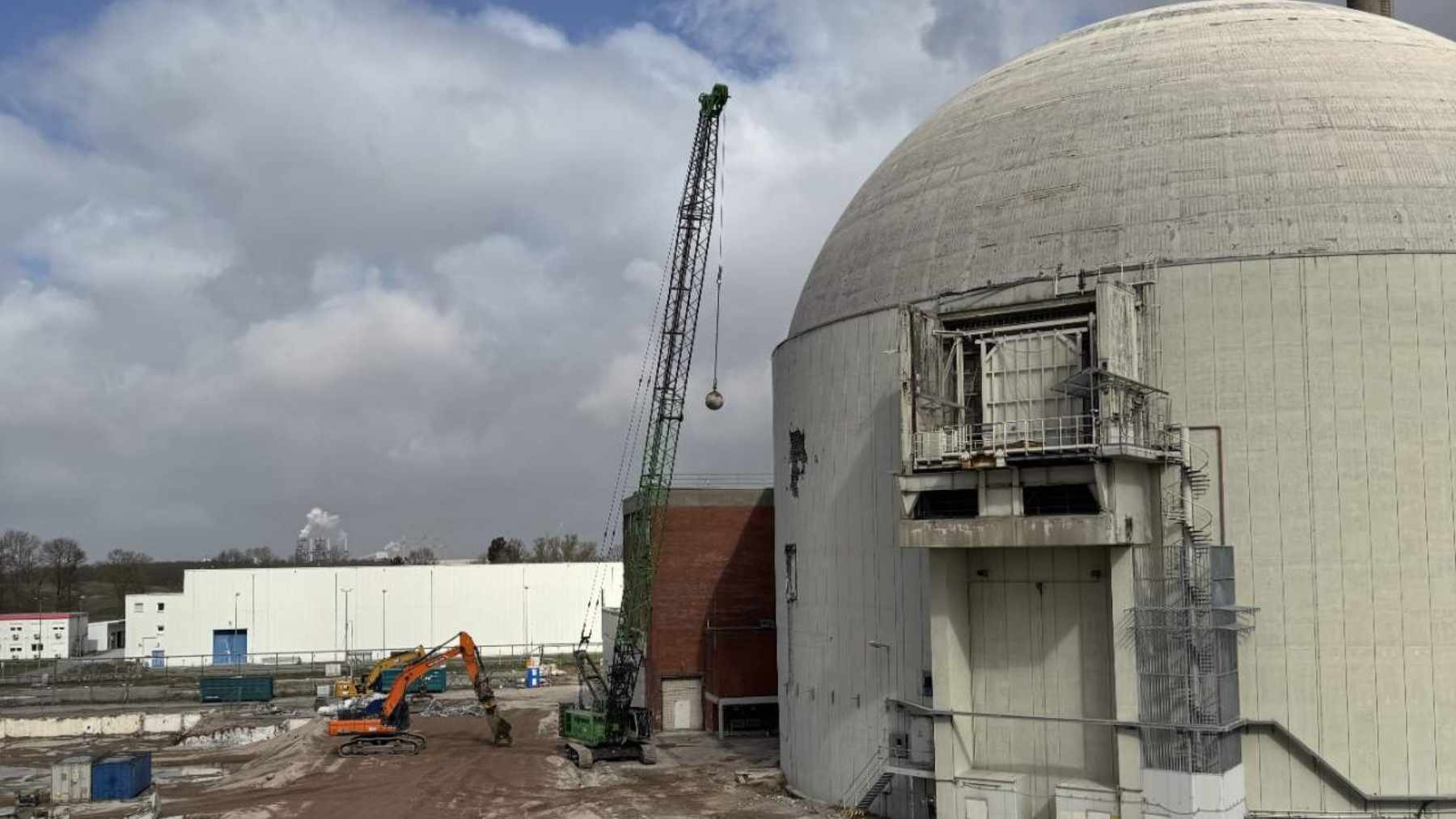
Which makes the reactor building at the old Stade nuclear plant, on the Elbe west of Hamburg, an odd sight right now. Crews have been swinging a four-metric-ton steel ball at it since March 31, and it is not for the cameras.
World Nuclear News published a fresh set of site photos on July 23 showing how far the work has gotten. The building is supposed to be gone by the end of this year, and the site itself comes off Germany’s nuclear register in the fall of 2027.
The ball is not there to knock the building down
The sequence matters more than the spectacle. According to operator PreussenElektra, the ball’s only job was to weaken a concrete shell roughly 80 centimeters thick, about 31 inches, before the real cutting began.
Once the shell was cracked, crews finished off the auxiliary buildings and came back to the reactor building at the start of June. The heavy lifting since then has fallen to a 16-metric-ton hydraulic shear and a 180-metric-ton cable excavator.
Heavy reinforcement is the reason for the two-step approach. A shear will bite through rebar all day, but it struggles to get a purchase on a thick, densely reinforced wall that offers nothing to grab.
The ball fractures the concrete, exposes the steel inside, and hands the shear something it can actually close its jaws on. Old tool, specific job.
Stade has run this play before. In its October 2024 site report, the Deutscher Abbruchverband, Germany’s demolition trade association, noted that the turbine hall could only come down with a cable excavator and a ball, specifically because its load-bearing structure was too heavily reinforced for anything else.
Everything else on site runs on hydraulics. The same report counted 15 to 20 excavators working the plant at operating weights between 30 and 110 metric tons, with long-front machines and concrete shears taking the taller structures.
Germany is not short of oversized digging equipment either. The country also built the heaviest machine ever to move under its own power, a 14,196-metric-ton bucket-wheel excavator working a lignite mine west of Cologne. The Stade machine is a rounding error next to it, and it is doing considerably more delicate work.
The building had to stop being radioactive first
None of this would be permitted if the structure were still hot. The most contaminated hardware, including the reactor pressure vessel itself, came out between 2008 and 2011.
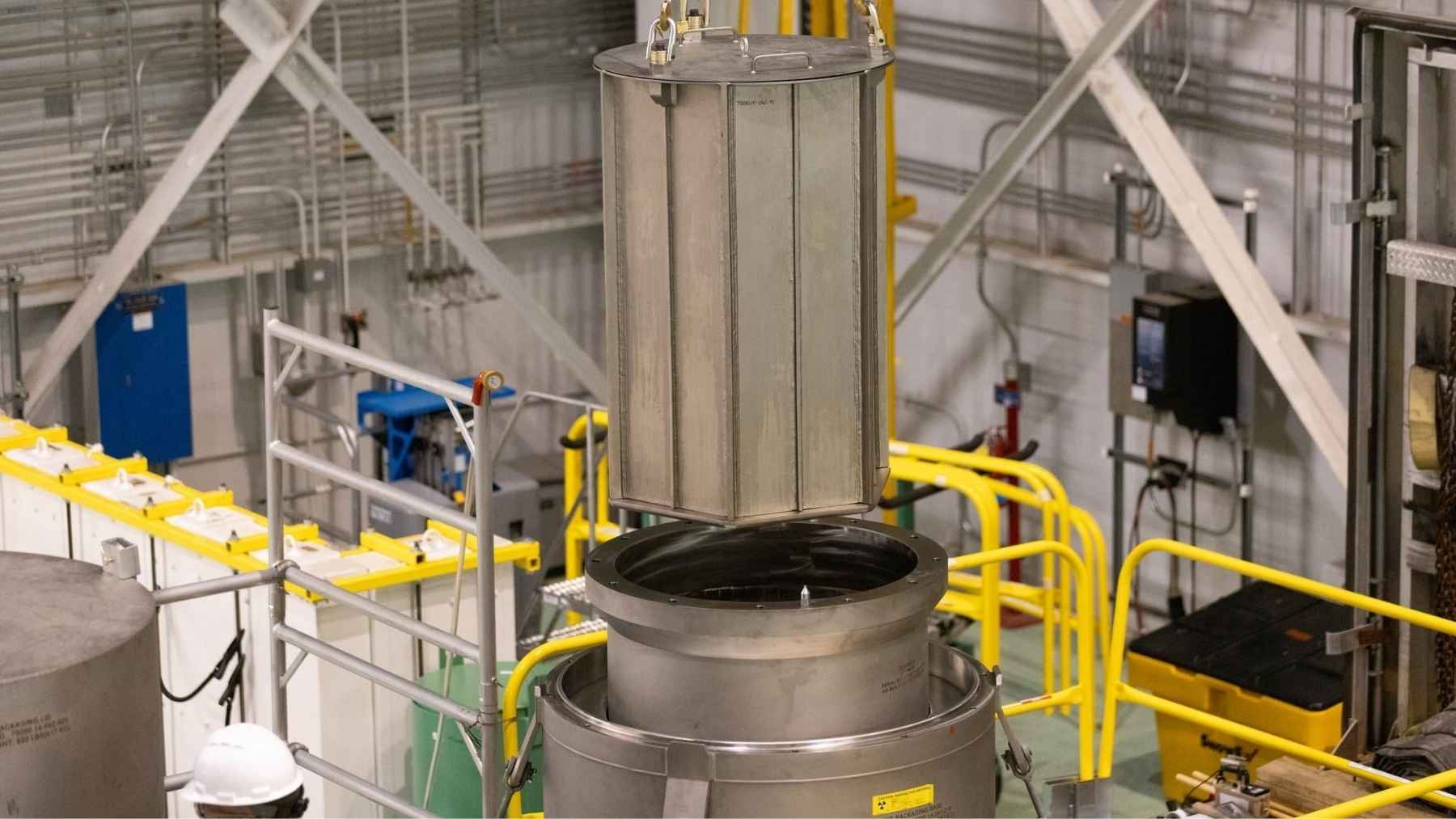
Then came the part that ran long. Inside the reactor building sat a cylindrical concrete missile shield weighing more than 20,000 metric tons, with walls up to eight feet thick, and it could not simply be pushed over.
PreussenElektra’s answer was to saw it. The structure was cut into roughly 1,500 segments averaging about 14 metric tons each, with every segment measured for contamination before it went anywhere. That work started in 2018 and pushed the overall schedule back by about two years.
The steel containment vessel underneath was cleared separately, and that mattered more than the concrete. Local paper Kreiszeitung Wochenblatt reported in April that thousands of square meters of surface were checked over several years before the containment could be classified as no longer radioactively contaminated.
That release is what turns the steel from nuclear waste into scrap metal, and it is the reason a demolition contractor is allowed anywhere near the building with a ball on a rope.
Twenty-two years from shutdown to a ball on a rope
Stade was the first German plant switched off after the country’s phase-out agreement. The pressurized water reactor, rated at 630 megawatts net, entered commercial service in May 1972 and shut down on November 14, 2003, with the operator citing economics rather than safety.
Over 31 years it generated 152,460,660 megawatt-hours gross, a figure PreussenElektra still lists to the last megawatt-hour in its own plant fact sheet.
The license to begin taking it apart arrived on September 7, 2005, and dismantling started that October. Lower Saxony’s environment ministry splits the job into five phases, the first four under nuclear law and the last one ordinary construction work, which is where the site sits now.
That conventional stage covers 17 building complexes and roughly 199,745 cubic meters of enclosed volume, about 7 million cubic feet, per the demolition association’s numbers. The turbine hall alone accounted for around 3.7 million of that, standing 110 feet tall.
Plant manager Marco Albers said in March that with demolition of the reactor building under way, “we have reached the final technical milestone” the team had been working toward. He credited the regulator’s approval and the contractor, demolition firm Freimuth.
Finishing the job will make Stade the first commercially operated pressurized water reactor in Germany taken all the way down, according to World Nuclear News. Germany has cleared other reactors to bare ground, including the prototypes at Niederaichbach and Grosswelzheim, the experimental unit at Kahl and the Würgassen boiling water plant. None of them was a commercial PWR.
America is pulling its domes down with excavators instead
The United States is working the same problem at larger scale and reached for different tools.
At San Onofre in California, the two containment domes every driver on Interstate 5 knows are coming down without explosives and without a ball. Ron Pontes, the plant’s general manager for site closure and environmental oversight, told KPBS in December that crews will work large excavators around the outside and let the structure’s own weight bring it down, an approach he said keeps residual contamination under control better than an implosion would.
The plant’s own decommissioning update puts the Unit 3 dome first in line, starting in the first quarter of 2027. The Unit 2 reactor vessel, roughly 40 feet long and 750,000 pounds, is still being cut into shippable pieces.
The global picture is genuinely split on this. In July a crew in Guangdong lowered a 950-metric-ton steel room into a reactor building under construction, the structural box that carries the reactor vessel and steam generators. Germany spent the same summer knocking one of those buildings apart.
America is attempting a third option. Holtec International wants to restart the 800-megawatt Palisades plant on Lake Michigan, a reactor already handed over for decommissioning back in 2022. World Nuclear News reported on July 3 that the company had closed out the last of its major restart projects and moved into testing and inspection, though it has still not named a restart date.
Stade’s reactor building is scheduled to be rubble by December. After the outer shell goes, crews still have to dismantle the steel containment underneath and flatten the auxiliary building, and only then does the site start the paperwork that gets it off the nuclear register in the fall of 2027.
Twenty-two years after the reactor stopped making electricity, the last piece of specialist equipment on the job is a lump of steel on a wire rope. It is not the elegant answer. It is the one that works on 31 inches of reinforced concrete.
 @paulharrow ROOKIE2 months ago