
Every machine big enough to matter eventually needs a part swapped, and the bigger the machine, the worse that job gets. A car transmission is a bad Saturday. A furnace heat exchanger is a bad week. Now picture the part standing 74 feet tall, weighing something north of 400 tons, sealed inside a steel containment vessel, and radioactive enough that you spend a decade planning the swap before anybody picks up a wrench.
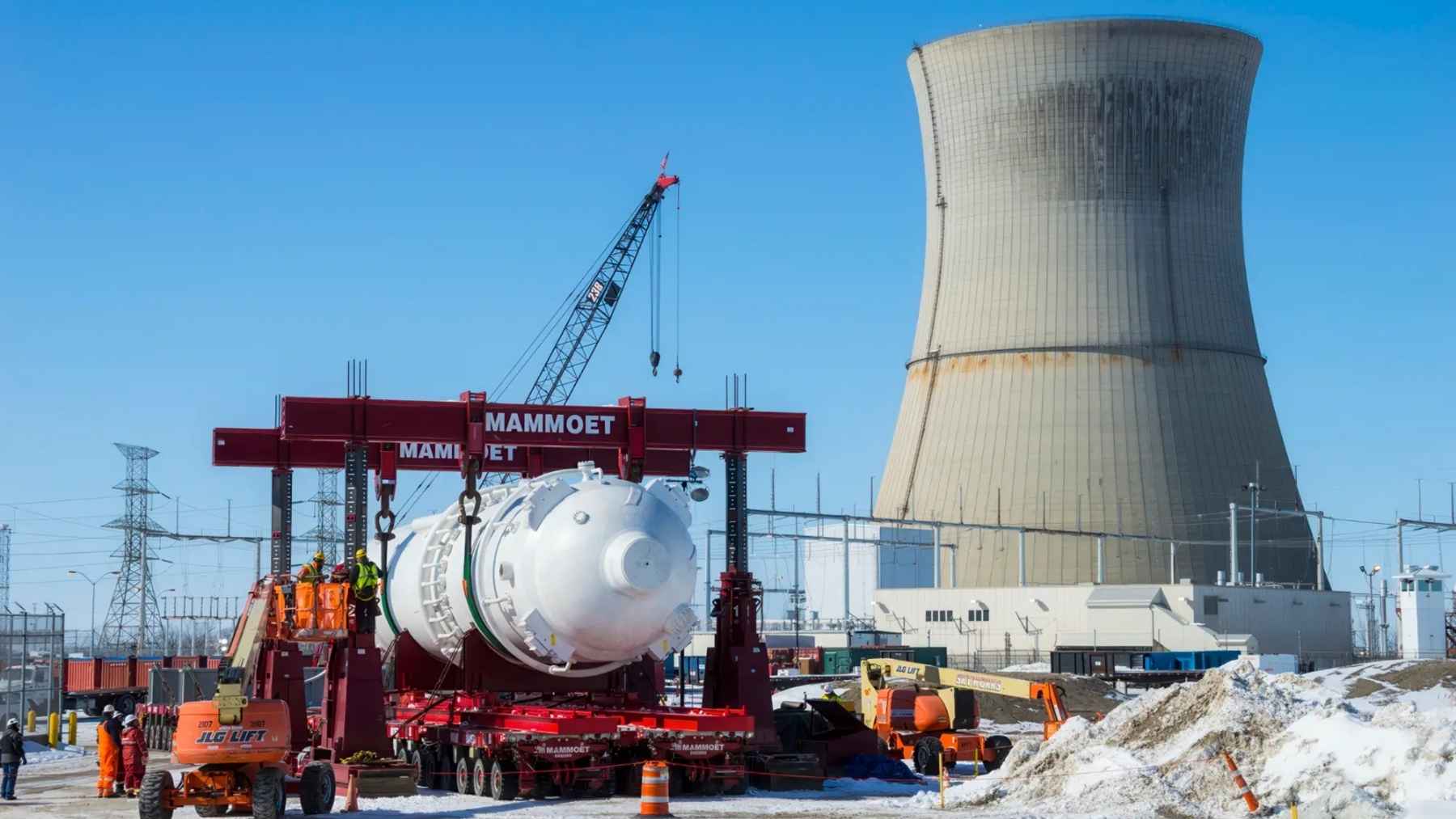
That’s basically what happened at the Davis-Besse Nuclear Power Station, on the Lake Erie shore about 21 miles east of Toledo, Ohio. The plant went offline on February 1, 2014. Crews pulled out both of its steam generators, dropped two new ones in, and the reactor started making electricity again at 12:20 p.m. on May 8. FirstEnergy, which owned the plant back then, said each component measured 74 feet long and 12 feet across and weighed 470 tons. More than 2,300 temporary contractors and borrowed staff from other plants showed up to help.
The whole outage ran $600 million. For two heat exchangers.
So what does a steam generator actually do?
It keeps two batches of water apart while letting heat cross between them. That sounds like a footnote and it’s actually the entire safety argument for the design.
Water in the first loop goes through the reactor core, gets extremely hot, and picks up radioactivity along the way. You do not want that water anywhere near the turbine hall, where people walk around. So it gets pumped into the top of the steam generator, runs down the inside of a bundle of thin metal tubes, and comes back out the bottom on its way to the core again. Meanwhile a completely separate batch of water sits on the outside of those same tubes, soaks up the heat coming through the tube walls, and boils. That second batch is the steam that spins the turbine, and it never touches the first one. The tube wall is the only thing doing the separating, which is why the tubes get inspected obsessively and why a cracked one is a genuinely bad day.
Davis-Besse uses a slightly unusual version. Most American pressurized water reactors use generators with U-shaped tubes and a recirculating water level, but this plant was built by Babcock & Wilcox, and B&W did it differently. FirstEnergy’s own filings with regulators describe the units as “vertical, straight-tube-and-shell heat exchangers”. Water makes one pass, top to bottom, and the steam comes out the other side already superheated. No recirculating, no steam dryers up top. That one-pass design is why the things are 74 feet of skinny vertical cylinder instead of the squat pear shape you’d see at most other plants.
The tubes were the reason for all of it
The original pair went in during the 1970s and their tubes were made of Alloy 600, which the industry spent about three decades learning to distrust. It corrodes and it cracks, slowly, and when enough tubes get plugged the plant can’t hold full power anymore. The replacements use Alloy 690 instead, which has more chromium in it and has held up remarkably well. The NRC counted 577,070 thermally treated Alloy 690 tubes in service across the fleet as of the end of 2004 and found that only 333 of them, or 0.06 percent, had ever been plugged. Most of that plugging happened before the generators were even put into service.
Nobody involved published a tube count for these two specific units, and I’m not going to invent one for you. Bechtel, which handled the installation, will only say a typical steam generator holds more than 3,000 tubes, which for a B&W once-through unit is a fairly conservative way of putting it.
Getting them into the building was arguably the hard part
B&W started building the replacements at its Canadian plant in Cambridge, Ontario in 2009. When they were finished they went across Lake Erie by ship, got unloaded at the Port of Toledo, and rode the last stretch to the plant on rail cars in October 2013. Then they sat on site for three months waiting for the outage.
The reactor building has no door big enough for a 74-foot vessel, so there isn’t one. You cut an opening through the shield building and the steel containment vessel, move the old units out, move the new ones in, and then weld the hole shut and heat treat the weld. Bechtel says it built a full-scale mockup and trained its crews on the cutting and welding before anyone touched the real building, which strikes me as the correct amount of paranoia.
Here’s where I have to admit a gap. FirstEnergy said 470 tons per generator. Bechtel, the company that physically installed them, says 550 tons on its own project page for the same job. Neither one states what’s included in the number, and I spent a while trying to reconcile them and couldn’t. My guess is that one figure is the component as shipped and the other includes rigging or internals, but that’s a guess, so treat the 470 as the owner’s number and the 550 as the installer’s.
Not everybody wanted it done this way
FirstEnergy handled the swap itself under a federal rule that lets a licensee modify its own plant without a new license, as long as the change doesn’t trip any of eight specific criteria. It filed separately, in January 2013, to amend four of the plant’s technical specifications, because the new generators are dimensionally and materially different from the old ones and the rulebook had to catch up. One of those changes removed the option to repair a bad tube. Under the amended specs, a tube that meets the criteria gets plugged, full stop.
Four groups, including Beyond Nuclear, Don’t Waste Michigan and the Ohio Sierra Club, petitioned the NRC in May 2013 for a full public hearing on the whole replacement project. Their expert, Arnold Gundersen, listed nine design changes he called significant. An NRC licensing board turned the petition down in August 2013, ruling that the groups hadn’t shown standing and that their objections fell outside the narrow scope of the four technical specifications actually up for amendment. It did not rule on whether the generators were any good. Those are two very different findings and they get conflated a lot.
Twelve years later the hardware is still in there and still working. It’s a much happier ending than the one at San Onofre in California, where replacement generators started leaking within two years and the plant never restarted.
Which brings me to the part that makes this a live story instead of a history lesson. Vistra, which bought the plant in 2024, wrote to the NRC on January 14, 2026 to say it intends to ask for permission to run Davis-Besse at 3,014 megawatts of heat, up from the 2,817 it’s licensed for now. That’s about 7 percent more, with the application going in during the second half of 2032 and the extra power expected around the spring of 2034. Two 470-ton tubes-and-shell heat exchangers installed in 2014 are what has to carry it.
If you want the other end of this same object’s life cycle, we’ve covered France forging four 510-ton steam generators at once for a reactor that doesn’t exist yet and Germany shipping four retired ones to a Swedish smelter to be melted into ingots.