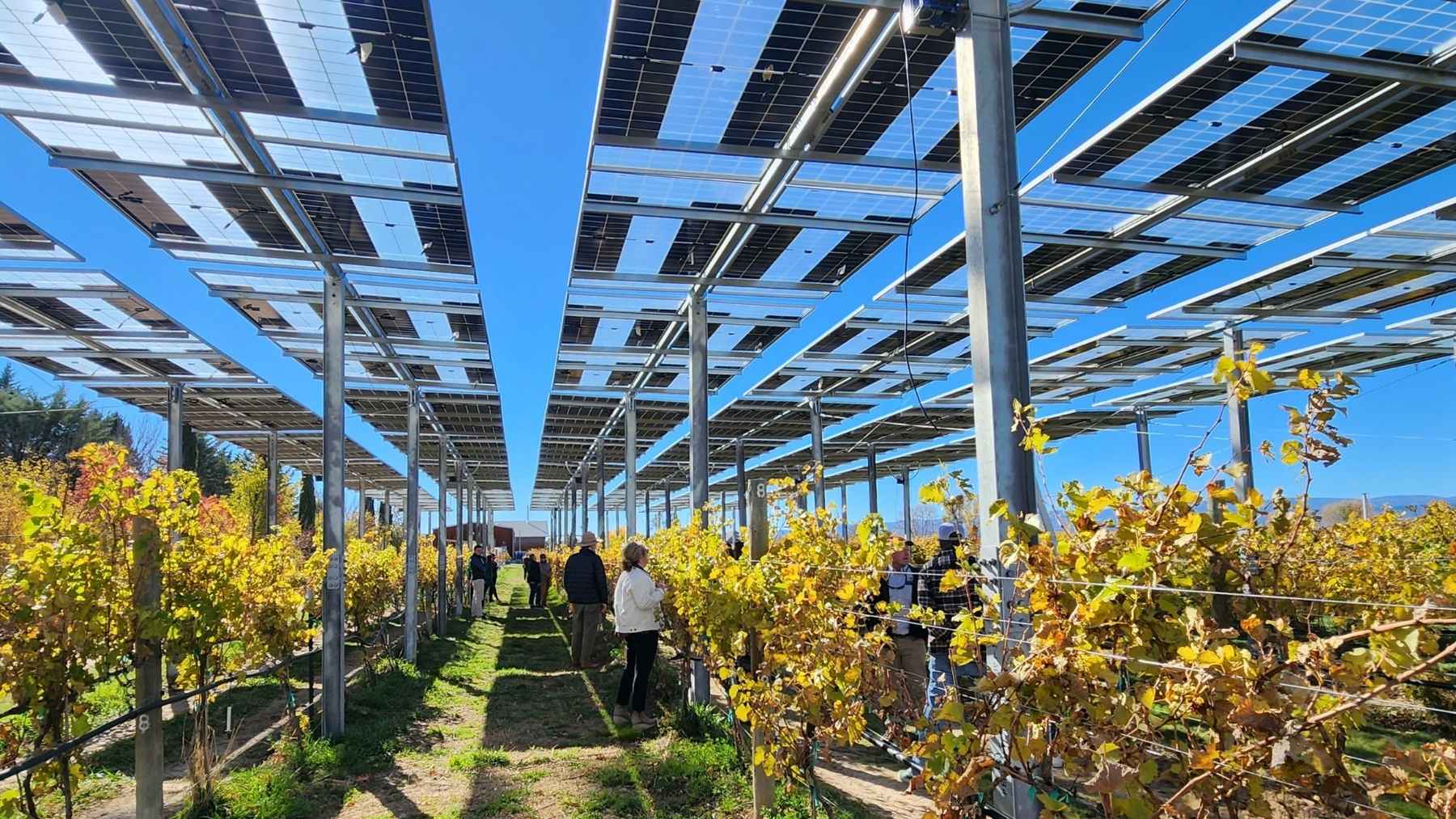

Put a solar panel anywhere near a crop and you have started a fight. The panel wants sunlight, the plant wants sunlight, and there is only so much of it falling on any given acre. Nearly every agrivoltaic project ever built is some version of managing that argument, deciding how much light the hardware gets to take before the harvest starts paying for it.
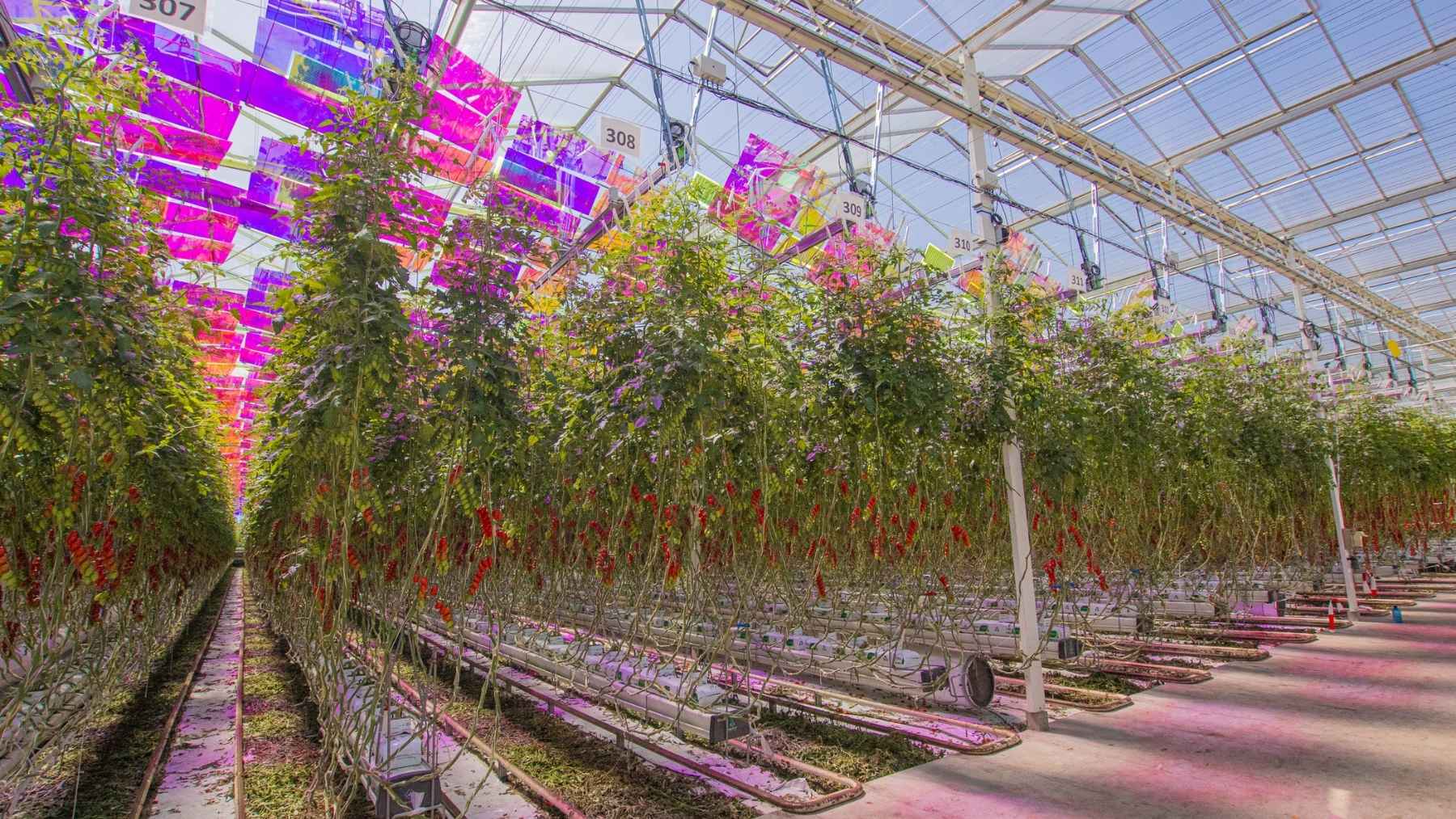
A cherry tomato grower in northern Switzerland skipped the fight entirely. Meier Gemüse, a family operation in Rütihof in the canton of Aargau, hung 1,736 solar modules from Lausanne-based Voltiris inside its greenhouse over four weeks in the spring of 2025. Not on the roof. Under the glass, directly above the tomato rows, on a working farm that never stopped picking.
The reason nobody had to choose between fruit and electricity is that these modules never touch the light the plants use. They take the near-infrared, the part of sunlight that carries heat and does nothing for photosynthesis, and turn it into up to 1 megawatt-hour of electricity a day. The tomatoes carried on as if nothing had changed. Slightly better than that, actually, and we will get to the numbers.
The module is a mirror that plays favorites
Each Voltiris unit is built around a dichroic mirror, a filter that treats different wavelengths of light differently. The band plants run photosynthesis on, what growers call PAR, passes straight through and lands on the crop below. The near-infrared bounces off instead, and the mirror’s curve concentrates it onto a small solar cell mounted at the front of the module.
That concentration trick is what makes the economics work. Because the reflected light gets focused, the actual photovoltaic cell can stay tiny, which keeps both the shading and the silicon bill down. The modules also sit on dual-axis trackers and follow the sun across the sky all day, the same way utility-scale solar farms do. Except these are hanging from a greenhouse frame over tomato vines.
The filter itself was co-developed with 3M, which liked the idea enough to put money in as well. Its venture arm co-led a CHF 4.8 million seed round into Voltiris in early 2025, according to Startupticker.
Four weeks to install, no shutdown, no building permit
The installation ran four weeks with the greenhouse in full production underneath it. No lost crop cycle, no scaffolding army, no downtime. “I was able to peacefully work from my office during the installation period, which says it all,” owner Ruedi Meier said at a Voltiris grower event held at the farm last fall.
Because the hardware hangs inside the existing structure rather than sitting on top of it, the company says the system needs no building permit. In a country that takes construction paperwork as seriously as Switzerland does, that alone probably shaved months off the calendar. The canton of Aargau, which helped finance the project, called it the largest greenhouse solar installation in the world when it went live.
How many modules went in depends on which Voltiris page you read. The project card says 1,736. The project writeup says about 1,800. By the time the company hosted more than 40 European growers at the site in October, the count had rounded up to nearly 2,000. The hectare of coverage stays the same in every telling, so somewhere along the way the same hardware quietly gained 250 units. We are going with the project card.
The tomatoes came out slightly ahead
Meier shared the first season of results at that October event, and they read like the pitch deck came true. Up to 1 MWh of electricity a day, which is roughly what an average American house burns through in a month. Cherry tomato yield up about 1% against the reference compartment next door. Summer grid electricity use down around 35%.
The climate data explains the yield bump. With the infrared skimmed off before it reaches the canopy, leaf temperatures ran 3°C cooler on average during sunny periods, and the crop spent 74% of its time inside the optimal 20 to 25°C window, against 57% in the reference section. Plant temperatures rarely crossed 28°C, the zone where pollination and fruit set start to suffer.
The cooling had one side effect nobody engineered. During the hottest hours of the summer, Meier’s harvest crews started choosing to pick under the modules, because those rows were simply more comfortable places to work.
Meier said the project shows “that tomato and energy production do not have to compete,” and that the two “can strengthen each other.” His motivation is blunter than any sustainability slide, though. “I want to become independent of external suppliers when it comes to energy,” he told HortiDaily, pointing at a power market that gets more volatile every year. He did not buy the hardware outright either. Voltiris finances, installs and operates the system, and the farm pays for the electricity it uses, with a Swiss ethical bank and a foundation carrying the financing.
This is a very different bet from the crop-and-panel experiments we have covered before. The Spanish trial that grew tomatoes 40% heavier under a solar roof won by blocking a third of the plants’ light and letting the shade work as air conditioning in a brutal climate. The Colorado team that doubled saffron yields did it with panels that pass 40% of all light, and the German orchard that resets its harvest calendar hangs its array 16 feet over the apple trees. All of those trade light for something. The Voltiris filter only takes the colors photosynthesis leaves on the table, so the trade mostly disappears.
Strawberries are next, and the Dutch get theirs in September
On May 20 this year, Voltiris announced its next hectare: Genson Group, a Dutch strawberry grower with 16 production sites that supplies Bakker Barendrecht, the fresh produce partner of supermarket giant Albert Heijn. Almost 2,000 modules are going over one hectare of glass in Someren, rated for up to 25 kWh of electricity per square meter per year, which works out to roughly 250 MWh annually across the hectare.
Strawberries arguably have more to gain than tomatoes. Heat forces the fruit to develop too fast and come out small, and in earlier trials at two research centers, Delphy Improvement Center and Proefcentrum Hoogstraten, premium-grade strawberry yield under the filters climbed 26%. “A cooler and more stable climate during peak summer leads to larger high quality berries and more predictable harvest timing,” said Bart Goorts, Genson co-owner and operational manager of the Someren site.
The Dutch install is slated for this summer, with the system running from September. As of mid-August it is a construction schedule, not a power plant, so file it under coming attractions rather than results.
It will be the company’s fourth one-hectare installation, and Startupticker reports eight are planned by the end of 2026 across Switzerland, France and the Netherlands. Voltiris says it has more than 20,000 modules in production and shipping to projects in the Netherlands, Belgium, France and Switzerland this year, and its client list already includes a Belgian tomato grower, a Dutch energy project and a French research station.
A word of calibration before anyone declares the food-versus-energy problem solved. A 1% yield gain is a rounding error next to the 40% swings shade can produce in the right climate, and that is sort of the point. This is not a yield technology. It is an energy asset that happens to leave the crop alone, and on a farm where the crop is the business, leaving it alone is the entire sales pitch.
The open questions are the usual ones for young hardware. How the mirrors hold up after a decade of greenhouse humidity, what the electricity really costs once pilot financing and grants wash out of the equation, and whether eight hectares by December survives contact with construction reality. The tomatoes, for their part, have registered no complaints.
 @wadeworkman ROOKIE2 months ago