
Winnipeg has had a sewer line running across one of its highway bridges for more than two and a half years. Not under the bridge. On it, with the speed limit on the Fort Garry Bridge knocked down from 50 mph to 37 and the lanes squeezed to make room for the pipe. That’s what you get when both of the pipes carrying a chunk of a city’s sewage under a river give out within a few months of each other, which is exactly what happened here, and roughly 60 million gallons of raw sewage went into the Red River before the bypass caught up.
The permanent fix went under the river instead. And the machine that cut the path for it had to do something you don’t see much in this line of work: dive into hard rock, flatten out under the riverbed, then climb back out the far side at a grade that would get your attention on a mountain highway.
Erritt Construction, the Ontario contractor the City of Winnipeg hired for the job, posted on August 10 that the drive was done. The tunnel runs 1,148 feet. It launched on a 12 percent downgrade, leveled off under the river on a vertical curve with a 3,281-foot radius, then came back up through a tighter 2,461-foot curve and entered the reception shaft at 19.5 percent. The machine bottomed out 39 feet below where it started, and the shaft it popped into sits 59 feet above that low point.
So what’s a microtunneling machine, exactly?
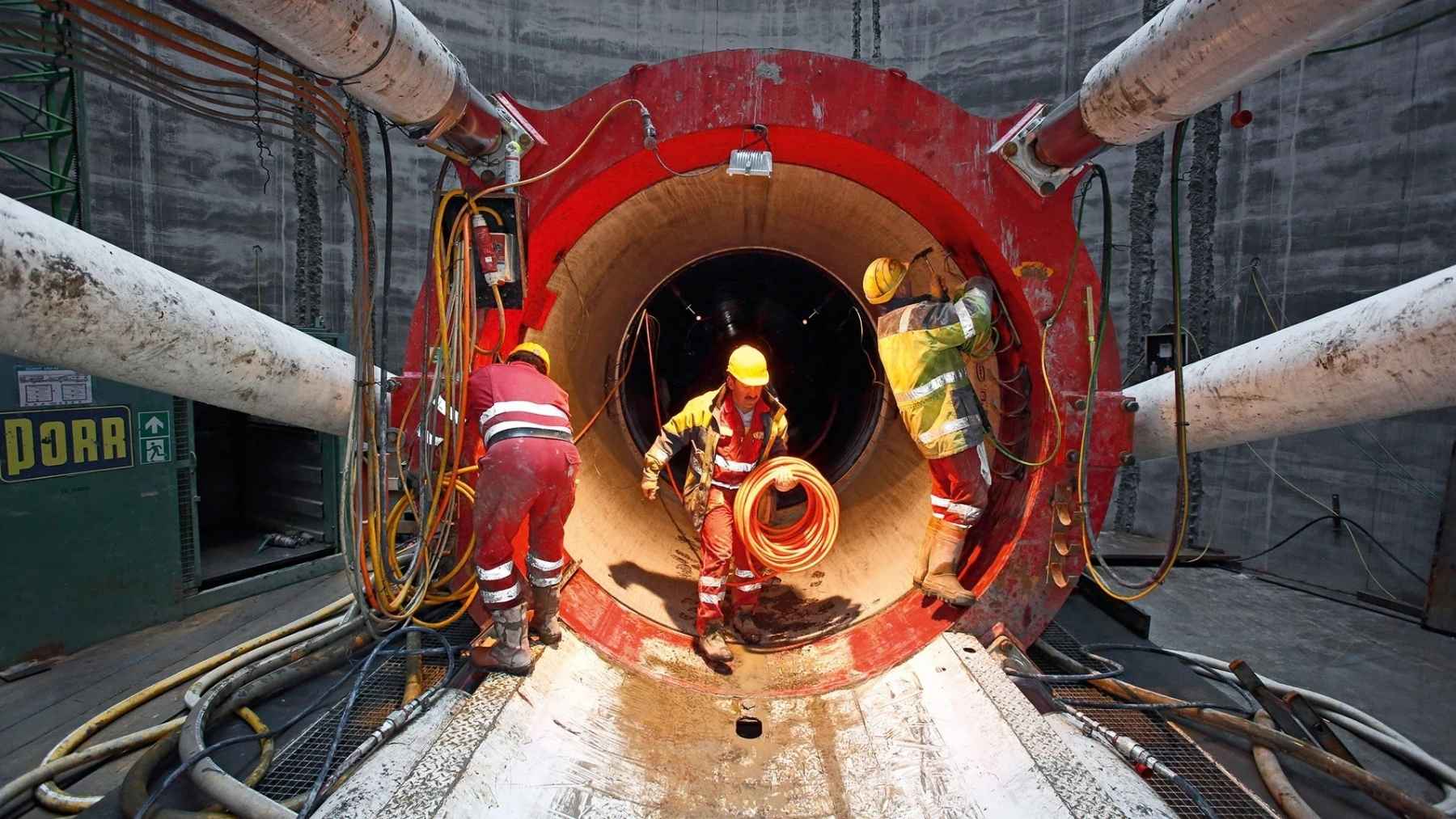
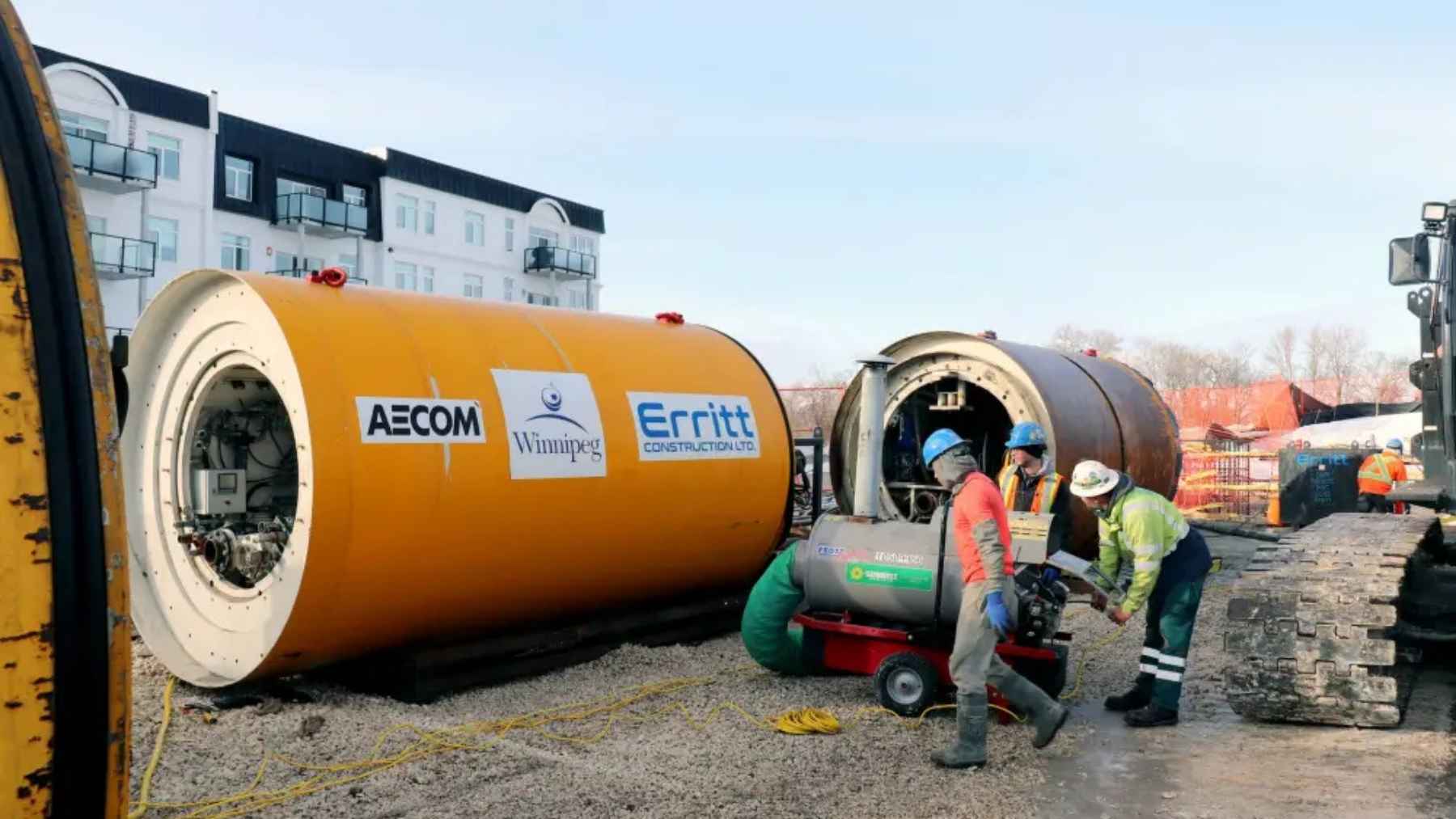
Basically a steel cylinder with a rotating cutting wheel on the front and nobody inside. The crew stays at the surface, and an operator steers it from a control container next to the launch shaft, watching a guidance screen instead of the ground. Hydraulic jacks in the shaft shove a string of concrete pipe forward and the machine rides at the tip of it, so the pipe’s both the tunnel lining and the thing pushing the cutter along. Ground-up rock gets mixed with drilling fluid and pumped back to the surface as a slurry.
The city says this one was lowered 56 feet into a launch shaft on the riverbank, started cutting right around the start of April, and moved about 4 feet an hour, 24 hours a day in two 12-hour shifts. The bore it left is roughly 8 feet across.
We covered the same contractor’s other Winnipeg drive a few weeks ago, where a bigger machine ground through 2,000 boulders under St. James. That one was long and lumpy. This one’s short and steep, and frankly the steep part is the harder trick.
Why does the tunnel go down and then back up?
Because the alternative’s digging two enormous holes. If you want to pass under a river with a flat tunnel, your shafts on each bank have to be as deep as the deepest point of the crossing, and shafts aren’t cheap, they’re slow, and in this case they’d be sitting next to a busy bridge and a bunch of houses. A tunnel that dips under the river and climbs back out lets you keep both shafts shallower. The trade-off is that your machine, which has no windows and can’t back up, now has to steer through two curves in the vertical plane while it’s grinding rock.
A 12 percent grade means the tunnel drops 12 feet for every 100 feet it travels. The 19.5 percent climb on the way out is steeper than almost any public road you’ve ever driven on. Ryan Lucky, a design and specification engineer in the city’s water and waste department, put it pretty plainly in April: entering bedrock through mixed soils on a vertical curve is tricky, and only a handful of contractors in North America can do it. The city’s own report from last fall said the same thing a different way.
One company bid on the job.
If you want to see what happens when a curved drive goes wrong, a 14-ton machine under a New Jersey bay is the cautionary version. This one apparently didn’t need rescuing.
How hard is the rock, really?
Erritt puts the bedrock at 250 megapascals, which works out to about 36,000 psi. For scale, the concrete in your driveway tests somewhere around 3,000 to 4,000 psi, and the limestone a 400-ton machine is chewing through under Nashville right now tests at 14,000. So 36,000’s a serious number. It’s also a number I’d normally expect from granite rather than from the limestone and dolomite that sits under Winnipeg, so I’d want to see the lab sheets before I repeated it as gospel. It’s the contractor’s figure and the only one anyone has published, and the city’s geotechnical report did warn bidders they’d be in bedrock for the river section.
One thing I’d keep straight: that’s rock strength, not the pressure the machine was working under. They get mixed up in press releases all the time.
Erritt also says its people went down to inspect the cutterhead 66 feet below the river through an airlock. That matters more than you’d think. The front of a sealed machine like this is held up by pressurized fluid, and if you open it to look at the cutting wheel, the river tries to come in. So you pump the chamber full of compressed air to push the water back, and anyone going in passes through an airlock the same way a diver decompresses. It’s not a casual walk down a ladder.
So how much does this thing weigh?
I can’t give you an exact figure, and I looked. Neither the city nor Erritt has published the machine’s weight or its model number. What I can tell you is that the city describes the bore as about 8 feet across and that Erritt’s whole fleet is Herrenknecht AVN machines. Herrenknecht’s data sheets for its AVN2000 size, the one that cuts a hole just under 8 feet across, list the heaviest single section at roughly 70,000 to 84,000 pounds depending on the version, and that’s just the biggest piece that comes off the crane, with the rest of the machine on top of it.
Treat that as a range for the class of machine, not a spec sheet for this unit.
If Erritt wants to send me the number, I’ll print it.
What’s left under the river
The machine pushed a reinforced concrete casing pipe behind it as it went, a hair under 7 feet on the inside. Once the tunnel was through, Erritt pulled two HDPE sewer pipes, each just under 3 feet across, into that sleeve, tested them, and grouted them in place. Those two plastic pipes are the actual siphon. The concrete tube is just the garage they live in.
Which means Winnipeg now has a crossing it can inspect and, if it ever has to, re-line without digging up a river. The old pair, more than 50 years old, offered no such option, and the city found out the hard way in late 2023 when an inspection caught one leaking and the second one let go while the bypass was still being built.
None of this came cheap. The city’s September 2025 report put the replacement at C$26.6 million, up from an original estimate of C$18.6 million, and blamed long waits for parts and a Winnipeg winter for the delay. It’s still, arguably, small money next to the C$4.8 billion lawsuit several First Nations downstream filed over the 2024 spill.
The city’s last public update, from April 7, said it expected the new crossing in service over the summer, with the bypass pipe coming off Abinojii Mikanah after that. Erritt posted the completed drive and the installed, tested, and grouted carrier pipes on August 10, 2026.