
The rules behind a French wine label are famously fussy. Which grapes you can plant, how many vines per hectare, when you are allowed to pick, whether you can irrigate at all.
One of those rules has been sitting on the books since 2002. It says you cannot put a roof over a vineyard carrying an AOC or IGP designation. That covers about 95 percent of everything France bottles.
A cognac producer in Charente-Maritime built one anyway.
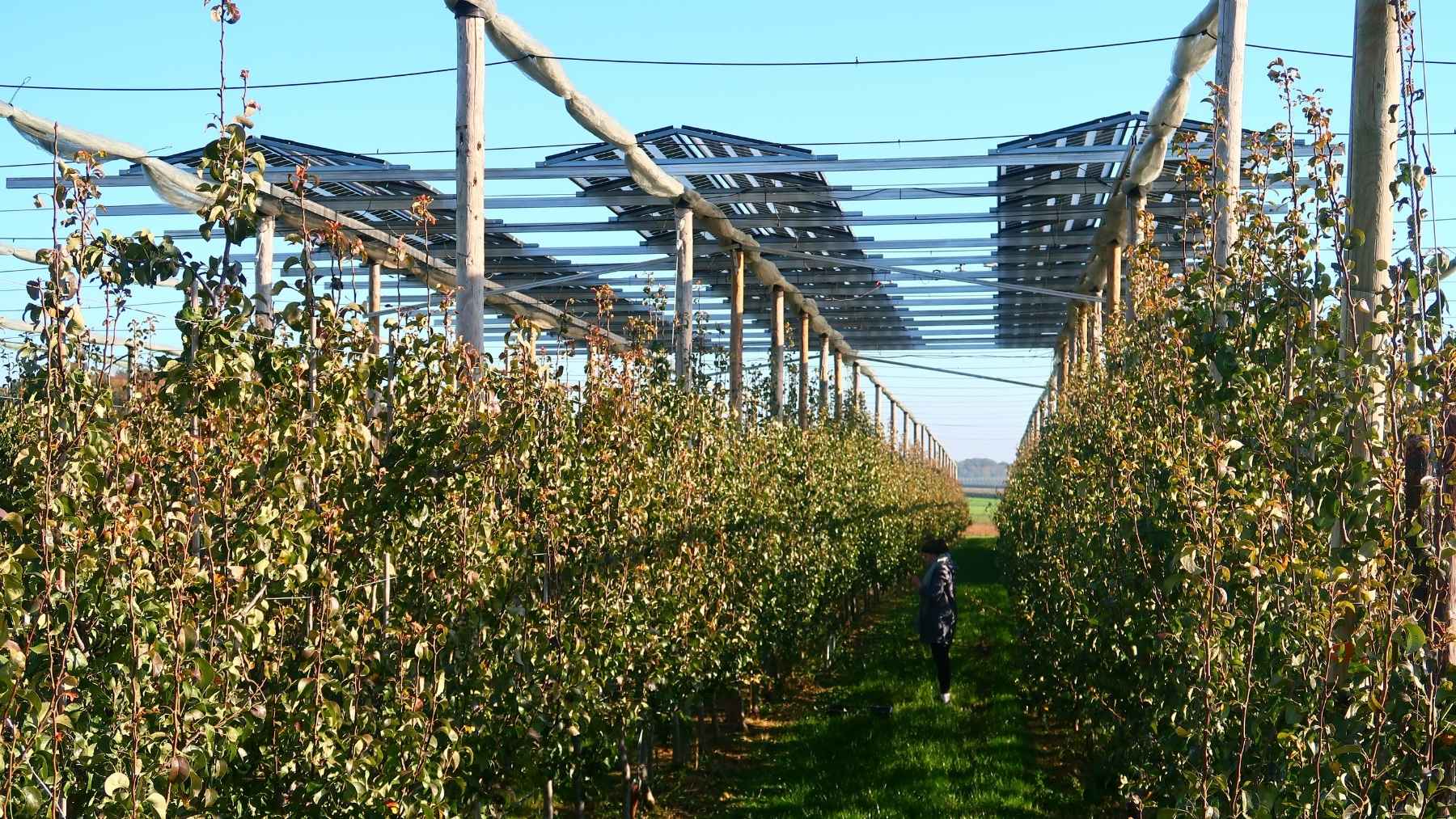
David Moreau, 45, planted four hectares of ugni blanc at Saint-André-de-Lidon, south of Saintes, underneath 6,000 solar panels held about five meters above the rows. The installation was inaugurated in early May, and AFP reported it as the first of its kind in the department’s wine sector. Moreau knows exactly what it costs him. Whatever comes off that ground, he told the agency, will be sold as wine without a geographical indication.
He is giving up the label to keep the crop.
Four hectares, 6,000 panels, and no appellation
Moreau’s reason is a number he watches every summer. He loses 5 to 10 percent of his harvest annually to échaudage, the scorching that happens when grapes cook on the vine in a heat spike.
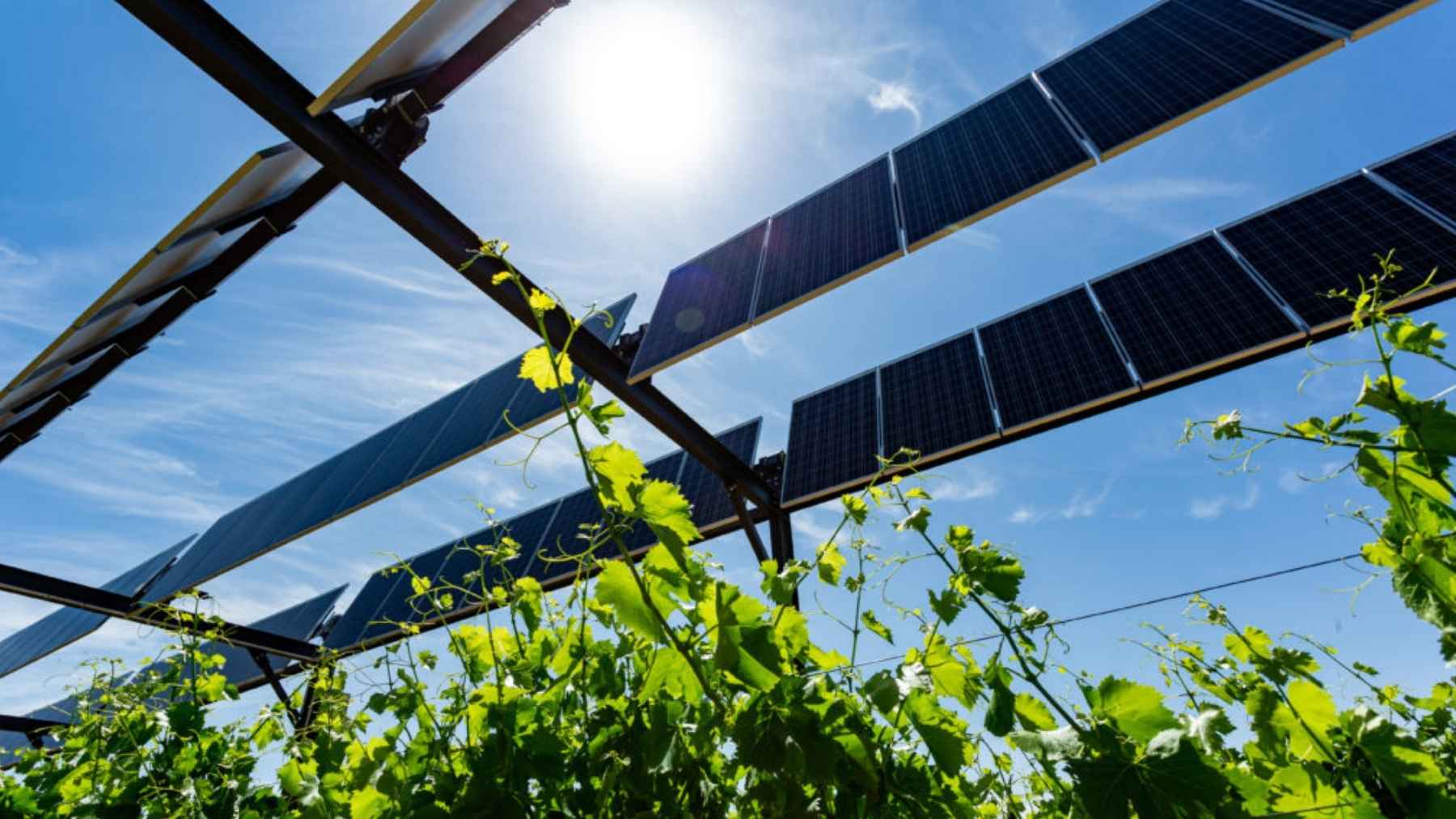
The hardware came from Sun’Agri, the agrivoltaic arm of the Eiffage group, at a build cost the company puts at €4 million. The panels are steerable, tilting through the day to trade shade against sun depending on what the vines need. Software running on plant-growth models and on-site weather sensors handles it in real time, though Boris Marchal, Sun’Agri’s director of public affairs, says the grower can seize manual control.
The economics are not what you would guess. Electricity from the site goes to an investor, and that investor pays Moreau rent of €600 a year across a 30-year term, per AFP’s account. Sun’Agri puts the annual output at roughly what 800 to 1,000 households consume.
Six hundred euros against a four-million-euro structure. Nobody is doing this for the rent. Moreau is buying insurance and taking the electricity money as a rounding error.
The panels lie down when the hail arrives
This is the part worth picturing. In a hailstorm, the array goes flat, presenting the panel edges and the metal frame to the sky and putting a hard ceiling between the stones and the fruit. Moreau told AFP that laying them flat saves 70 to 80 percent of the vines, and that the system gives him roughly a 90 percent chance of dodging frost damage.
Both figures come from the grower and the installer, not from an independent trial, and Moreau will not have his own harvest to check them against until 2029.
American solar has spent the last few years solving the identical problem in the exact opposite direction. Utility-scale trackers in hail country stand their panels near-vertical when a storm line closes in, tilting steeply so the stones skid off the glass instead of punching through it. Same hazard, same hardware, mirrored solution. A solar farm flinches upward to protect the panel. A vineyard array flattens to protect what is underneath it.
The frost mechanism is simpler and less dramatic. A panel five meters up traps a layer of air and slows radiative cooling on clear spring nights, which is the same physics behind the smudge pots and wind machines that fruit growers have used for a century. Sun’Agri’s own published research summary on vine growing describes a roughly 2°C benefit when the thermometer approaches zero, and up to 5°C of cooling under the panels in hot weather.
The Pyrenees estate that has eight years of data
Moreau is not going in blind. He cites the feedback from Domaine de Nidolères at Tresserre, in the Pyrénées-Orientales, where Pierre and Martine Escudié planted 4.5 hectares under a Sun’Agri array back in 2018 with a matching uncovered control plot alongside it.
Sun’Agri published results from the 2024 harvest there, and pv magazine carried the figures. Yields under the glass ran 20 to 60 percent above the open plots depending on variety, with irrigation demand down between 20 and 70 percent. A second trial in the Vaucluse held above 30 percent, irrigated or not.
2024 harvest at Domaine de Nidolères, Pyrénées-Orientales. Figures released by Sun’Agri, the system operator, and not independently audited.
Take the percentages with the caveat they deserve. Sun’Agri sells these systems and Sun’Agri counted the grapes. That said, the plot has a control block sitting next to it and eight growing seasons behind it, which is more than almost any agrivoltaic installation anywhere can claim.
The direction of travel also lines up with what other crops have shown. Researchers in Spain grew tomatoes 40 percent heavier under a semi-transparent solar roof because the panel worked as air conditioning, and the reason the vine numbers land where they do is the same one: in a hot enough place, shade is worth more than the light it takes away.
Not every crop agrees. A Bavarian hop grower who mounted panels on the poles already holding up his bines got excellent electricity and fewer cones out of his first prototype, because the plants hit the glass and went bushy instead of setting the flowers brewers actually buy. Grapes sit on a trellis at a fixed height. Hops climb until something stops them.
Some appellations have already said no
France’s regulatory fight over this is live and it is not going Sun’Agri’s way everywhere.
Christian Paly, who chairs the wines and spirits committee at the INAO, points out that the 2002 covering ban can be waived for research purposes, which is how the pilot plots exist at all. Two of them, Vitivolt in the Val-de-Loire and Vitisolar at Villenave-d’Ornon near Bordeaux, run through 2028 under INRAE.
Other appellations have gone the other way and written the prohibition into their own specifications. Côtes-du-Rhône did exactly that last autumn, citing among other things the disfigurement of the landscape. The Cognac trade body has not settled its position and is waiting on assessments covering landscape, quality, economics and regulation.
The FNSEA, France’s dominant farm union, is friendlier. Olivier Dauger, an FNSEA administrator who co-chairs the France Agrivoltaïsme association, argues the systems make cheap electricity and visibly improve the product, while conceding the appellations are nervous because nobody has long-term data yet. He also wants growers to stop imagining panels blanketing the countryside. Current projections put agrivoltaics on about 0.5 percent of French farmland by 2050, across every sector.
American growers do not have to make this trade
Here is where the story gets useful to anyone farming grapes in the United States, because the constraint that is costing Moreau his label does not exist here.
An American Viticultural Area is a boundary on a map. The TTB defines it as a delineated grape-growing region with distinguishing features, and to put the AVA name on a bottle at least 85 percent of the fruit has to come from inside those lines. That is the requirement. Nothing in it dictates how you train the vines, whether you irrigate, or what you are allowed to hang above the canopy.
Roof a Napa vineyard in glass and it is still Napa on the label. Roof a Cognac vineyard in glass and the wine loses its geographical indication. Two regulatory philosophies, one physical structure, wildly different bills.
Somebody is already testing it. At Colorado State University’s Western Colorado Research Center at Orchard Mesa, state viticulturist Horst Caspari has an 85.2 kW array standing about 14 feet over mature vines, a mix of opaque and semi-transparent panels on different tracking axes so he can work out how cheap a system can get before the fruit underneath starts to suffer. The Colorado Department of Agriculture lists frost protection, water retention, grape chemistry, hail damage and labor among the things he is measuring.
The build ran north of $400,000 and covers roughly a third of the research center’s power. What makes it interesting is that it went up over a 34-year-old vineyard without pulling a single vine, which is the opposite of what a ground-mounted solar farm does to farmland. American farms have been putting arrays on stilts over row crops for years, and the Arizona work on raised panels over vegetable beds established most of the shade-and-soil-moisture case that vineyards are now borrowing.
Caspari has told Colorado Newsline that a few degrees Fahrenheit can be the difference between a full crop and no crop. In a state where a late frost can erase a season, that is the whole argument.
The timing is strange on both sides of the Atlantic
Both wine industries are shrinking while this happens.
Cognac is deep in a downturn and has announced a large vine-pullout plan. On this side, USDA’s National Agricultural Statistics Service and the CDFA put California’s wine grape acreage at 540,000 acres for 2025 in a report released April 22, down from 580,000 in 2024 and 610,000 in 2023. Bearing acreage fell 5.6 percent in a single year. Growers have been tearing out tens of thousands of acres a season to work off an oversupply.
So the pitch for a $400,000 canopy over grapes nobody is short of is a hard one to make on yield alone, and Sun’Agri knows where the limits are. Marchal says the climate-protection benefit is not proven further north, and the company’s roughly twenty comparable projects sit around the Mediterranean, in the Rhône Valley and in Nouvelle-Aquitaine. This is a hot-and-violent-weather technology, not a universal one.
Which leaves a narrow but real case: growers in places where heat spikes, hail and late frost are already writing off a tenth of the crop most years, who own the land, and who can find somebody else to fund the steel. Moreau found that somebody, paid for it with his appellation, and will not know whether the trade was worth it until his first harvest in 2029. American growers looking at the same array get to run the experiment without putting the label on the table.
Image credit: Boris-Yvan DASSIE