
Hail netting is one of the few things an orchard pays for twice. There’s the net itself, then the crew that hangs it after pollination and pulls it back down after harvest, and eventually the plastic goes brittle and the whole cycle starts again.
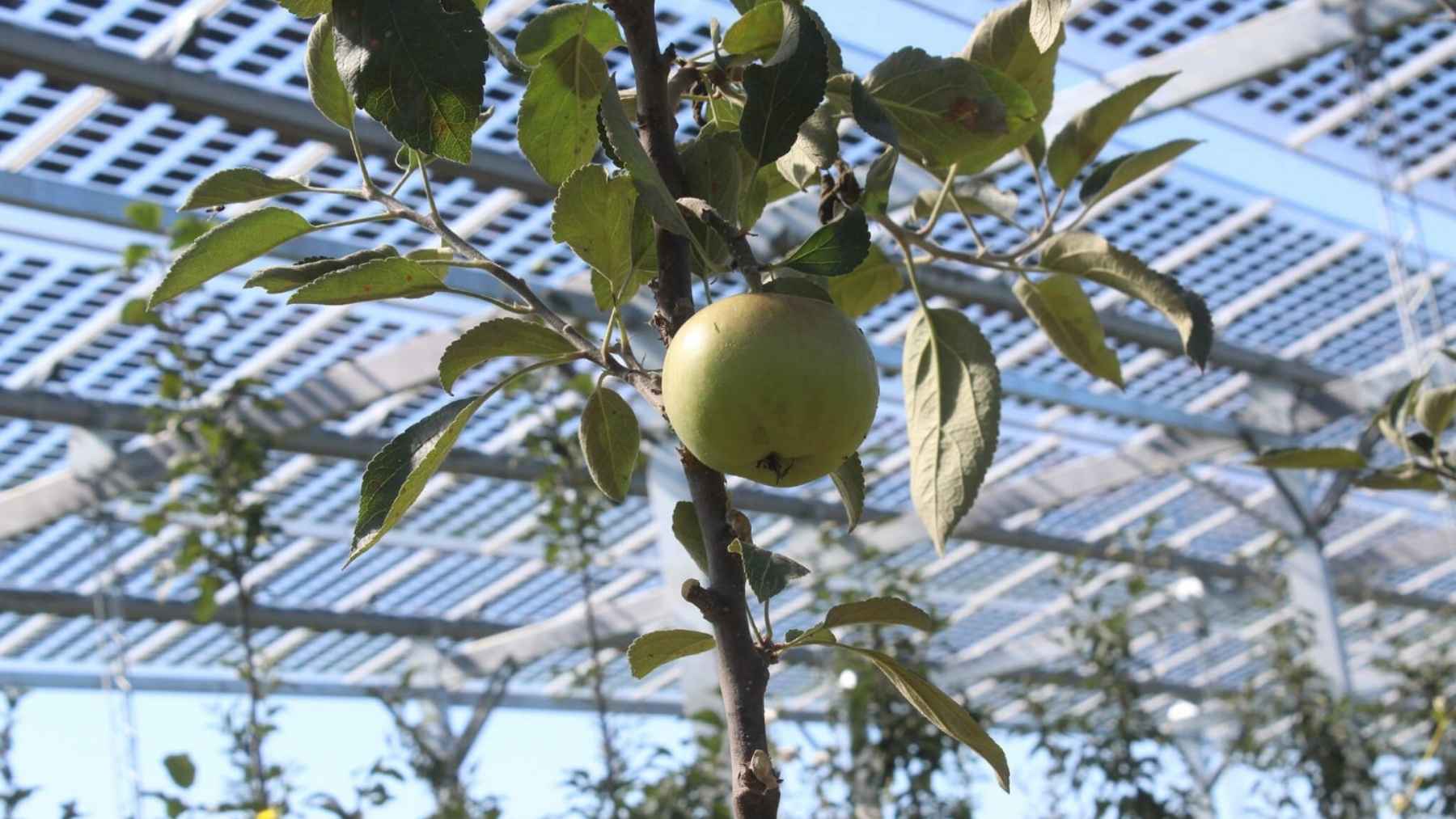
An organic apple farm in the German Rhineland has spent five years testing what happens if you make that roof permanent and wire it to the grid. Since 2021, apple rows at the Nachtwey orchard in Gelsdorf have been growing under 258 kilowatts of solar glass while Fraunhofer ISE counts everything that lands on the fruit underneath.
The project is called APV-Obstbau, and Fraunhofer built it to answer one question: can a solar roof do the job the netting does. The institute already states the intended answer on its own project page, where a photo of the array carries a caption saying hail protection nets become redundant with an agrivoltaic system.
That’s the design goal, not a published result. The harvest data that would settle it is still being processed, which is worth knowing before anyone in Wenatchee or the Hudson Valley starts pricing steel.
Five different roofs over the same orchard
The site sits at Grafschaft-Gelsdorf in Rhineland-Palatinate, on roughly 2.2 acres of trial ground, with the solar array covering about a third of it. Eight apple varieties went in under five different coverings so the comparison runs row against row.
Two of those are the controls growers already use: standard hail netting, which lets rain through, and plastic foil roofing, which doesn’t. The other three are photovoltaic. One is a fixed array in a zebra layout with cells and gaps alternating, one is a fixed array in solid blocks, and one sits on trackers that can be turned to let rain and light down or angled to close the canopy.
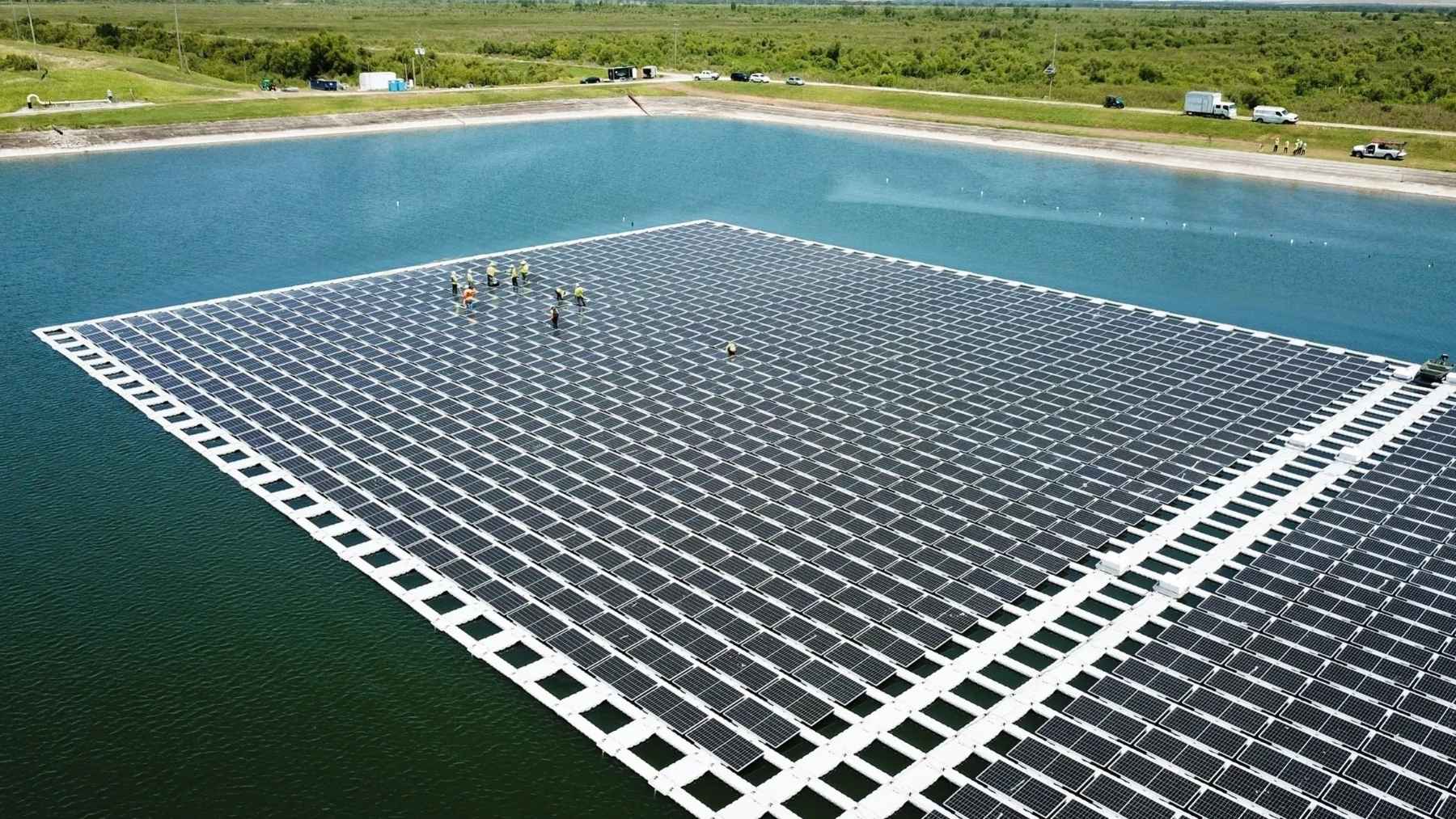
The hardware is eleven rows of glass-glass modules, roughly 22 square feet apiece, hung just under 16 feet up. Eight fixed rows carry 106 modules each and three tracked rows carry 100, which comes to 1,148 panels rated at 258 kilowatts between them. Fraunhofer’s own accounting puts annual output between 1,006 and 1,199 kilowatt-hours per kilowatt installed.
A Bavarian hop farm reached the same conclusion about its trellis poles, which were already holding a structure 23 feet in the air and doing only one job with it.
One design decision at Gelsdorf came from the road rather than the trees. The plot sits near the A61 autobahn, and a pitched roof would have thrown glare at passing traffic, so the modules had to be built as a single-slope roof draining one way. Jürgen Zimmer of DLR Rheinhessen-Nahe-Hunsrück, who runs the agronomic side, has reported that every module dumps its rainwater along a drip edge into the same wheel track, leaving one rut soaked and the other dry. In a wet year like 2024 the wet track digs itself deeper every pass.
The disease numbers are the ones growers will read twice
The covered rows get a reduced spray program aimed mostly at mildew, while the netted control gets the full organic scab strategy of copper, sulfur and potassium bicarbonate. Hold that comparison in mind, because it means the covered trees are largely unprotected against scab and are being asked to survive on shelter alone.
In 2024, a heavy infection year, they did. Zimmer recorded average leaf scab of 6.3% under the hail net and 5.1% fruit scab, against 2.26% leaf scab under the tracked array and under 1% beneath the fixed panels and the foil. Infection also increased from the treetops down, since the canopy shelters the top of the tree better than the bottom.
Storage told a similar story. Fruit from the 2023 crop, assessed from December through February, showed Gloeosporium rot at 13.6% under the netting against 5.42% on average under the panels. Bitter pit ran 19.94% in the netted variant and between 10.25% and 13.65% everywhere else.
Then there’s the cost of a drier canopy. Powdery mildew went the other way, with 3.14 and 3.08 infected shoot tips per tree under the zebra and tracked layouts against 1.09 under the net.
Figures from the agronomic assessments run by DLR Rheinhessen-Nahe-Hunsrück at Gelsdorf.
The glass has its own vulnerability to what it’s blocking, which is why American solar farms have spent years engineering their way around hailstorms.
Less light means less fruit, and the project lead says so out loud
Andreas Steinhüser, who leads the project at Fraunhofer ISE, has been unusually direct about the catch. In an interview published by the BLE, the federal agency administering the funding, he said the light reduction caused by the modules leads unavoidably to lower yields under German climate conditions.
The power side takes a haircut too. Zimmer notes that the row spacing an orchard needs limits how densely you can mount modules, and the semi-transparent glass-glass panels used here deliver roughly 60% of what a conventional fully covered module would.
Which is why the project never framed itself as a yield play. The stated goal is secure, high-quality apple production with electricity on the side, and Steinhüser’s argument is that the value chain has to sit with the farm, or the ground rent has to be high enough to cover the light the trees lose.
Sunburn is where the shade pays outright. Depending on how the array is built and oriented, Steinhüser says sunburn damage is avoided completely, and fruit temperature under the panels runs well below what it does under a hail net. The same cooling effect has shown up under panels raised over Arizona farmland, where researchers measured it on the crews as well as the crops.
The apples now ripen almost two weeks later
Christian Nachtwey, who farms the site with his family, runs the practical read on it. He told a visiting delegation from the Rhein-Sieg energy agency last summer that the modules cut direct sunlight by about 30%, that the soil under them stays roughly 3.6 degrees Fahrenheit warmer through winter, and that the cooler summer air also lowers the modules’ operating temperature, which nudges their efficiency up.
The detail he keeps returning to is timing. Ripening under the panels has shifted 10 to 12 days later, which runs directly against the steadily earlier harvest dates that warming has been forcing on German growers.
His verdict on layout is that the zebra pattern beats the block. Solid blocks throw a hard shadow while the alternating design spreads shade more evenly, and the trees prefer even.
He also thinks the structure he has is too heavy. Four years in, he says the current array counts as oversized by today’s standards, and any follow-up he builds will be lighter and shaped better to the terrain.
The money is the part that isn’t settled. Germany’s Solarpaket I promises agrivoltaic installations an extra 2.5 cents per kilowatt-hour, and Brussels still hasn’t cleared it under state aid rules. The Bundesnetzagentur’s conditions for the July 1, 2026 auction round confirmed the approval was still missing. With it, Nachtwey puts payback on a new array at 10 to 12 years against a service life of at least 30.
American growers keep asking somebody else to go first
The American version of this argument runs on nearly identical economics. A state-funded report published in November by Washington State University with The Nature Conservancy, American Farmland Trust and UC Santa Barbara found 87,000 acres of Washington farmland within a mile of a substation where agrivoltaics could work, half of it orchards, worth between 8.7 and 17.4 gigawatts against a state target of roughly 20.
The report’s list of things solar could replace reads like the German pitch translated: irrigation cost, trellising, the shade cloth itself, and the labor of putting it up and taking it down every season.
The exposure behind that is serious. Stefano Musacchi, tree fruit endowed chair at WSU, has put sunburn at up to 50% of the crop when no mitigation is in place. Washington orchards growing Honeycrisp, Granny Smith and Cosmic Crisp account for about 35% of US domestic apple sales across more than 50,000 acres. A 2017 survey of New York growers found hail injury knocked 96% off crop value.
Nobody has built it yet. WSU’s own report noted that no agrivoltaic project was operating in Washington, with the designed pilot at the Sunrise Research Orchard near Wenatchee still chasing construction money. On the other coast, NYSERDA awarded Cornell $5 million last November for a roughly 300-kilowatt tracked array over about two acres of high-density apples at the Hudson Valley Research Laboratory in Highland, New York. Lab director Jared Buono says nobody in North America has covered an apple orchard with solar panels, and his team expects to break ground in late 2026 over roughly 800 trees.
Max Lambert of The Nature Conservancy, the report’s lead author, put the holdup plainly: farmers like the idea and want to watch somebody else do it first.
None of this makes Gelsdorf a template. It sits at 50 degrees north in a mild Rhineland climate, it’s certified organic, and its eight varieties were picked for a shade trial rather than for a packing line in Wenatchee. The economics also lean on a German feed-in premium that Brussels has been sitting on for more than two years.
What it does offer is five seasons of side-by-side numbers on the exact question American growers are being asked to answer, from a plot where the netted control sits in the next row over. Fraunhofer got the project extended through the end of 2026 specifically to work up the 2025 and 2026 full-yield harvests, the first two crops big enough to say anything definitive about tonnage.
Anyone ordering netting this fall will have made the call long before those numbers land.