
Saffron is expensive for a boring reason. Every thread is a dried stigma pulled out of a crocus flower by hand, three threads per bloom, and the counting has been done precisely. University of Vermont researchers who grew the crop inside a working solar array logged between 159 and 179 flowers to make one gram of dry saffron.
That labor math is why saffron has never been a serious American field crop. It is also why it keeps turning up in agrivoltaics research, where the whole exercise is finding something worth harvesting on land that already has panels bolted to it.
The newest result comes off a rooftop in downtown Denver, and it points at the hardware instead of the dirt.
Panels you can see through doubled the flower count
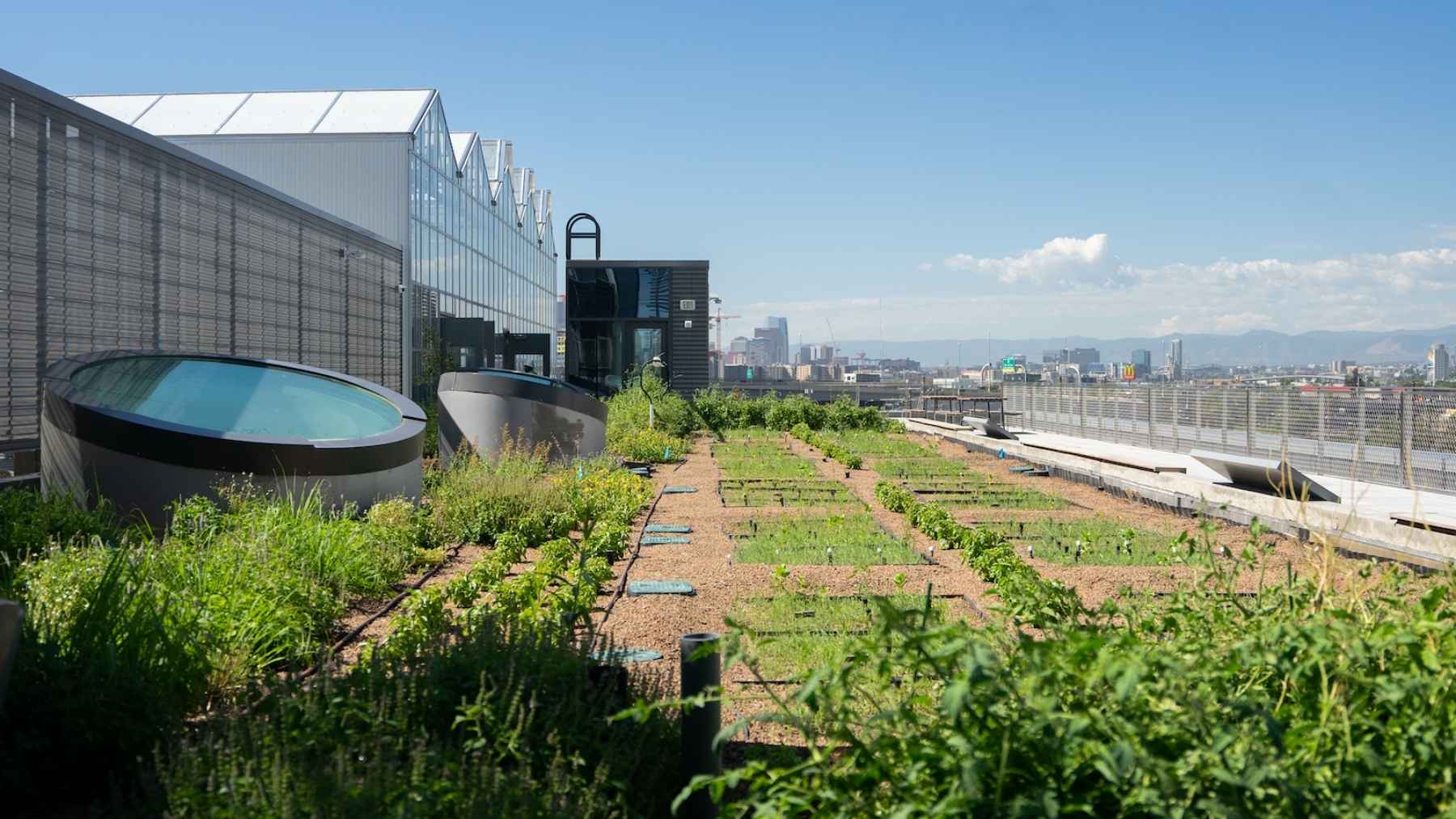
Jennifer Bousselot has been studying what happens when you put plants under solar panels on a roof since 2007. She is an associate professor of horticulture at Colorado State University, and her lab runs two research green roofs at the CSU Spur campus in Denver. One has panels over it, one does not, which gives her a control.
Reece Bailey, a master’s student in that lab, spent his thesis on saffron. Writing with Bousselot in Living Architecture Monitor this spring, he reported that flower counts and dried stigma yield both came in at twice the level under panels rated at 40 percent transparency.
Not twice some low baseline. Twice the unshaded plots.
The catch sits inside that transparency figure. Semi-transparent modules exist, but they are not what gets bolted onto American roofs and fields. Standard opaque panels pass roughly 10 percent of the light to whatever is growing underneath, per the same paper.
Saffron does not want full sun and it does not want a cave. Research out of eastern Morocco, published in 2022, put the optimal shade level for the crop at 30 percent. The Colorado team lands close to that. Designing a rooftop system around saffron from scratch, they specify 30 to 40 percent transmission, mounted 6 to 8 feet above the growing surface.
They are also direct about the downside, noting that too much shade is “detrimental to saffron yield.”
The Denver budget pencils out, with an asterisk on where the numbers come from
The paper runs a five-year enterprise budget on the array CSU Spur already has. It is 46 kilowatts, southeast-facing, with 4,356 square feet of usable growing space.
Electricity off that array is worth about $2,694 a year, or $13,470 across five years. The saffron side assumes $35 a gram for dried stigmas, which works out to $992 an ounce, plus 25 cents apiece for the daughter corms that multiply underground and get sold off periodically.
Run it out five years and the estimate clears $60,000 net from the spice alone.
Year one loses money. That is not a flaw in the model, it is how saffron works. You buy corms, you plant them, and they spend the first season getting acclimated before they do much of anything.
An enterprise budget is a forecasting tool farmers use before entering a new market, not a record of sales, and the authors say as much. The doubled yield also came out of shade test plots rather than that 46-kilowatt array. The two figures sit beside each other in the paper, not inside each other.
Vermont ran the ground-level version and the weather ate year three
None of this started in Colorado. The North American Center for Saffron Research and Development at the University of Vermont has been working the crop since 2015, and it got there by asking a blunt question: what can a small diversified farm grow that isn’t kale.
Their first run at a solar field went badly. In 2018 they planted at a site in New Haven, Vermont with heavy clay soil, raised the beds to compensate, and lost the corms anyway. Drainage under the beds was poor, the winter turned unusually wet, and fungal infection took the lot.
The second site worked. From the summer of 2019 the team built 18 beds at an iSun array in Burlington and tested three positions, in the aisles, directly under the panels, and around the perimeter, each one both in raised beds and in the ground.
Aisles and edges beat under-panel. That is the finding that matters if you are standing in front of your own array wondering where to dig.
Year two was the good year. Year three came apart, and not because of the panels. The fall of 2021 stayed warm too long, the first frost held off until late November, and growers across the region had a poor harvest that season.
Saffron under panels is still saffron outdoors.
The three-year totals in the final UVM report landed between $7,500 and roughly $130,000 net per acre, turning almost entirely on whether corms get sold alongside the threads. A spread that wide is at least an honest one.
Setup is where the money goes. There is no domestic corm supply at scale, so American growers import, and the report puts the corm bill near $100,000 an acre before a single flower opens. Call it 40 percent of total setup cost, spent in year one.
Corms do multiply, which helps. Each parent throws off three to five secondary corms a year, so the second planting costs a fraction of the first.
Margaret Skinner, the UVM researcher who started the program, has been straightforward about who this crop suits. Picking the flowers and separating the stigmas by hand rules plenty of people out, she told Canary Media in 2022: “You need some fine motor skills.”
iSun, the contractor hosting that Burlington trial, is gone. The company filed for Chapter 11 in 2024, which is a large part of why the vertical agrivoltaics array it was supposed to build in Vermont, saffron between the rows included, never got built at all.
State money is going to sheep, not spice
Colorado runs one of the few dedicated agrivoltaics funding programs in the country. It came out of Senate Bill 23-092 in 2023, and the state Department of Agriculture has awarded $1 million across 13 projects in its first two rounds.
Look at what the most recent round paid for and high-value crops are not on the list. The 2025-26 awards went to rangeland forage research in Weld County, sheep grazing on a 55-acre array in Boulder County, an extension training program, a set of producer and utility interviews, and regional workshops for county officials.
All of it useful. None of it a spice.
That is not a knock on the program so much as a fair reading of what the industry is actually asking. Landowners and utilities want to know whether the grass holds up and whether the sheep cover the mowing bill, the same practical question that put wildflowers and twentyfold native bee counts under two Minnesota arrays.
The number to watch is the glass, not the gram
Every agrivoltaics result comes attached to a specific piece of hardware, which is what keeps the field honest. Arizona’s water and heat numbers come off panels raised on stilts high enough to walk under. Vermont’s come off a conventional tilted array with aisles wide enough to kneel in. Denver’s doubled yield comes off glass that passes 40 percent of the light.
Change the hardware and the result moves with it.
Which is why the interesting figure in the Colorado work is not the $60,000 or the price per gram. It is the transmission spec.
Saffron does not need a solar farm. It needs a panel that is not opaque, mounted high enough to get a bucket under, over soil that drains. Two of those three are cheap. The third is a procurement decision almost nobody in American solar is making yet.