
If you’ve ever bought a box of borax for the laundry, congratulations, you’ve handled fusion fuel. Sort of. Borax is how most of us meet the element boron, and on September 28, a Chinese energy company announced that a machine it built has been slamming hydrogen into boron hard enough to fuse the two more than 100 million times every second.
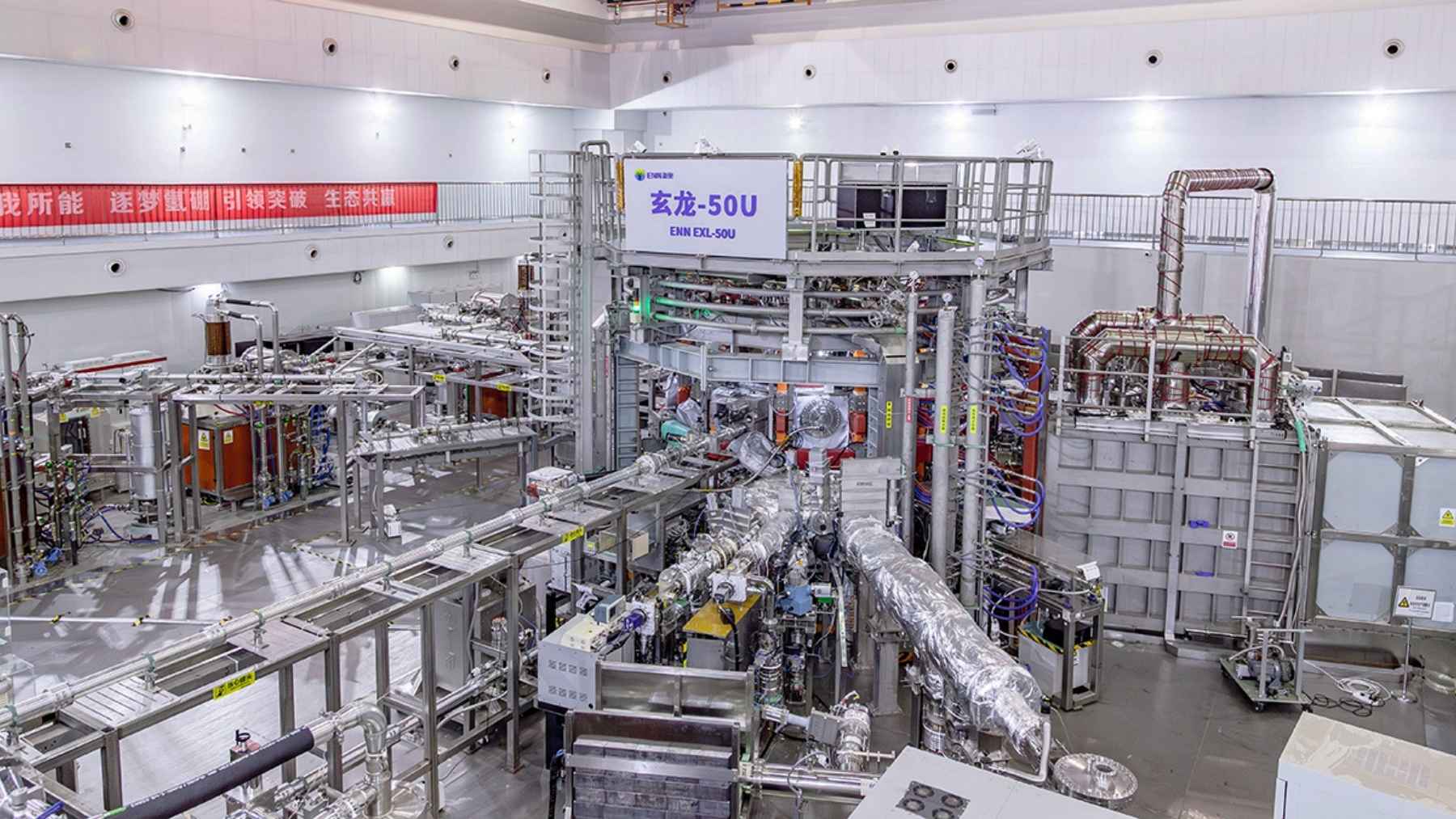
The company is ENN Group, the machine’s called the EXL-50U (Xuanlong-50U if you want the full name), and it sits on the company’s campus in Langfang, Hebei Province, just south of Beijing. ENN says this is the first time a commercial fusion company has achieved hydrogen-boron fusion on a device of its own. That claim comes with an asterisk we’ll get to, but as far as I can tell, it holds up.
The machine itself is small by fusion standards. ENN’s own spec sheet puts it at 12.7 feet across and a shade under 15 feet tall. It’s a spherical tokamak, which is basically the cored-apple version of the donut-shaped reactors you’ve seen in every fusion story, like the one in San Diego. Its magnets run at 1.2 tesla with 150,000 amps in the coils, and they can hold that field for 2 seconds at full strength or 8 seconds dialed back to half.
So why boron? Isn’t regular fusion hard enough?
It is, and that’s kind of the point. Just about every mainstream fusion project, from ITER in France to the big government labs, runs on deuterium and tritium, two heavy flavors of hydrogen. They fuse at the lowest temperature of any fuel pair, which is why everybody uses them. The catch is the exhaust. Most of the energy comes out as neutrons, and neutrons batter the reactor walls, slowly make the structure radioactive, and are generally miserable to build around. Tritium is also radioactive, scarce, and expensive.
Hydrogen-boron fusion dodges most of that. A proton fuses with a boron-11 nucleus, the form about 80% of natural boron comes in, and the main reaction spits out three helium nuclei instead of neutrons. They’re charged particles, so you can at least imagine steering them with magnets and harvesting their energy directly as electricity. Side reactions still throw off some radiation, so “perfectly clean” is marketing, but the wall-battering problem shrinks dramatically. And the fuel case is pretty compelling on paper: hydrogen is everywhere, and boron is cheap enough to sell in the laundry aisle.
So why isn’t everyone doing this?
Because boron has five protons, and five protons push back against an incoming proton far harder than hydrogen pushes against hydrogen. You need the plasma vastly hotter. ENN’s leadership has talked about an eventual operating target around 1.8 billion degrees Fahrenheit, and the ions inside the EXL-50U have reached about 72 million so far, according to the ITER Organization. Closing a gap of roughly 25 times is pretty much the entire ballgame.
So what did ENN actually do?
Here’s the clever part, and I’ll admit it took me a minute. Instead of trying to heat the whole plasma to boron-fusing temperatures, which nobody on Earth can do yet, ENN’s team used high-energy particle beams and radio-frequency waves to push a specific slice of the protons to exactly the energy where a collision with boron-11 is most likely to stick. Physicists call that sweet spot a resonance peak. Think of it as skipping the boil and flicking individual droplets to precisely the right speed.
The proof came out of the exhaust. The team detected the helium nuclei the reaction produces, repeatedly. That’s the receipt: without those alpha particles, all you’ve got is hot hydrogen bouncing off boron. Science and Technology Daily, the outlet run by China’s science ministry, carried the announcement on September 28 and put the rate above 100 million reactions per second.
Now, about that “first.” Japan’s Large Helical Device, working with TAE Technologies, measured hydrogen-boron fusion in a magnetically confined plasma back in 2023, so the reaction itself has been done before. ENN’s claim is narrower, and it checks out: first commercial fusion company to do it on hardware it designed and built itself.
So how big is 100 million reactions a second?
Not very, in power terms. I ran the arithmetic: each hydrogen-boron reaction releases about 8.7 mega-electronvolts, so 100 million of them per second works out to roughly 0.00014 watts, and a 20-watt phone charger moves about 140,000 times that. ENN isn’t claiming otherwise; the company calls this an entry into burning-plasma-related experiments, not a power result.
A few things stay open. ENN hasn’t said how long the September run lasted. I also can’t find a peer-reviewed paper on this specific experiment yet, so the reaction rate rests on the company’s announcement, backed by those repeated alpha-particle measurements. That’s normal this early, and it’s still a company grading its own homework, so keep the attribution in mind.
This machine has been on a streak
The September result didn’t come out of nowhere. On April 16, 2025, the EXL-50U pushed a million amps of current through a hydrogen-boron plasma, which ENN says was a world first for that fuel. The 1.2-tesla field milestone followed in May 2025. In December 2025 the company reported the first hydrogen-boron plasma running in H-mode, the high-confinement state every serious fusion machine chases, and by January 2026 electron temperatures had passed 180 million degrees Fahrenheit. The boron itself goes in as diborane gas mixed with hydrogen and as fine powder dropped straight into the plasma, per ENN’s published papers.
Outside labs are treating the operation seriously too. In April 2026, ENN joined the physics activities of the international tokamak program coordinated through ITER, only the second private fusion company to do so after Commonwealth Fusion Systems.
The next machine is already under construction
ENN isn’t planning to reach a billion degrees with this hardware. The successor’s called Helong-2, and per the company, the engineering design’s finished and construction has started, with completion targeted for the end of 2027, hydrogen-boron fusion lighting its “first lamp” by 2030, and a commercial demonstration plant penciled in for 2035. Those are the builder’s dates, and fusion dates have a long tradition of sliding to the right, so file them accordingly.
ENN has company on this fuel, too. TAE in California is chasing hydrogen-boron with a completely different machine, one that got shorter instead of bigger, and Marvel Fusion in Germany is after the same reaction with lasers. Everybody wants the cleaner fuel. ENN is just the first of that commercial crowd to get the reaction running on its own hardware, if the company’s numbers hold.
ENN announced the result on September 28 and says Helong-2 should be standing by the end of 2027. I’d call that ambitious, but this is also the outfit that rebuilt the EXL-50U into its current form in about two and a half months. So maybe don’t bet the borax against them.