
You have probably read a fusion story this year, and it was almost certainly about a reactor. The magnets, the lasers, the pit in Provence, somebody’s pilot plant promising power on the grid in the 2030s. Fifty-six fusion companies raised $4.48 billion in the twelve months to July 2026, according to the Fusion Industry Association, taking the total since 2021 to $14.24 billion. That money went into magnets, vacuum vessels, buildings and payroll.
None of it makes fuel.
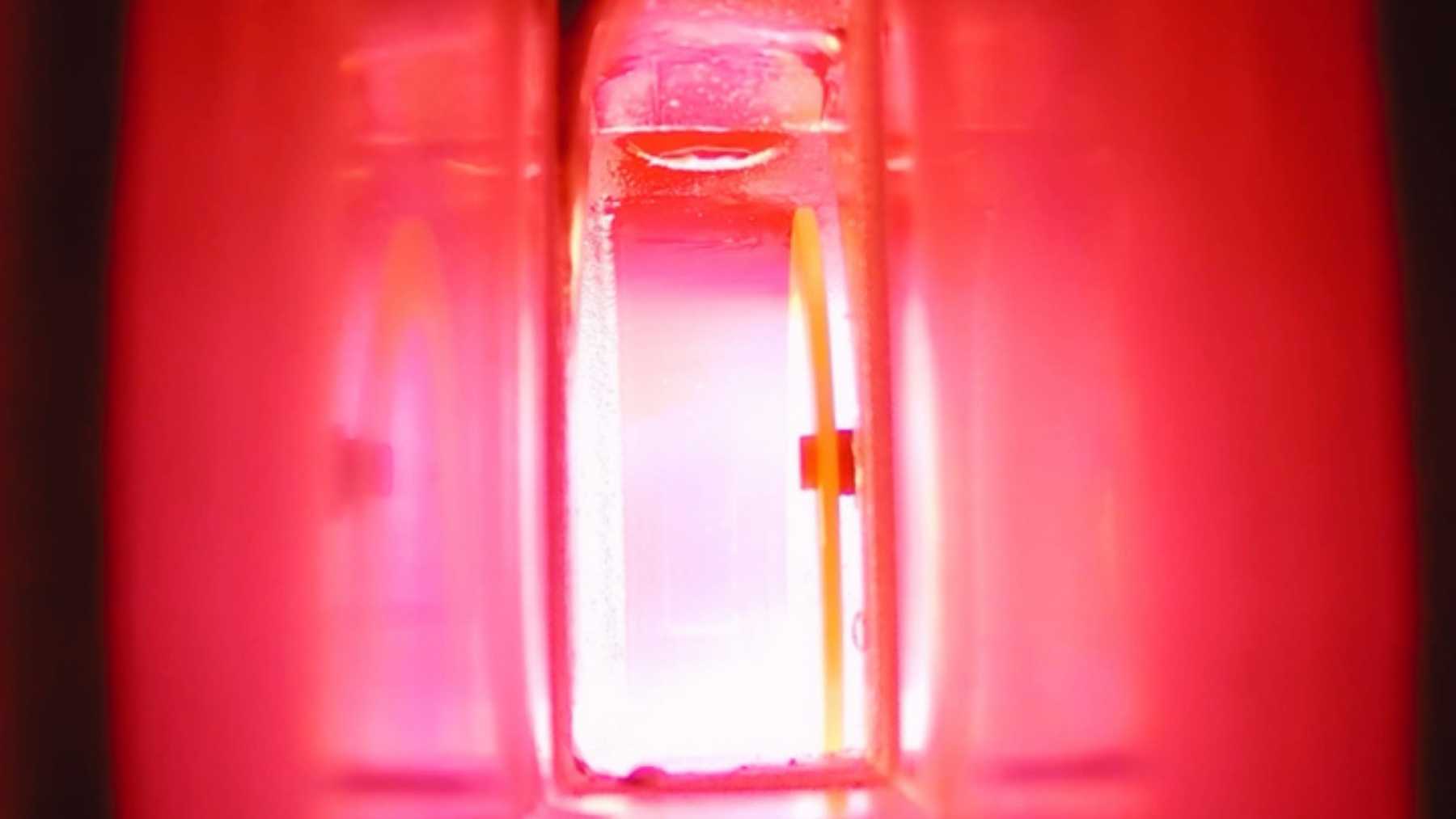
On August 27 a San Francisco startup called Marathon Fusion said it had pulled apart both hydrogen and lithium isotopes inside a spinning column of plasma, one machine doing two jobs the industry has treated as separate problems. Crossed electric and magnetic fields whip the gas around at supersonic speed. Heavier isotopes get thrown out toward the vessel wall, lighter ones stay near the axis, and you draw off whichever end you want. The company says the same architecture can scrub a reactor’s exhaust and enrich the raw lithium going in, and that it shrinks the tritium processing plant by a factor of ten or more.
Nobody has put tritium through the machine yet.
America last enriched lithium in 1963
Deuterium-tritium reactors, which is most of the ones being built, run on two heavy forms of hydrogen. Deuterium comes out of seawater and nobody worries about it. Tritium is radioactive, decays at 5.5% a year, and the entire civilian world stock comes to roughly 55 pounds (25 kilograms). We went through that arithmetic when Britain hired America’s biggest fusion startup to breed tritium inside a reactor.
Breeding it means lining the reactor with lithium and letting fusion neutrons split lithium-6 into tritium and helium. Natural lithium is only 7.5% lithium-6, so somebody has to enrich it first.
The United States knows exactly how to do that, because it did it at industrial scale seventy years ago. Y-12 at Oak Ridge ran the COLEX process in two buildings from 1955 to 1963, pumping lithium hydroxide against a mercury amalgam to pull out the lithium-6 that went into thermonuclear weapons. The Energy Department says more than 20 million pounds of mercury ran through Y-12 in those years, and that about 700,000 pounds of it was lost into the buildings and the surrounding environment. The columns shut in 1963. No American plant has enriched lithium since.
What is left of that supply chain sits in Russia and China. Per F. Peterson, the UC Berkeley nuclear engineering professor who advises Marathon, said in the company’s announcement that annual world output of enriched lithium now runs below one metric ton, about 2,200 pounds, and that the mercury-based process behind it survives only in those two countries.
The Special Competitive Studies Project, a Washington think tank, reached the same place from the policy side. Its December 2025 fusion supply chain report said American companies will need lithium enriched in lithium-6, “for which there is no domestic commercial supply.”
Spinning a plasma is easier than spinning steel
Centrifuges themselves are old news. Engineers have spun uranium hexafluoride in mechanical rotors for decades, fast enough that the heavier isotope drifts outward and you tap the enriched fraction off the wall. Hydrogen ruins that plan. Light gases move at high thermal velocities, so a rotor has to spin far harder to sort them, and metal and carbon fiber tear themselves apart before they get there.
A plasma has no such limit, because nothing solid is doing the spinning. Physicists have been studying plasma centrifuges since the Manhattan Project era, and, as Heatmap News reported in its account of the announcement, none of them had been commercialized for lithium and hydrogen.
The obstacle was heat. Lithium and hydrogen isotopes sit close together in mass, so the plasma has to spin hard to separate them, and earlier machines cooked themselves until the separation fell apart. Marathon runs its device only partly ionized, with some atoms stripped of their electrons and the rest left neutral. The charged particles collide with the neutrals and drag the whole gas around with them, which the company says lets the centrifuge work at lower temperature.
The Energy Department is paying for part of this. Marathon’s centrifuge is an ARPA-E Vision OPEN project, one of 49 selections sharing $147 million. The agency’s own project description says the technology aims at “a massive simplification of fuel processing systems.”
Most of a reactor’s tritium comes straight back out
A tokamak burns almost nothing you put into it on any given pass. Researchers expect ITER to burn under 1% of the tritium injected, with the rest sweeping out to the edge and into a recycling plant that strips helium and impurities and sends the isotopes back around. Hours to days, every cycle, forever.
A 1-gigawatt commercial plant would consume roughly 123 pounds of tritium a year (56 kilograms), and the world’s fission reactors together make a few kilograms of it, under 15 pounds. Marathon puts the quantity cycling through that plant’s fuel loop at about 1,235 pounds a year (560 kilograms), nearly all of it coming back out unburned.
Every pound of that has to be caught, cleaned, separated and reinjected. Every pound sitting in the plant at any moment is radioactive inventory a regulator will ask about. Marathon’s pitch is a process it calls differential pumping: park the centrifuge on the exhaust line, let it fling the heavy deuterium and tritium away from the helium ash and the lighter protium, and the tritium plant downstream gets a smaller, richer stream to work on.
Dennis Whyte, the MIT nuclear science and engineering professor whose group quantified what selective pumping does to a fuel cycle, backed the direction in the company’s release, saying the technology can “improve fusion power plant performance while dramatically reducing the required tritium inventory.” His group’s 2023 paper in Nuclear Fusion put achievable tritium burn efficiency at 5% to 10%, a measure of how much injected tritium a plant actually fuses, and tied it to how quickly the exhaust pumps pull helium ash out against unburned fuel.
Nobody has run tritium through it yet
This is a company announcement, not a peer-reviewed paper, and the gaps are worth stating plainly.
Marathon has not tested the centrifuge on tritium. Heatmap reported that the startup is validating the separation physics with deuterium and protium, the non-radioactive stand-ins, because tritium is expensive and tightly regulated by the Nuclear Regulatory Commission. The materials lab Covalent certified the lithium-6 enrichment result. The hydrogen separation result has not been independently verified, though an MIT nuclear engineering professor reviewed the device’s design, and the company presented the hydrogen methodology at an ARPA-E fusion programs meeting in June. Marathon also says its measurements tracked its own magnetohydrodynamic models closely enough to design the next machine from them.
The company has form for announcements that outrun the hardware. In July 2025 it posted a preprint claiming fusion neutrons could transmute mercury-198 into gold at more than 4,400 pounds per gigawatt of thermal power per year (over two metric tons). That work is still simulation, still unreviewed, and if it ever leaves the computer it will need mercury, which is a peculiar fate for a company whose lithium pitch is that it uses none.
The pilot plant is where this gets expensive
Marathon is a seed-stage startup, and it is going out for a Series A on the back of these results. CEO Kyle Schiller told Heatmap the science is far enough along to commit and the rest is scale, listing “bigger magnets, better cooling, bigger power systems” as the buildout ahead.
The targets he gave are specific. Full-scale production by 2029. Tens of tons of lithium-6 a year out of the first full-scale facility, enough by his math to fuel a new gigawatt-class fusion plant roughly every two years, plus about 1,235 pounds of tritium a year recovered and put back to work.
Set that against the same executive’s estimate of the hole. One fusion power plant needs around 1,000 times more lithium-6 than any country produces today.
The supply side of fusion has quietly turned into a business of its own. A Japanese firm spent a decade cornering the microwave guns and breeding blankets every reactor will eventually have to buy. Andrew Holland, who runs the Fusion Industry Association, said in July that fusion companies still need government help with “the availability of resilient materials and the fusion fuel cycle.” The Energy Department finalized its Fusion Science and Technology Roadmap on June 9, 2026, aiming at commercial fusion power on the grid by the mid-2030s, and named tritium processing a core challenge.
Reactors still get the photographs. Pacific Fusion is ringing a chamber in Albuquerque with more than 150 capacitor modules the size of box trucks, and no lab bench in San Francisco is ever going to compete with that shot.
The mercury is still in Tennessee, though. The Energy Department calls it Y-12’s highest environmental cleanup priority, puts the loss at roughly 700,000 pounds, and has the Outfall 200 Mercury Treatment Facility, the plant that has to be running before the old lithium buildings can come down, scheduled for completion in 2027.
Image Credit: FusionX