
AI keeps getting announced into jobs it doesn’t really do. Somebody’s usually bolted a chatbot onto a product nobody wanted to have a conversation with, and the press release says it’s a breakthrough. So when a national lab says it handed the heating systems on a working fusion machine over to a machine learning model, that’s a different kind of claim, and I want to know exactly what that model was allowed to touch.
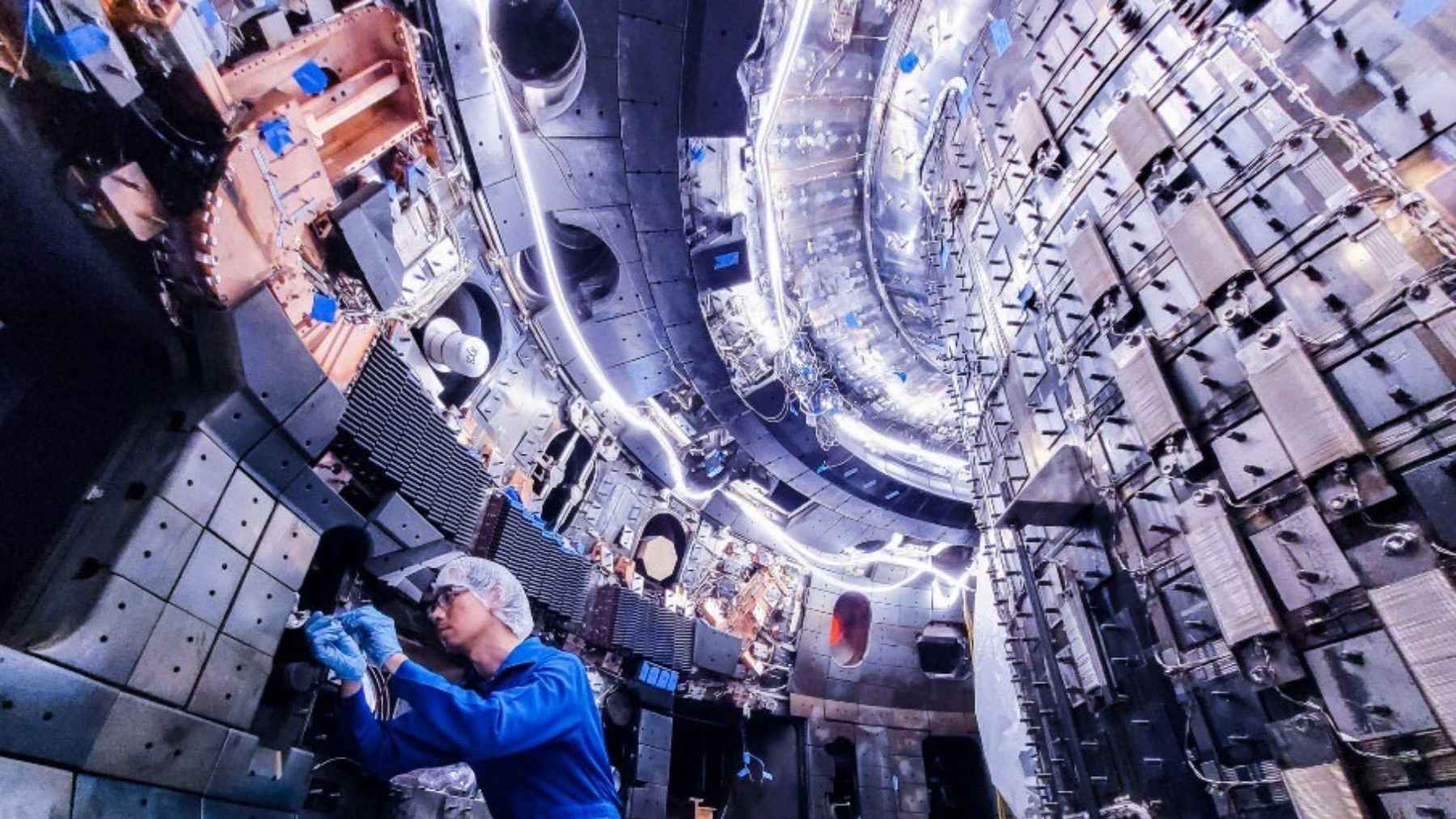
It’s quite a lot, as it turns out. Researchers at the Princeton Plasma Physics Laboratory and Princeton University built a control framework called PACMAN, short for Prediction And Control using MAchiNe learning, and ran it on the DIII-D National Fusion Facility tokamak in San Diego. The lab says the whole loop comes around about every 20 milliseconds, roughly 50 times a second, over and over for the length of a shot.
Let’s get the dates out of the way, because they matter here. PPPL put its announcement out on September 2. The paper behind it went into the journal Nuclear Fusion on July 2, and a preprint has been sitting on arXiv since November 2025. The experiments are older than all three, and the lab doesn’t publish the dates of individual shots. The paper names one of them, shot 204975, and there’s no calendar date attached to it. It’s a July result with a September press release.
The loop runs about 50 times a second
A tokamak holds plasma, an electrically charged gas, inside a magnetic field, and plasma doesn’t sit still. Disturbances grow in thousandths of a second. A focused human operator reacts in seconds, according to Andy Rothstein, one of the two lead authors, and the plasma isn’t going to wait around that long.
The simulation codes that describe plasma properly take days or months to run, so they’re no use at all during an experiment that lasts a few seconds. Machine learning models are fast and approximate instead of slow and exact. That tradeoff is the whole reason they’re in the control room.
PACMAN does four things in order and then does them again. First it grabs every real-time measurement the machine produces, temperatures, densities, magnetic signals, checks them for errors and packs them into a single bundle. Then the AI models take the inputs they want and put out a call on where the plasma is headed. Controllers turn that call into hardware requests, like telling a heating beam to go up. Last comes the stage that settles arguments between controllers, clamps every command against the machine’s hardware limits and sends it out. If that sounds like a lot of plumbing for an AI story, that’s fair, and the plumbing is what nobody had built before.
That last stage doesn’t get talked about much, and it’s arguably the most important piece of the whole design if you’re the one signing off on letting a model near the hardware.
So what’s a tearing mode?
The magnetic field in a tokamak is supposed to hold the plasma in smooth nested layers, a bit like the rings of an onion. A tearing mode is what happens when those layers tear and reconnect into islands. Heat leaks across the islands, confinement drops, and a bad one can end the shot early.
So why not just catch it the old way? Because a conventional controller can only spot a tearing mode once it’s started, and suppressing one after the fact costs you performance. In one of these experiments, the model flagged the mode roughly 200 milliseconds before it showed up.
Then the controller does something physical about it. When the predicted probability crosses 10 percent, the first gyrotron stops driving current broadly off-axis and starts tracking the q=2 surface. That’s the layer of the magnetic field where these islands like to form, and putting current drive right there makes it harder for one to grow. Past 20 percent, a second gyrotron switches to the same target.
Aiming heat at a problem before the problem exists is a pretty different way to run a machine than waiting for the alarm to go off.
PACMAN steered all six microwave heaters at once
A gyrotron is a tube that produces a very high power microwave beam, and DIII-D has six of them. The beams don’t go in fixed. Each one bounces off a steerable mirror, so move the mirror and you’ve moved where the heat and the driven current land inside the plasma. The tubes are a serious business in their own right, and we’ve written about the Japanese supplier selling them into DIII-D that skipped building a reactor of its own entirely.
PACMAN steered all six at the same time, swinging the mirrors over and trimming the power on each one while the shot ran, to hit goals the researchers had set beforehand. “There was no algorithm to find that optimal solution before,” said Hiro Farre Kaga, the other lead author.
A different experiment used beams, microwaves and gas together to hold 33-point profiles of plasma density and rotation on target. That one ran on a 20 millisecond cycle, about 4 milliseconds to squash the plasma state down into a small mathematical model and up to 10 more for the optimizer working out what to do about it.
Even so, it isn’t driving everything
The authors are blunt about where PACMAN doesn’t belong. The framework, they write, “would be inappropriate” for vertical displacement events, where the plasma slips vertically and disrupts in under a millisecond. A loop that comes around every 20 milliseconds turns up to find the shot’s already over.
There are other guardrails. If two controllers ask for conflicting settings on the same hardware, the output stage sends nothing at all and tells the operators. That’s the safe answer, and the authors are honest that doing nothing can occasionally be more dangerous than doing something imperfect. If a diagnostic fails, the model that needed it doesn’t run that cycle. Beam power, microwave power, gas valve voltages, mirror angles and coil currents all get clamped to fixed minimums and maximums before any of it reaches the tokamak. Humans still set the targets before each shot, and physicists retune the controllers between them.
And no, this wasn’t one heroic shot with everything switched on together. Each experiment was its own run at its own speed, from a 2 millisecond cycle for the model predicting edge energy bursts up to 50 milliseconds for the reinforcement learning controller. The paper describes five of them and mentions four more it doesn’t detail.
So does any of it travel?
That’s the actual pitch. Building the framework and getting the first model into it took months of work. The second one was in within a couple of days, according to Rothstein, and he says it went in far more cleanly than the first.
Egemen Kolemen, the Princeton professor who supervised the work, argues that the modular setup means a model can be dropped in, pulled back out or stacked alongside others while everything else stays where it is, and that the same framework could move to tokamaks of other sizes and shapes, including machines nobody has designed yet. I’d file that under reasonable goal rather than delivered result. Every tokamak you’d want to put this on has its own diagnostics, its own actuators and its own control system, and the machine being assembled in southern France has spent three years fixing a heat shield.
You’re not getting electricity out of any of this either, and DIII-D isn’t built to produce any. What PACMAN did is steer hardware faster than a person can, inside limits a person wrote down first.
PPPL says the framework is ready to take new models as DIII-D works toward its next control targets, and the team wants to run the models and controllers in parallel to speed the loop up further. The paper went up in Nuclear Fusion on July 2 with Rothstein and Farre Kaga as co-lead authors, and the lab announced the results on September 2.