
The fusion industry just wrapped up the best fundraising year it has ever had. Companies chasing fusion power raised $4.48 billion in the 12 months to July, according to the Fusion Industry Association’s annual report published July 13, bringing the sector’s total haul to $14.24 billion since 2021.
All of that money is chasing the same prize, electricity on the grid, and the industry’s own report pegs delivery for the 2030s. Nobody has sold a fusion kilowatt-hour yet. The 56 companies surveyed estimate they will need around $2.7 billion apiece to get a first commercial plant running.
Then there is Janesville, Wisconsin, a city of about 60,000 roughly 100 miles northwest of Chicago. The fusion machines running there every day already have a paying job, and it has nothing to do with your power bill. They make neutrons for medicine. And on April 9, the Department of Energy offered the company behind them a loan of up to $263 million to finish the factory built around that idea.
SHINE sells neutrons, not kilowatts
The company is SHINE Technologies, founded by Greg Piefer, who studied nuclear engineering at the University of Wisconsin-Madison and never moved the operation far from home. Its core hardware is a particle accelerator that fuses deuterium and tritium, which Piefer describes as the easiest fusion reaction to run at the lowest temperatures. SHINE does not try to capture the energy. It harvests the neutrons that fly out.
Neutrons, it turns out, are a product. SHINE’s machines already earn revenue X-raying aerospace and defense hardware with them, a trade called neutron radiography. The company also produces lutetium-177 in Janesville, a cancer-fighting isotope in such demand that a 40-year-old Canadian power reactor now breeds it mid-shift.
The bigger business is the next step. Aim those fusion neutrons at low-enriched uranium and you get fission, and among the fission fragments sits molybdenum-99, the isotope this whole story runs on. The DOE describes the setup as fusion and fission working together. SHINE runs the uranium as a liquid target and recycles it, which the company says cuts both waste and operating costs, and none of it involves highly enriched uranium. That last detail is exactly why the federal nonproliferation office spent 16 years helping pay for the development.
America runs 40,000 of these scans a day and imports every dose
Mo-99 itself never goes into a patient. It decays into technetium-99m, the workhorse tracer of nuclear medicine, which is used in over 40,000 medical procedures in the United States every single day, per the DOE. Attach it to a drug that follows blood and a gamma camera shows cardiologists exactly where blood is flowing through heart muscle, or where it is not. Point the same trick at bone and it lights up tumors.
The United States consumes nearly half of the world’s Mo-99 and produces none of it commercially. Domestic production ended in the late 1980s, according to the National Academies, and every dose since has arrived from research reactors in the Netherlands, Belgium, South Africa and Australia.
The isotope is also a terrible traveler. It loses about 1 percent of itself every hour, a half-life of roughly 66 hours, and by the federal government’s math a third of the volume and value is gone by the time it crosses an ocean. “You can’t just store up a bunch of Mo-99,” David Dick, a clinical professor of radiology at the University of Iowa, told Wisconsin Public Radio in early July. Hospitals take fresh generator deliveries every week because there is no other way to run the system.
The reactors making it are not young either. Much of the supply leans on machines dating to the Cold War, including a 1960s reactor buried in Dutch coastal dunes whose replacement is only now being poured. SHINE’s April announcement called the current fleet “venerable but aging,” which is corporate for old and full.
The $263 million comes with an if
What the DOE issued on April 9 is a conditional commitment for a loan of up to $263 million, through its Office of Energy Dominance Financing, to a SHINE subsidiary set up for the plant. Conditional is the load-bearing word here. The government has stated its intent to lend, and no money moves until a list of technical, legal, environmental and financial conditions is satisfied and definitive documents get signed. SHINE said in April it would work to meet them.
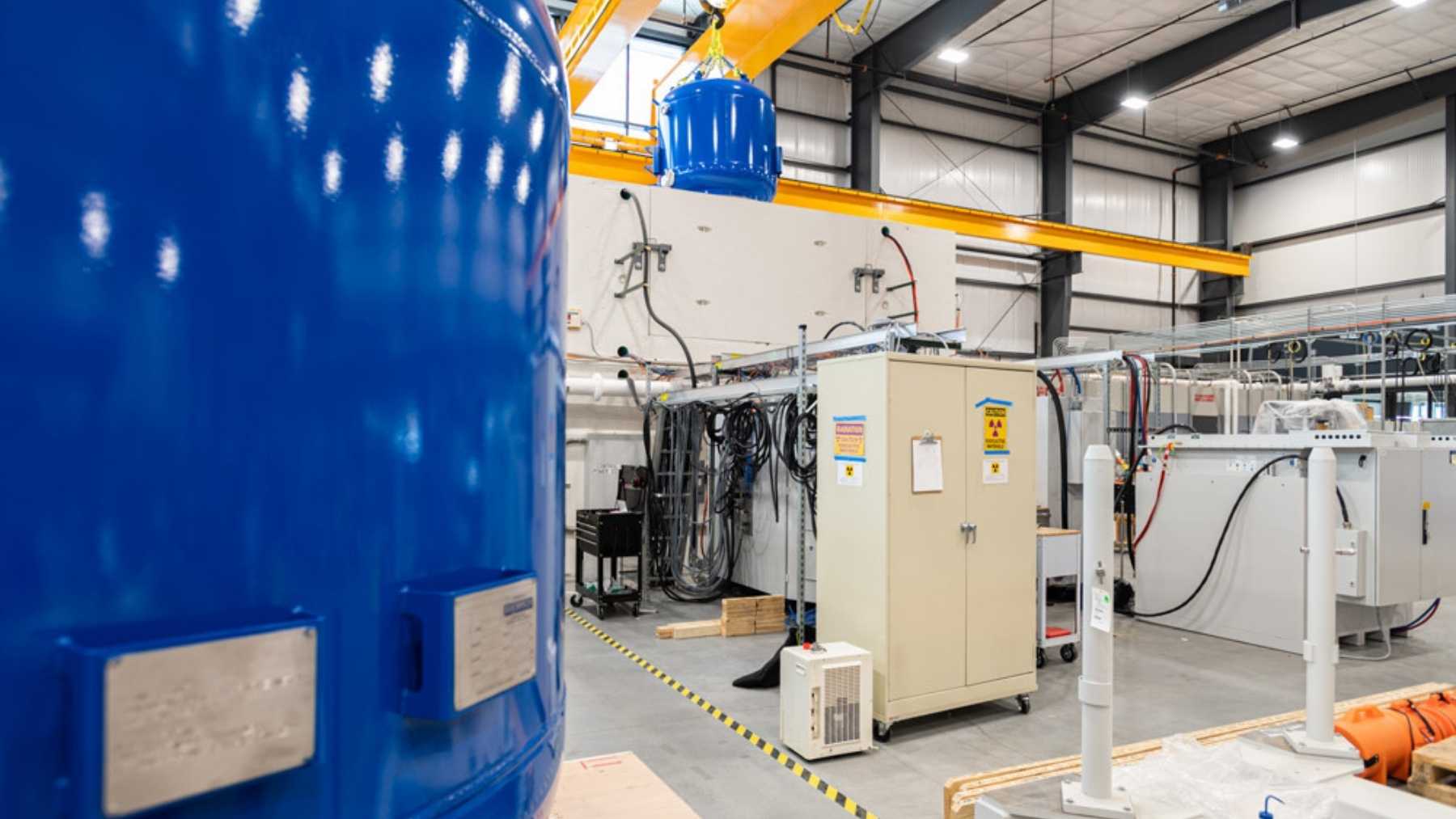
The factory the loan would finish is called Chrysalis, and it is not a rendering. The National Nuclear Security Administration put construction at 75 percent complete when the commitment was announced, on a site where ground first broke back in 2019. If the loan closes, SHINE expects roughly two more years to finish the building and start producing Mo-99.
The advertised numbers are not small. NNSA says Chrysalis could cover up to three-quarters of American demand on its own, and SHINE expects it to become the largest medical isotope production facility in the world once fully running. The same accelerator lines are designed to turn out iodine-131 and xenon-133 as side products. The build supports about 200 construction jobs and 150 permanent positions.
“Chrysalis shows that fusion can improve the lives of millions of people each year,” Piefer said in the NNSA’s announcement.
Janesville has built big machines before
If the city’s name rings a bell for car people, it should. Janesville housed General Motors’ oldest operating plant, a 4.8 million square foot complex that opened in 1919 building tractors and spent its later decades turning out Tahoes, Suburbans and Yukons. The last Tahoe rolled off the line on December 23, 2008, two days before Christmas, and the remaining production wound down the following spring.
At its peak the plant employed around 7,000 people. Demolition crews finished clearing the site in 2019, the same year SHINE broke ground on its isotope facility across town. SHINE’s own announcement leans on that history, framing the project as Janesville trading its automotive roots for a nuclear future. A 150-job isotope plant does not replace a 7,000-job assembly line, and nobody serious claims it does. It is still the most consequential machine anyone has bolted to a factory floor in Janesville this century.
Fusion electricity is still a target date, not a product
Which brings this back to the $14.24 billion. Helion, the most aggressive of the power-plant builders, raised another $465 million in June and is constructing its first plant in Washington state to sell Microsoft 50 megawatts under a deal that targets 2028. Other players skip the reactor race entirely and focus on selling the picks and shovels every future plant will need. Every one of them is still working toward the first fusion kilowatt-hour anyone actually gets billed for.
SHINE’s bet inverts the order. Sell the neutrons now, in industrial imaging, in lutetium-177, and in Mo-99 at scale if Chrysalis comes online, and let the isotope margins fund the long climb toward energy. Piefer told Wisconsin Public Radio in early July that he still wants SHINE’s technology making clean power one day. The difference is that his fusion machines already send invoices.
None of this is a done deal. The commitment is an intent to lend, not a wire transfer. The plant needs about two more years of work after any closing, and until it runs, every dose of America’s most-used medical isotope keeps landing on a plane from another continent. The Dutch are pouring concrete for their replacement reactor at the same time, so the old supply chain is not standing still either.
But if Chrysalis does switch on, the first thing fusion sells America at scale will not be electricity. It will be a look inside your own chest. The grid can wait its turn.