
Anyone who’s ever replaced a kitchen faucet knows how step one goes. You crawl under the sink, find the shutoff valve and crank it closed before you touch a single fitting, unless you’d like to see what your home’s water pressure can do to a cabinet full of cleaning supplies.
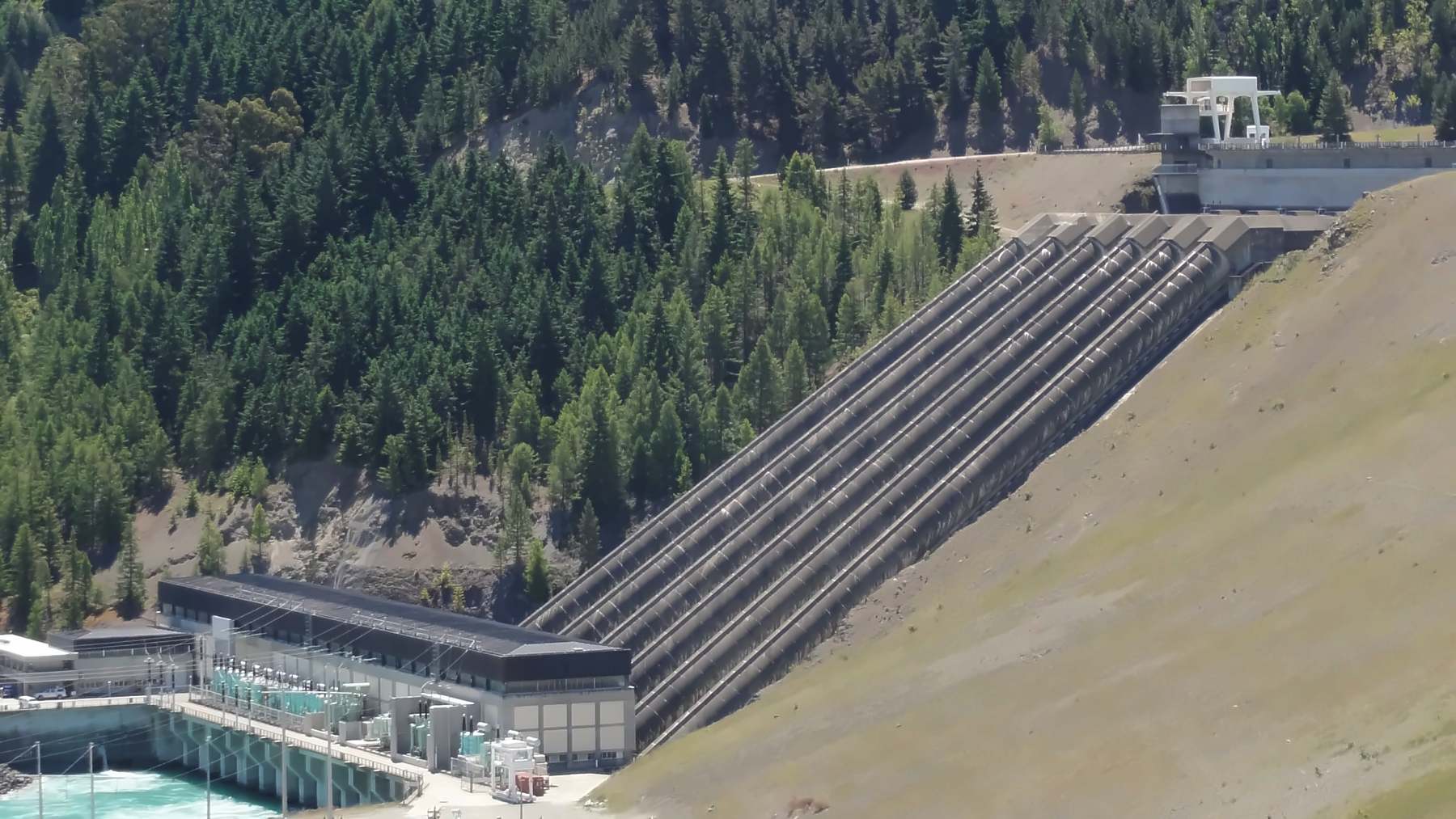
Meridian Energy’s skipping step one on purpose. The New Zealand utility is replacing the rubber bearings under six huge concrete water pipes at its Benmore hydroelectric plant, and it’s doing it while water keeps rushing through them to the turbines. That’s frankly a pretty brave way to do plumbing.
So why don’t they just turn the water off?
Mostly because Benmore’s a tough one to do without. It’s New Zealand’s second-biggest hydro plant, Meridian says it makes enough electricity for around 300,000 homes, and it’s where the country’s high-voltage DC link begins. If the term’s new to you, that link is a long-distance power line, part of it under the sea, that ties New Zealand’s two main islands together. Benmore sits at the South Island end of it.
A drained pipe isn’t spinning a turbine, either. Utilities usually shut things down for this kind of work, and when we wrote about a 200-ton valve at a Tennessee power plant buried inside a mountain, its last checkup took a crew of 300 and a 60-day shutdown.
The original bid documents at Benmore called for shutting the pipes down, according to Seipp Construction, the contractor on the job. Seipp says its method should cut two years off the schedule and spare Meridian NZ$65 million in generation costs. That’s the company’s own math, and it hasn’t been audited. Oddly enough, the savings figure matches the NZ$65 million Seipp gives as the estimated cost of the whole project. I’d probably take it with a grain of salt.
So what’s a penstock, anyway?
A penstock is the big pipe that carries water from a reservoir down to a hydroelectric turbine. The farther the water drops inside it, the more pressure it’s carrying when it hits the turbine at the bottom.
Most of the big ones are steel. Benmore’s aren’t, which Meridian itself points out is unusual for a dam anywhere in the world. Its six pipes are concrete, they’ve been carrying water down the hillside for about 60 years, and each one measures 17 feet across on the inside.
They sit at a 37-degree angle, too. That’s about the pitch of a steep staircase, except this one’s a few hundred feet long and the people working on it are hauling hydraulic gear.
If you’re curious what happens when one of these pipes gives out, we covered a 14-foot penstock in California that split in February and put 130 million gallons on the hillside below it all at once.
The jacks ride in on a trolley
Each pipe sits on rubber bearings, and if you’ve ever driven over a highway overpass, you’ve driven over the same basic idea. Bridge decks rest on thick pads of rubber and steel that let them shift a little as they heat up, cool down and get pounded by traffic. Benmore’s six pipes rest on 636 of them, and Meridian plans to replace every one.
Each one’s a pain to get out, though. It’s squashed under the pipe’s weight, and there isn’t much room around it. So the contractor and a specialist subcontractor built a trolley that gets winched up the slope with hydraulic jacks on board. Once it’s up there, it tucks into a tight spot and then reaches out to line the jacks up with the bearing to within a fraction of an inch. The jacks take the pipe’s weight around that spot while the old pad comes out and a new one goes in.
The contractor isn’t lifting a whole pipe off the hill, by the way. The jacks only carry the section around the pad that’s being changed.
The trolley’s hydraulics and electronics alone weigh more than 2,200 pounds, and they hang out over the slope at a steep angle once the rig’s extended. So the contractor tried the whole thing on a mock-up slope in Christchurch first, then tested it at Benmore on a penstock with water running through it.
I’d argue the trolley is the cleverest bit of the whole project. Structex, the engineering firm that designed the method alongside the contractor, says it’ll also let Meridian replace individual bearings down the road.
I’d love to know how far along they are, but I couldn’t find a count of finished bearings from Meridian. The contractor’s write-up doesn’t put a date on that live trial, either.
How heavy is one of these pipes?
That depends on who you ask. Meridian says each pipe weighs nearly 3,300 tons with water inside. Seipp puts it at about 5,500. They don’t agree on length either, with Meridian at about 427 feet and Seipp at 394.
I ran Meridian’s own dimensions, and the water alone in a pipe that size comes out to just under 3,200 tons, before you count any concrete. So my guess is Meridian’s figure describes the water and the contractor’s describes the pipe with the water in it. Neither company has explained the gap, so you’re better off treating both numbers as rough.
Meridian is bracing for the Alpine Fault
Meridian’s doing all of this because of earthquakes. Tania Palmer, Meridian’s general manager of generation, put the odds of a significant quake on the Alpine Fault at 75% over the next 50 years when the company announced the work in January.
If you haven’t heard of it, the Alpine Fault is where two tectonic plates grind past each other along the spine of New Zealand’s South Island, and it’s the reason the Southern Alps are there at all. Earth Sciences New Zealand, the government’s earth-science institute, says the fault produces a magnitude 8 or so roughly every 300 years, and its last big rupture came more than three centuries ago.
Meridian says the dam itself isn’t at risk. The company wants to keep a big quake from knocking some of the pipes out of action for a long stretch, since Palmer expects Benmore to play a big part in the country’s recovery.
The bearings are one piece of a bigger job. Meridian’s also changing the joint at each pipe’s upper end so the pipe can move freely when the ground shakes, and it’s adding what it calls fluid viscous dampers. Those are basically giant versions of the shock absorbers on your car, and 24 of them are going in midslope.
The concrete blocks that anchor the pipes to the hill are getting 12 reinforced concrete sleeves on top of that. Going by Meridian’s description, the pipes should be able to move a little in a quake while the dampers soak up the energy.
Figures: Meridian Energy, Seipp Construction.
Palmer says Meridian thinks this is “the first time a project like this has been undertaken anywhere in the world.” The contractor’s more modest and calls the bearing swap a first for New Zealand. I can’t verify the world-first part myself.
Don’t expect a finish line anytime soon. Meridian’s annual results on August 26 counted the Benmore penstock job in its maintenance spending for the fiscal year that ended in June. That presentation also gives the job its own line in the capital spending guidance for the current year, and the schedule Meridian announced in January still runs into early 2029.
Image Credit: Wikimedia Commons