- 2 MONTHS AGO · MILITARYA German drone submarine 13.8 feet long and 882 pounds is built to fit a standard torpedo tube, swim four days on a 42-kWh battery and sit on the seabed listening for weeks, rated for the same 19,685 feet as the three-ton American one Iran hauled in
- 2 MONTHS AGO · MILITARYA 49-foot drone boat, the first the Turkish navy ever commissioned, laid a training version of a smart seabed mine once under remote control and once fully on its own, and the live mine waits on the bottom at up to 328 feet for a ship’s sound, magnetism and pressure
- 2 MONTHS AGO · MILITARYNineteen 154-pound underwater drone gliders with no propellers flew at once off Portugal in NATO’s biggest uncrewed naval exercise, hunting submarines by listening, and a bigger 377-pound glider dragged a line of hydrophones through the water behind it
- 2 MONTHS AGO · MILITARYA 39-foot drone boat from a German startup, built to carry 10 attack drones and four anti-ship missiles, launched its drones during a NATO exercise off Portugal, and its 20-foot sister boat in German military hands carries nothing that shoots
- TODAY · THIS ARTICLEA 39.4-foot drone submarine turned up at a NATO exercise in Portugal carrying a rig whose only job is rehearsing a payload drop, with nothing live leaving the hull while engineers read the telemetry, and the US Navy has already taken delivery of the same long version
Car companies don’t put people in the cars they crash into walls. Thankfully. Well, there’s a few people I could think of… Anyway, they strap in dummies, run the violent part, and read the sensors afterward. Navies work pretty much the same way with weapons.
We just covered an 18-foot Turkish drone boat that spent its early trials with an inert lump bolted in where the warhead goes. Now it’s a submarine’s turn.
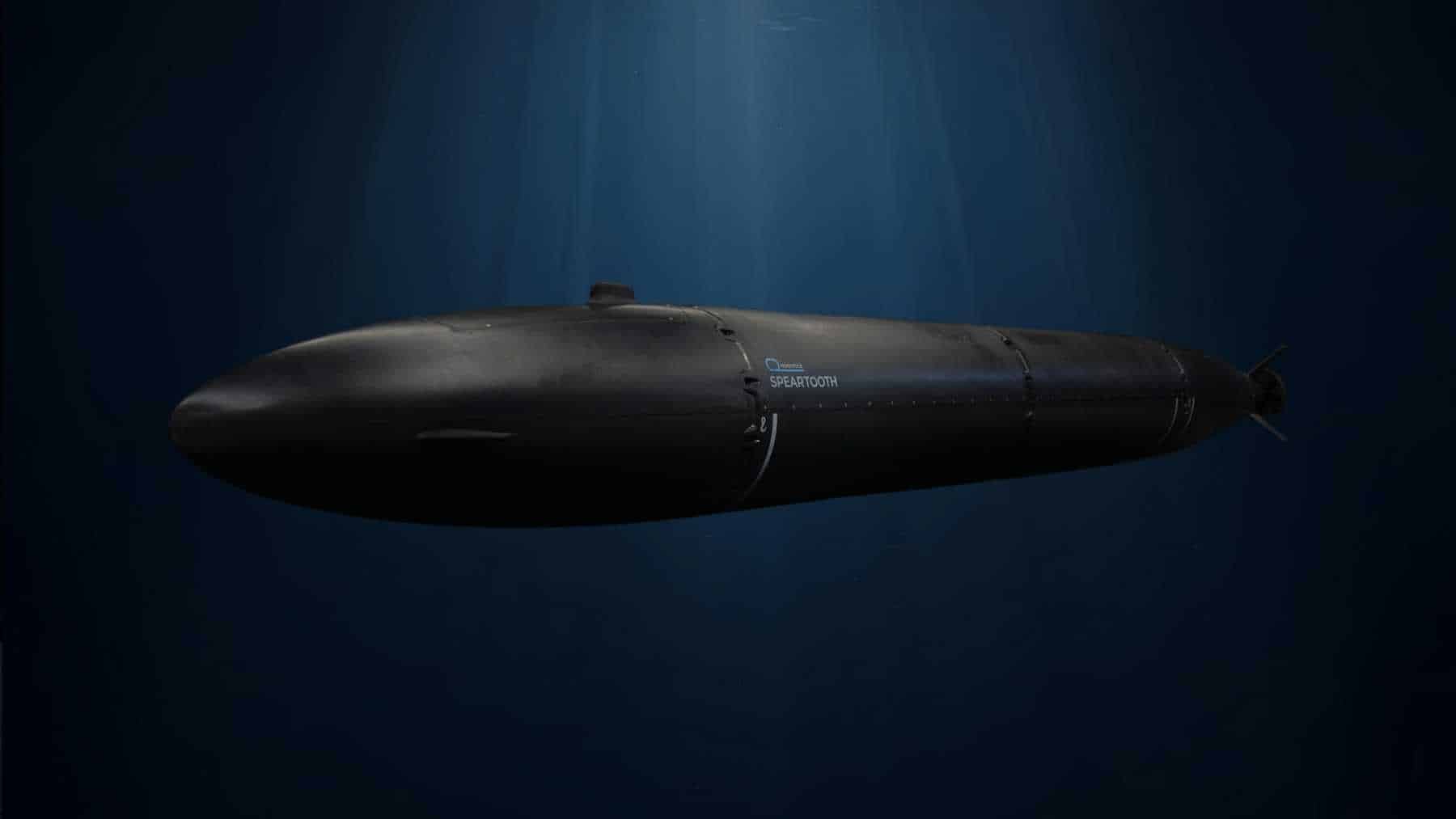
The Speartooth, an Australian drone submarine we wrote about in June, when the US Navy took delivery of its first, turned up at a NATO exercise in Portugal in September, fitted with hardware whose sole job is to pretend to release a payload. Janes spotted it there and published its report on September 16th.
The Bold Machina 2026 exercise ran from September 7th to the 15th at the Lisbon Naval Base in Alfeite, Portugal. NATO describes BOMA as a small-scale experimentation event where its maritime special operations community tests new technology alongside industry and academia. The 2026 edition focused on crewed and uncrewed systems for long-range strike and reconnaissance, underwater communications, and counter-drone gear for small boats.
So what was a drone submarine doing at a special forces exercise?
Don’t expect any explosion. It was mostly just, well, looking at things. “It’s just standing there… menacingly!”
The boat in the water for Vignette 1 of the exercise, a scenario called Operate the Machine, was the 39.4-foot configuration with two payload modules installed, on a hull 3.28 feet across. Janes reports the primary aim was intelligence, surveillance, and reconnaissance, which is defense-speak for going somewhere quietly, collecting data, and coming home with it.
The new hardware was a canister injection system, fitted to simulate a payload release. This means the boat carried a rig that rehearses pushing something out of the hull, with nothing live on board. So the engineers get their data, the operators get their practice, and the only thing that actually leaves the boat is telemetry.
No torpedo was fired at BOMA. Instead, the canister setup simulated the release, reported Janes. That’s the right order of operations: you rehearse the drop until it’s boring, and then somebody signs off on trying it with something that explodes.
A Eurobotics representative told Janes the two-module layout could also suit a harbor attack, meaning the boat slips into a harbor to release a payload or resupply whoever’s waiting there. The same representative declined to share payload figures, but said a one-way version carrying an explosive payload could “put out of service” a frigate-type vessel. That’s a vendor describing a hypothetical at a military exercise. Nobody ran that test in Portugal, and I’d file the frigate claim under marketing until somebody demonstrates it.
How does it find its way around down there?
Unfortunately, GPS doesn’t work underwater. Satellite signals are weak radio waves, and water soaks them up within a few feet of the surface, so a submerged drone has to keep track of its own position some other way.
Per Janes, the Spear Tooth does so with a Doppler Velocity Log, a sonar sensor, and an inertial navigation system. The DVL pings sound off the seabed to measure how fast the boat is really moving over the ground, and the INS is basically a box of gyroscopes and accelerometers that adds up every turn and nudge since the last known position. Neither is perfect, and small errors pile up the longer you stay down, which is why the boat can optionally come up, grab a satellite fix, and duck back under, according to the Eurobotics representative who spoke with Janes.
If you’ve ever watched your phone’s blue dot wander around a parking garage, you’ve seen the same problem at consumer scale. The Speartooth just solves it with hardware that, I’d wager, costs more than your car. And that’s valid, since explosives will (eventually) be involved.
The catalog numbers don’t quite match the boat
Eurobotics is the German company that sells and builds the Speartooth in Europe as the partner of C2 Robotics, the Australian firm that designed it, and its official spec sheet lists two configurations. The longer one comes in at 37.7 feet and 2,535 pounds without payload, with 84.8 cubic feet of payload volume. The hull Janes saw at Alfeite measured about 39.4 feet, compared to 37.7 on that sheet. I’m not going to pretend those are the same line item, because neither company has said they are.
The published ratings give a top speed of 7 knots, about 8 mph, and a range of over 575 miles on battery power. Extra battery packs can go into the payload bay to stretch that further, per the same sheet.
The European sheet lists a rated depth of 19.7 feet, roughly the deep end of a decent municipal pool, and that’s the only depth number Eurobotics publishes for this configuration. My guess, and I’m not a drone expert, is that the public brochure is deliberately boring, because interesting performance figures rarely survive the trip to a marketing page.
If you’re wondering why an Australian boat with a German sales operation matters to anyone on this side of the Atlantic, the US Navy already owns Speartooths. The service took delivery of its first one back in May, and it ordered the long, two-module configuration specifically. So whatever this canister rig teaches in Portugal, it’s safe to assume the lessons won’t stay in Portugal.
Janes photographed the two-module Speartooth pierside at Alfeite on September 11th, four days before Bold Machina 2026 wrapped up, and published its report from the exercise on September 16th.
 A 1,123-foot aircraft carrier with eight defueled reactors is under tow from Newport News to Mobile, where a scrapyard will cut the hulk apart around those reactors over the next four years while a 100-yard safety zone moves with herMilitary · 2 weeks ago
 A 13-foot-wide US Navy nuclear mini-sub rolled across the seabed off Scotland on wheels, found an F-14 upside down in fishing nets nearly 1,900 feet down and brought its secret Phoenix missile up with a Soviet spy trawler watching, after a month of sonar ships had come up emptyMilitary · 2 weeks ago
 Drone boats that ride almost awash like a drug smuggler’s semi-submersible just went to three American companies to prototype, and the Pentagon’s spec asks each one to haul 18,000 pounds of Marine supplies up to 2,000 nautical miles alone and sink itself on commandMilitary · 2 weeks ago