
Pretty much every water story out of the Southwest this fall has gone the same way: there isn’t enough of it. We’ve written about New Mexico’s biggest reservoir sitting under 5% full and Lake Mead hanging a few feet above the level where most of Hoover Dam’s turbines have to sit out. So an Arizona dam with too much water in front of it took me a second to process.
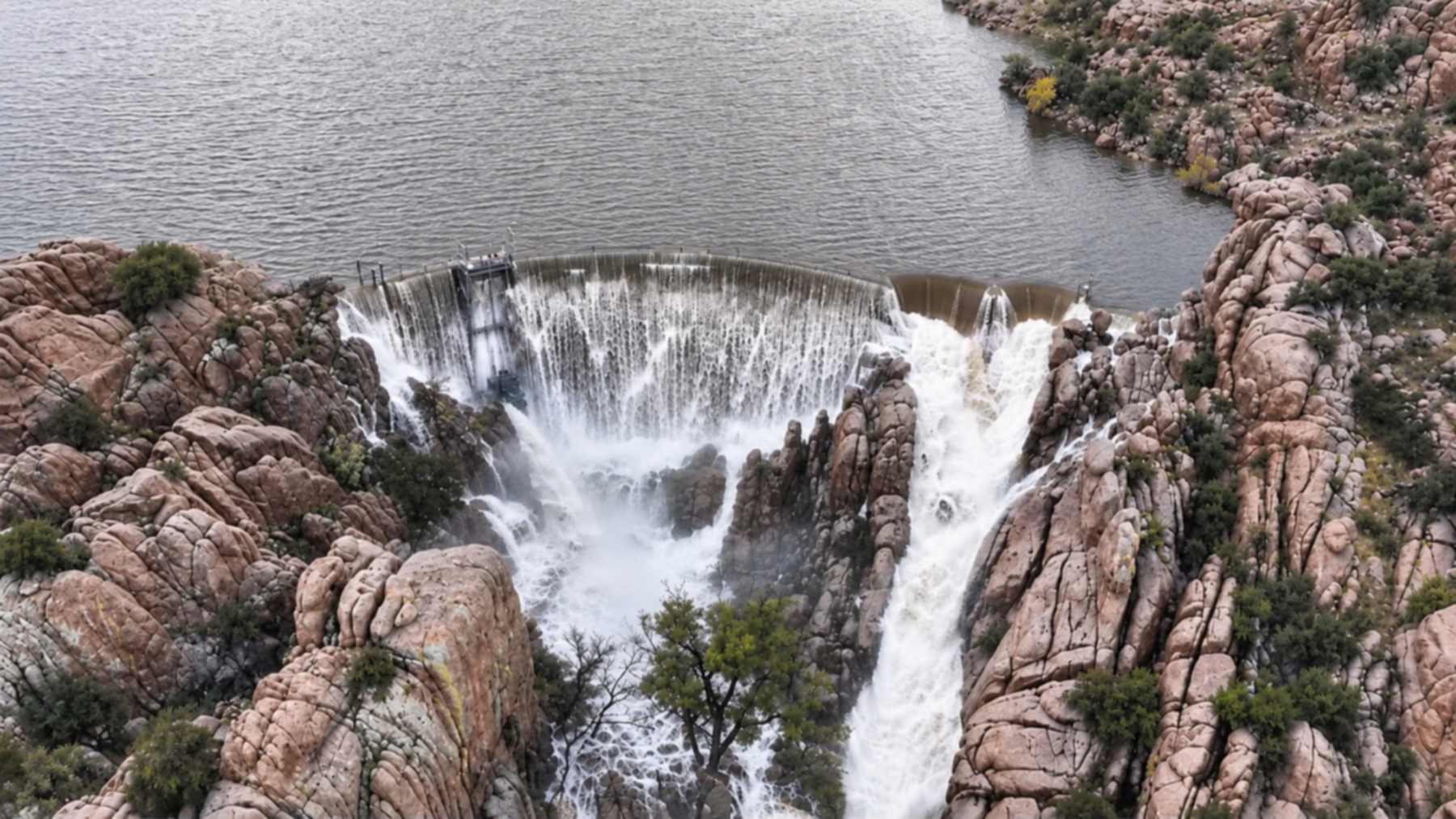
Watson Lake Dam, which also goes by Granite Dam, sits in the Granite Dells a few miles north of downtown Prescott. On Sunday, November 1, water ran over the top of it. And the city had tried to get ahead of this. According to Prescott’s release, Public Works opened the dam’s 36-inch release valve before the storm, along with the crosscut channel to neighboring Willow Lake, so the reservoir would have some room. It overtopped anyway.
So what good is a valve if the water’s going over the top regardless?
How much water are we talking about?
A lot. The city puts the peak coming into Watson Lake at more than 4,000 cubic feet per second, or cfs. The ground was already soaked, so runoff came in at two to three times normal, and the mountains were the worst of it. By the time the city put out its release, the inflow had dropped to about 1,680 cfs. A cubic foot is about 7.5 gallons, which makes that peak close to 30,000 gallons every second. Picture an Olympic pool (about 660,000 gallons) showing up every 22 seconds.
Now look at the valve. A 36-inch opening is about 7 square feet. To squeeze 4,000 cfs through it, the water would have to move at around 566 feet per second, or about 385 mph. That’s roughly double what a NASCAR stock car does at Talladega, and I’m pretty sure no pipe in Arizona is doing it.
That valve’s real job comes before the flood, when it can lower the lake a little at a time. Prescott hasn’t said how much water it passes or exactly when it was opened, so let’s build a hypothetical. Say water ran through it at a lively 30 feet per second, which works out to about 212 cfs, and say it ran for three days. You’d clear out around 1,260 acre-feet. (An acre-foot is a foot of water spread over an acre, about 326,000 gallons.)
At 4,000 cfs, you’d burn through that room in a little under four hours.
Those numbers are mine, not the city’s, and the crosscut channel would’ve added some capacity I can’t put a figure on. Still, I’d say Public Works made the right call. A few extra hours is worth having when you know a storm’s coming, and it’s pretty much what you’d want a city to do with a Flood Watch out two days before the rain was due. The National Weather Service posted that watch on Thursday, October 29, and the city says the rain still beat the forecast.
Figures: City of Prescott, November 1 release.
So what is Watson Lake Dam?
It’s a concrete arch, which is basically a curved wall with the bulge facing the lake. The water pushes against it, and the curve hands that load off to the rock on either side, kind of like a stone bridge passing its weight into its supports.
Pinning down its size is harder than you’d think. A copy of the Army Corps of Engineers’ National Inventory of Dams lists it as Granite Creek Dam, 187 feet long, with a dam height of 81 feet, a separate inventory height of 98 feet, and normal storage of about 4,600 acre-feet. A 1947 report on the Chino Valley Project says about 85 feet. The Prescott Journal Miner, writing at the time, went with “nearly 100 feet from the bed of the creek.” I couldn’t find a weight for it anywhere.
The age is just as slippery. The inventory says 1920, the 1947 report says 1914, and the Journal Miner covered a big opening celebration in April 1915, complete with free barbecue. It was built to irrigate farmland in Chino Valley, and in 1998, Prescott voters got to decide on a $15 million deal to buy the lakes. The city owns the dam now.
That inventory copy also calls it “high hazard,” which sounds terrifying. The label rates what’s downstream, though, and basically means lives would likely be lost if the dam ever failed. It says nothing about the dam’s condition or how likely a failure is.
The valve and the channel both have some history
I went digging on that 36-inch valve and found my favorite detail of the whole story. In a 1998 column archived by the Sharlot Hall Museum, Prescott’s then-communications director, J.J. McCormack, wrote that a helicopter had flown in a new 36-inch gate valve, the hand-cranked kind, several years earlier. You could only get to the dam on foot or by boat. I can’t swear that’s the valve the city opened this time, and I don’t know if anyone still cranks it by hand, though the matching size is a pretty strong hint. I find it pretty charming that a flood plan might hinge on a valve that needed its own airlift.
The crosscut is even better. That 1947 report describes a cut through a thin strip of land between the two lakes, meant to send Watson’s overflow into Willow. According to the report, a mistake left the cut too shallow for water to get through, and “it has never functioned.” Prescott opened a crosscut ahead of this storm, so somebody presumably fixed that mistake or dug another one, but I couldn’t find out when.
The same report says Willow has a small drainage area and tended not to fill. That might explain why one lake was going over the top on Sunday while its neighbor still had 7.5 feet to spare, though the city hasn’t spelled that out. Watson wasn’t alone on Sunday, either. Upper Goldwater Reservoir topped too, and the city was keeping a close watch on Lower Goldwater.
Is water going over a dam as bad as it sounds?
It depends a lot on what the dam’s made of. We recently covered Michigan’s Edenville disaster, where the flood ran over Sanford Dam downstream and breached it. Water and dirt embankments don’t get along.
Concrete tends to take it better. Prescott says Watson is “rated for water to flow up to 10 feet over the top,” which is a pretty striking thing to read if you’ve always thought of overtopping as the disaster itself. The Bureau of Reclamation’s dam safety manual says concrete dams are generally seen as tougher against it.
The worry is the rock underneath. Water falling off the crest can scour what’s below a dam and the abutments, which are the rock walls an arch leans on, and that same manual says a concrete dam can be lost if its foundation support goes. Reclamation’s chapter on arch dams says foundation sliding has historically been the leading cause of their failures, and it doesn’t know of one failing from stress in the concrete itself. The Granite Dells are a whole lot of exposed rock, which sounds like good news to me, but I’m a car guy and not a geologist.
The city says staff are continuously monitoring for structural concerns. A city document on later dam repairs says the Arizona Department of Water Resources inspects each city-owned dam every year, and that Watson got concrete repairs in 2012. If there’s a post-flood inspection report, I’d like to read it, because I haven’t seen one.
There’s a lot more I can’t tell you. That 4,000 cfs is water coming into the lake, and the city hasn’t said how much went over the dam or how deep it got on the crest. So this could’ve been 6 inches or 6 feet against that 10-foot rating. This lake also spills in wet years. Back in 2020, city officials told The Daily Courier that Watson and Willow had been running over their spillways for weeks. I can’t tell from Sunday’s release if “overtopped” means the usual spillway or the whole crest, and I’d love to see a photo from someone who was there.
Prescott got off easier than its neighbors
Downtown still had a rough day, and Mayor Cathey Rusing proclaimed a state of emergency. Jim Bellington, who owns LazyG Brewhouse on Granite Creek, told AZFamily he saw “more water than I’ve ever seen over the last 20 years.” The city closed all its low-water crossings, which are spots where a road just dips through a wash and doesn’t bother with a bridge. Dead traffic signals became four-way stops, the Red Cross and Yavapai County opened a shelter at Yavapai College, and the airport kept running on time.
It was worse elsewhere. AZFamily reports more than 100 homes went underwater in Camp Verde when Beaver Creek jumped its banks, and it counts two deaths in Flagstaff. KNAU reports Oak Creek hit about 20,000 cfs on Sunday evening, against a more typical 200.
So if you were planning to take a kayak out on Watson this week, you may want a backup plan. Signals AZ reported on Monday, November 2 that water was still spilling over the Watson and Goldwater dams, both lakes were closed, and no reopening date had been announced.