
Despite their name, kamikaze drone boats haven’t really blown anything up at all.
Outside of Ukraine, where they sink real warships, these boats mostly live at trade shows and run their sea trials with an inert lump bolted in where the warhead goes. The boom stays on the spec sheet.
The Turkish Navy just took one off the spec sheet.
During Denizkurdu-I/2026, a national exercise that ran from September 20th to 25th, an 18-foot drone boat built by MKE, Turkey’s state-owned arms maker, drove into a surface target and set off a 220-pound (100 kg) live warhead. Baird Maritime reported the strike, citing an MKE statement carried by Turkey’s Anadolu Agency, and the company says it’s the first live-warhead attack on a surface target by that boat series.
Nobody was aboard at any point. The operator ran the attack from a console aboard a Tuzla-class patrol boat. That’s where the crew also was, a safe distance from the strike. That’s the trade-off: people ride the ship that comes home, leaving the drones to do all the dying.
So what does setting off a real warhead actually prove?
A trial with an inert nose proves that the boat can find and physically reach a target. That’s a start. But it can’t prove some messier parts of the job. It can’t prove that the fuze fires at the exact instant of metal meeting metal, that the explosive stays calm through weeks of trailering and rough water, or that the kill chain holds up when the Navy runs it instead of the factory.
A live shot checks all of that in one go, in front of the customer. And doing it inside a 100-ship exercise, with the brass watching from a patrol boat, is about the most public way a company can run that test.
So what exactly is the Pirana?
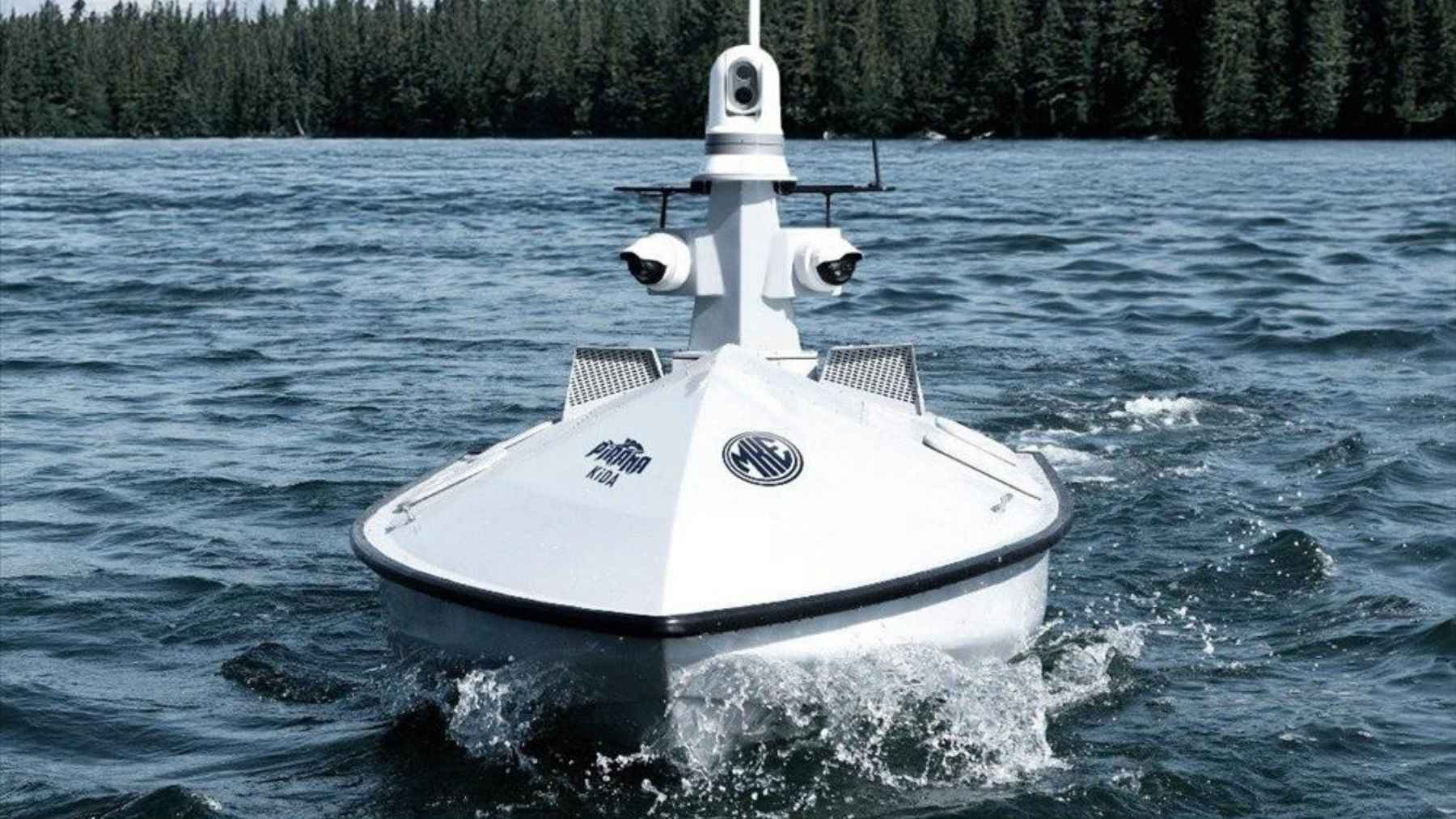
The full name is PİRANA KİDA, and the second word is a Turkish acronym for kamikaze unmanned sea vehicle. The naming department left nothing to the imagination.
The builder is MKE, a state-owned arms maker that’s been picking up naval work lately. MKE’s spec sheet describes a hull 18 feet long and 5 feet 3 inches wide, drawing about 15 inches of water and displacing roughly 3,200 pounds (1,450 kg). That’s lighter than a base Ford F-150.
A diesel engine spins a water jet, good for 40 knots (46 mph) flat out and a 23 mph cruise. The listed range is more than 200 nautical miles, which works out to about 230 regular ones. MKE rates the hull for Sea State 4, meaning waves running roughly 4 to 8 feet, and the sensor fit is a FLIR camera with radio links that work within line of sight and beyond it.
As you can imagine, this took a while to accomplish. As most things in the Navy seem to… MKE declared the boat ready for duty in a video back in May 2025. The company says that in earlier impact testing, the Pirana put a precision hit on a target only about 11 feet across. Every MKE statement repeats the same pitch: cheap, hard to spot thanks to a radar-absorbing coating, and happiest in a swarm, where a few boats pull the defenders’ attention while another one slips through.
Whether the swarm trick works as advertised, nobody outside the program can check yet, as far as I can tell.
So who found the target?
My favorite part of the Turkish coverage is who did the spotting. According to Türkiye Today, the target was picked out by a Kalkan, a vertical-takeoff drone aircraft from Baykar that was flying in a navy exercise for the first time, and the Pirana ran in on the mark.
So a flying drone found it, a floating drone hit it, and the humans supervised from a patrol boat.
This fits what the admiral was saying out loud that same week. Ercüment Tatlıoğlu, the Turkish Navy’s commander, says the fleet’s future concept rests on “using manned and unmanned systems in a way that supports one another.”
The exercise around the strike was designed to rehearse exactly that pairing. It wasn’t small: 100 ships, 50 aircraft, and about 14,000 people, spread across the Black Sea, the Sea of Marmara, the Aegean, and the eastern Mediterranean simultaneously.
The showcase day ran on September 24th aboard TCG Anadolu, the amphibious assault ship Turkey operates as a drone carrier.
The Pirana isn’t even Turkey’s only kamikaze boat
If an exploding Turkish drone boat sounds familiar, you’re probably thinking of that bigger one. Back in September, we covered the 26-foot Tufan, which carries 551 pounds of explosive in its bow and didn’t hit the water until August. The Tufan has the fatter warhead and a reported 40-boat order behind it. The Pirana now has the thing the Tufan hasn’t shown in public: a live warhead detonating against a target.
The two boats don’t appear to be in the same program, either. In February, Turkey’s top defense procurement committee approved the purchase of 100 expendable drone boats for the navy, and the reported industry split was divided among three teams, none of them MKE.
So from the looks of things, the Pirana is coming up on a separate track, and MKE was still saying in March that the boat would become the fleet’s new striking arm once it enters the inventory. Translation: it hadn’t entered it yet.
MKE’s name has come up around here before, by the way. The same company co-developed the MALAMAN smart bottom mine that a 49-foot Turkish drone boat learned to lay in August, so one arms maker now covers both ends of the problem: the boat that rams you and the mine that waits for you on the bottom.
MKE hasn’t attached an order count or a delivery date to the Pirana anywhere I can find, which makes sense for something that probably will end up delayed. Denizkurdu-I/2026 wrapped up on September 25th, and Turkey’s Ministry of National Defense posted the strike footage the next day. The translated title: “Pirana smashed it to pieces.”