
Navies have been smashing champagne against new hulls for a couple of centuries, and the ritual has survived ironclads, nuclear reactors, and every defense budget fight in between. A bottle breaks, somebody important says a few words, and the vessel officially joins the fleet. On May 1, 2026, at a ceremony in Canberra, the bottle still broke.
The hand swinging it, though, belonged to a robotic arm; the human stood off to the side, supervising instead of doing the honors. Which tells you most of what you need to know about the submarine being christened, because it doesn’t carry humans either.
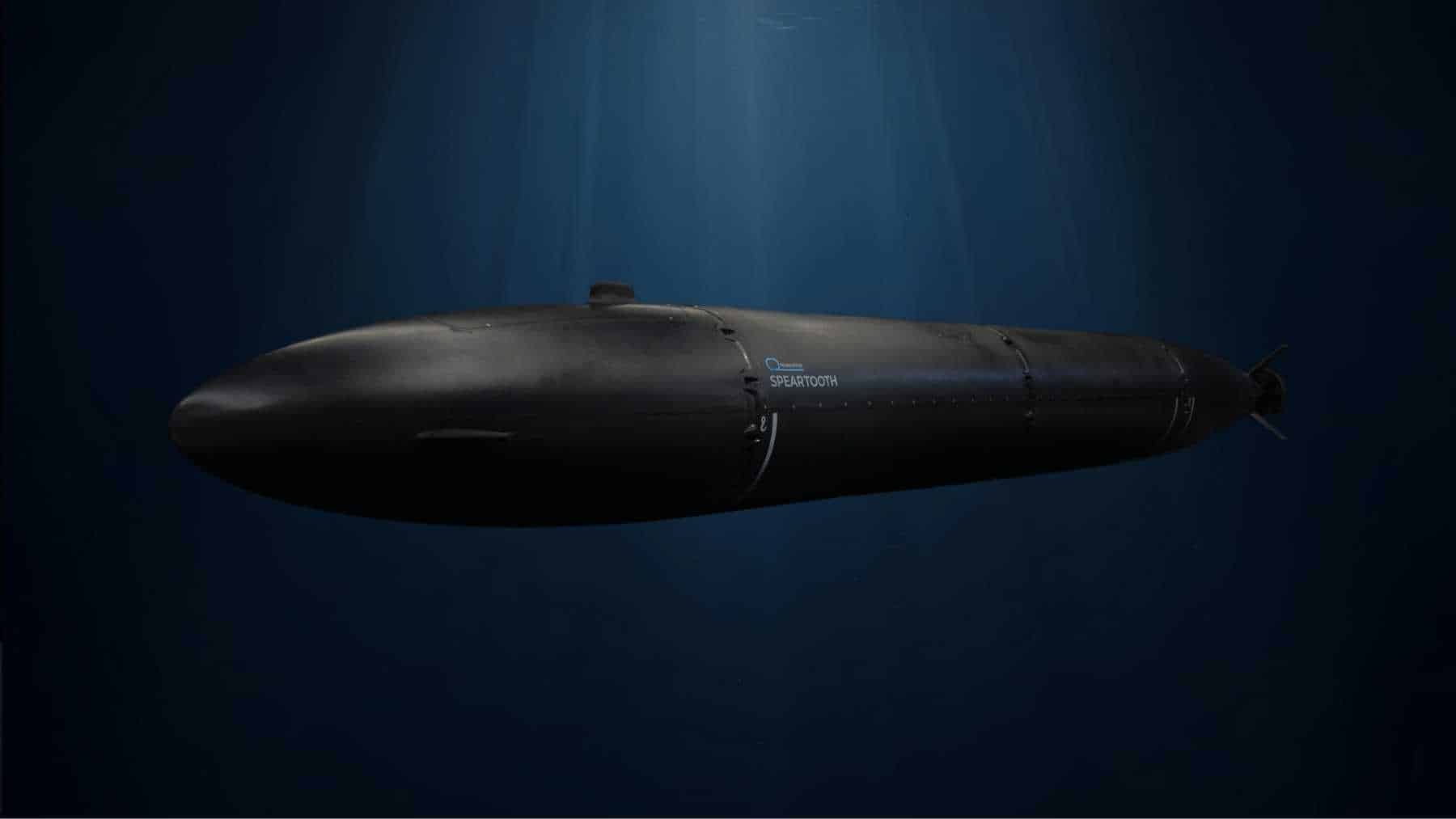
The boat is called Speartooth, a Large Uncrewed Undersea Vehicle (LUUV, because the defense world never met an idea it couldn’t squeeze into an awkward acronym) built by C2 Robotics, a Melbourne company that runs on an engineering team of roughly 20 people.
Naval News reported that the christening was officiated by Captain Josh Fagan, the US Naval Attaché based in Canberra, with Captain Tony Miskelly representing the Royal Australian Navy’s autonomous systems program, and that it was the first such ceremony C2 Robotics has ever held for one of its boats. The first hull the company considered worth a party was the one headed to the US Navy.
And if a robot baptizing another robot sounds like a marketing stunt, the spec sheet argues otherwise. Speartooth covers roughly 2,000 kilometers, about 1,240 miles, underwater on lithium-ion batteries, operates down to 2,000 meters (around 6,600 feet), and the entire vehicle ships inside a standard commercial container. Australia didn’t just sell America a drone. It sold America a way of doing submarine warfare by the crate.
The robot christening doubled as a mission statement
C2 Robotics didn’t hide the symbolism. Per Interesting Engineering, the company used the robotic arm for the ceremonial bottle smash as a deliberate nod to the vehicle’s design philosophy: a machine does the work while a human stays on the loop, watching and able to step in. That’s exactly how Speartooth operates at sea. The drone navigates, avoids traffic, and runs its mission autonomously, with pre-programmed check-ins for re-tasking, while its operators supervise from somewhere considerably drier. According to defense trade outlet EX2, one person at a console can keep tabs on upwards of 50 Speartooths simultaneously.
“Speartooth is built on the principle of ‘Small, Smart, Many,'” CEO Troy Duggan said at the ceremony, as quoted by Defence Connect. Strip the slogan down and the doctrine is simple. Instead of a handful of enormous crewed submarines that cost billions and can never be risked, you flood a contested stretch of ocean with lots of cheap autonomous hulls. Lose one, you shrug. Lose ten, you order ten more. An adversary suddenly has to find and kill dozens of quiet little robots instead of tracking one big boat, and that math gets ugly for them in a hurry.
The whole submarine fits in a shipping container
Per Overt Defense, the baseline Speartooth measures 8 meters, about 26 feet, on a composite hull roughly a meter across, and stretches to 11 meters (36 feet) with two payload modules installed. The mid-body payload bay runs 2.7 meters and is deliberately payload-agnostic: surveillance sonar for one mission, a communications relay for the next, munitions when the tasking calls for it. Electric propulsion keeps the boat quiet, the composite hull keeps it hard to find, and the lithium-ion pack carries it those roughly 2,000 kilometers without ever needing to surface.
The detail that rewires the logistics, though, is the box. Speartooth travels in a standard commercial shipping container, the same corrugated steel unit that hauls flat-pack furniture across the Pacific, and goes into the water from a simple rail-trolley setup down a boat ramp or off a ship. No submarine pens, no dedicated tender, no port sitting on an adversary’s target list. C2 Robotics says operators can stage it from austere coastlines, which is the polite way of saying you can open a submarine campaign from a beach with a trailer hitch. It’s the same infrastructure-allergic logic behind REGENT’s Squire seaglider, the Pentagon-backed maritime drone we covered that skips runways and ports altogether. Different element, same lesson: the launch site you don’t need is the launch site nobody can bomb.
The US Navy ordered three before anyone said its name out loud
The paper trail here is more interesting than the press releases. In August 2025, the US Naval Undersea Warfare Center’s Division Newport went sole-source on a buy of three Speartooth vehicles in the 11-meter configuration, a procurement detailed in an analysis at Second Line of Defense. Newport’s reasoning came down to something refreshingly blunt for government paperwork: nothing else on the market could carry weapons that far, that quietly, in a hull that size.
Then in late 2025, C2 Robotics announced its first export sale without naming the buyer, pointing instead to successful trials at exercises like Talisman Sabre 2025 in Queensland. Only after the Canberra ceremony did C2 confirm the mystery customer was the US Navy all along. A 20-engineer company in Melbourne spent months as the worst-kept secret in undersea warfare, selling robot submarines to the Pentagon while everyone politely pretended not to notice.
It’s built like an electric car, and that is the whole point
Here’s where the defense story turns into a car story, of all things. That same press release describes Speartooth as “essentially an underwater electric vehicle,” built from readily available commercial components so production can run in ordinary industrial facilities and scale fast in a crisis. In a submission to Australia’s Parliament, the company gets more specific: Speartooth’s batteries are identical to the ones used in electric vehicles, and the affordability comes straight from that commercial-off-the-shelf parts bin.
“Speartooth actually has a lot of commonality” with a modern electric car, chief technology officer Dr. Tom Loveard told Strategic Analysis Australia, noting that the technology inside a $20,000-to-$100,000 production car is genuinely impressive, and that the same commodity electronics and components already flow through Australia’s automotive, mining, and oil-and-gas supply chains.
So when C2 talks about generating mass, it isn’t hand-waving. The plan is to build submarines the way EV plants build crossovers: modular electronics, commodity battery cells, and a bill of materials a regular factory can source. The Second Line of Defense analysis pegs the per-hull target somewhere between hundreds of thousands and a few million dollars once production scales, which is a rounding error next to any crewed submarine program ever attempted.
That choice also puts Speartooth on a very different road from its rivals. Germany’s Greyshark drone submarine, which we’ve covered before, attacks the same problem with hydrogen fuel cells and a sixteen-week submerged endurance: maximum staying power, more exotic engineering. Australia went the other way, with car batteries, commercial parts, and a hull cheap enough to buy by the dozen. Both answers are valid. Only one of them can be built by the same suppliers that keep Australia’s mines running.
Sonar from Sydney, customers lining up in Europe
The supply chain pitch goes past batteries. Back in October 2024, C2 Robotics and Thales Australia announced a partnership to integrate Thales’ sovereign sonar into Speartooth, with the sensors and electronics designed and built at the company’s Acoustics Centre of Excellence in Rydalmere, Sydney. The sonar’s job is unglamorous and essential: sense-and-avoid, so the drone can detect obstacles, including other vessels, and operators trust it with longer missions in messier water. EX2 also notes the system is ITAR-free, meaning sales to allied navies don’t have to crawl through Washington’s export-control paperwork first.
Those allied navies are already forming a line. In its delivery announcement, C2 Robotics said news of more overseas sales through its European partner, Eurobotics GmbH, is coming soon. Australia’s own April 2026 National Defence Strategy, meanwhile, confirmed Speartooth in the Australian Defence Force’s force structure, where a new Maritime Autonomous Systems Unit will run it alongside Anduril’s larger Ghost Shark.
And the timing of all this is anything but random: AUKUS defense ministers just signed off on a joint program to field underwater drones guarding the 500-plus seabed cables that carry the world’s internet, with first deliveries due next year. The Indo-Pacific seabed is filling up with robots, and Australia just became an exporter.
Don’t expect combat patrols just yet
One bit of fine print before anyone pictures robot wolfpacks off a hostile coast. Coverage of the delivery, Defence Blog included, framed the moment as Speartooth “entering U.S. service,” and that’s accurate as far as it goes. What the Navy actually took delivery of is a vehicle headed into fleet trials and tactics development, per Overt Defense, not a weapon shipping out on patrol next week. Newport bought three of these to figure out what a cheap, containerized robot submarine is genuinely good for, and that homework takes time.
Still, as symbols go, May 1 was hard to top. Every christening in naval history assumed a crew would eventually sail away with the ship. This time the humans stayed on the dock, a robot swung the bottle, and the boat will do its job precisely because nobody is aboard. The champagne tradition survived. The crewed-submarine monopoly on undersea warfare might want to check its mirrors.
 @timmiller ROOKIE5 months ago