
Hail nets are basically car covers for apple trees. Growers stretch plastic mesh over the rows, the ice bounces off, and the rest of the time the net’s pretty much just there.
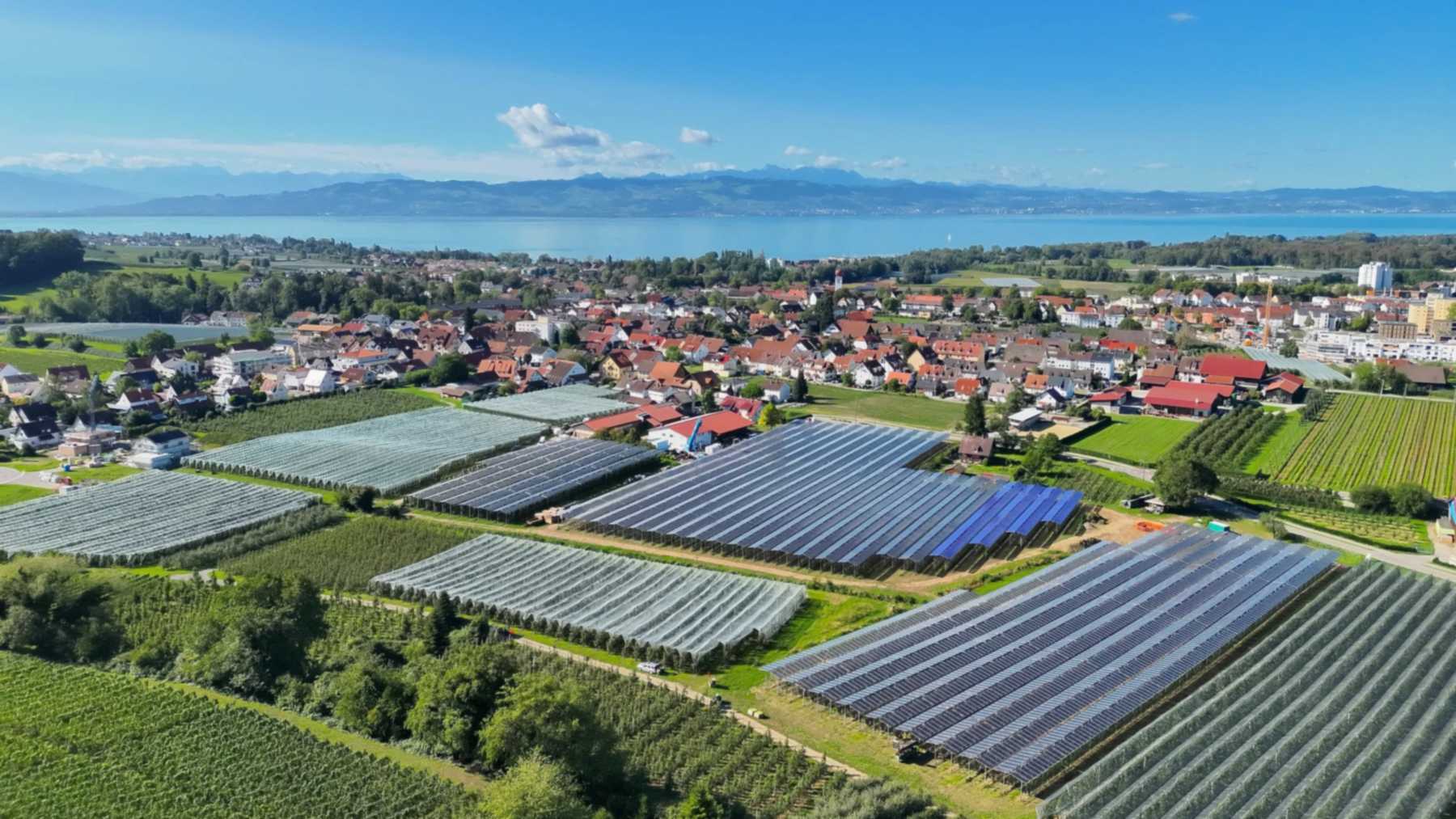
But one fruit farm on the German shore of Lake Constance (the big lake where Germany, Switzerland and Austria meet) has decided to skip the netting on its newest block of trees. It put solar panels over them instead, and on Sunday, October 25, about 200 people showed up at Obsthof Bernhard in Kressbronn to officially switch the thing on.
The system’s rated at 2.4 megawatts peak, according to pv magazine, and it covers about 5.2 acres. The developer, a young company from nearby Lindau called Sonntag Energy, says it’s the largest agrivoltaic system over apples in Europe, based on data from Germany’s Fraunhofer research institute. I haven’t seen anyone outside the company check that ranking, so I’d treat it as their claim rather than a settled fact.
If agrivoltaics is a new word for you, it just means farming and making solar power on the same piece of ground. Most of the time that involves lifting the panels high enough that the crop, the tractors and the people picking the fruit all still fit underneath.
So what does the roof actually look like?
Pretty industrial, judging by the photos. By mid-June, crews from the Maschinenring Tettnang, a local farmers’ cooperative, had already driven about 4,000 steel posts roughly 13 feet into the ground, according to Kressbronn’s town newsletter. The newsletter described the pile driving as loud and heavy on the vibration, which I’d guess the neighbors could confirm.
About 6,300 semi-transparent panels were due to go on top. That count comes from the same July newsletter, written while the frame was still bare, and I can’t find a final number published since. Nobody’s said how high the new roof sits above the trees, either. That’s a bit of a strange gap when the whole pitch is what happens underneath it.
Semi-transparent panels like these are usually glass on both faces, with gaps left between the solar cells so some of the sunlight falls through to the leaves. Think of a tinted sunroof rather than a sheet of steel. Here, the panels are supposed to let enough light through for the trees while keeping off hail and heavy rain, pv magazine reports.
That second job is the one the farmer actually cares about. “For us, the key thing is that we keep growing apples successfully,” Hubert Bernhard said at the opening, as quoted by pv magazine. The solar income, he added, gives the farm a second leg to stand on.
So where does the power go?
About a third of it can go down a direct cable roughly 1,640 feet long (a bit more than a quarter mile) to a BayWa Obst site in Kressbronn, where the fruit company runs big sorting and cold-storage lines. The rest gets sold on the power exchange.
That setup is called an on-site power purchase agreement. Basically, the solar farm sells electricity straight to a neighbor over its own wire, instead of pushing it into the public grid and letting the utility sort out who gets what.
Why bother running your own cable? Because the grid isn’t free to use, the same way your power bill has delivery charges stacked on top of the electricity itself. Mark Kugel, one of Sonntag Energy’s founders, said at the June groundbreaking that both sides skip grid fees and surcharges this way, so the farm earns more and BayWa pays less. He called it a perfect win-win, which is the kind of thing founders say, but I’ll admit the logic holds up pretty well here.
The company’s slogan for the project is “from apple to apple.” It’s a little cheesy. It’s also a pretty complete description of the whole thing.
Then there’s the battery. It stores 3.4 megawatt-hours and is about the size of a 20-foot shipping container, per the town newsletter.
So why does an orchard need a battery?
Solar panels make most of their power around midday, which is when pretty much every other solar farm in Germany is doing the same thing, so prices drop. A battery lets the farm hold some of that power back and sell it later when it’s worth more. If you’ve got time-of-use rates at home, you already know the idea. Farm magazine top agrar describes that timing trick as central to making the project pay.
Honestly, I’d argue the battery is doing more to make this pencil out than the panels are. Sonntag Energy spokesperson Timo Gass told Photon pretty much the same thing: the company adds a battery to every one of these farm systems because that’s how it gets the economics to work.
Kugel also used the opening to lobby the state politicians who showed up. He wants batteries allowed to charge from both the solar panels and the grid without more delays, plus more flexible grid connections and workable rules for selling power directly to the business next door. It’s safe to assume none of that is easy in Germany right now, or he wouldn’t have spent part of a party asking for it.
The farm tried this on a much smaller roof first
Bernhard isn’t new to this. Four years ago, his farm got about an acre of panels over a working apple orchard as part of a state research program, opened by Baden-Württemberg’s premier at the time, Winfried Kretschmann. According to the program’s project page, it was the first power-producing agrivoltaic system built into an active apple orchard in Germany, and the state covered half the cost.
That test roof used two kinds of panels that let through different amounts of light, roughly 40% and 51%. Researchers from Fraunhofer and the regional fruit-growing research center have been watching how the trees handle the shade ever since. Bernhard shared some of what he’s learned at the June groundbreaking, according to the town newsletter.
Yields under the panels usually ran about 10% lower at first, he said, but these days the covered trees are more likely to come out ahead. Gala and Elstar apples didn’t do so well in the shade. Kanzi, a cross between Gala and Braeburn, has done best.
I’m most interested in the spray figure. Bernhard said the farm never got crop-protection sprays down to zero, which was the original goal, but it did cut them by about 70%. As I understand it, a lot of orchard sprays wash off in the rain, so growers have to go back out after a storm and spray again. A roof keeps the rain off the leaves, so the spray stays put.
I’d love to point you to a published study with that 70% in it, but as far as I can tell it comes from Bernhard talking at a press event, not from a paper. Treat it as one farmer’s experience, and a pretty encouraging one.
The new block also fixes an annoyance from the pilot. On the test roof, hail nets still had to be strung between the panels. The new section uses wider panels, so Bernhard says the nets aren’t needed anymore.
Apparently the test roof turned into a bit of a tourist attraction, too. Bernhard said more than 3,000 visitors from every continent have come to look at it. I’m choosing not to ask about Antarctica.
He isn’t the only German apple grower trying this. We’ve looked at an organic orchard in the Rhineland that’s been growing apples under solar glass for five years, and at a Bavarian farmer who put panels over his hops and got fewer cones out of the first version.
This one went up without a subsidy
Here’s where the two roofs really differ. The state paid half of the pilot. The new 5.2 acres went up without any subsidy, according to top agrar and the town newsletter.
Germany’s renewable energy law actually includes a bonus for agrivoltaic power, 2.5 euro cents per kilowatt-hour, but it still doesn’t have the European Union’s sign-off, Photon reports. EU state-aid rules basically stop member countries from handing out subsidies Brussels hasn’t approved. So for now the bonus only exists on paper, and Sonntag says none of the seven agrivoltaic systems it has switched on this year uses it.
That’s not a small thing in a year when, according to top agrar, some of the leading companies in German agrivoltaics have gone through insolvency. Building one of these without the bonus is either pretty confident or a little stubborn. Given what the battery brings in, I’d lean toward confident.
The ownership setup is a bit different too. Leander Hengge, who runs the Maschinenring Tettnang, told top agrar that the farmer ends up owning the system, so the money it makes stays on the farm. What the whole thing cost hasn’t been made public.
On paper, the roof makes enough electricity for about 600 households, or roughly 14% of what Kressbronn uses, according to the town’s estimate. Keep in mind German homes use a lot less electricity than the average American one, so that’s not 600 houses in suburban Texas.
Sonntag Energy says Kressbronn is the seventh agrivoltaic system it has switched on this year. About a week before the apple roof’s opening party, it started building the next one on another Lake Constance farm, a 1-megawatt array of solar panels that tilt to follow the sun over strawberries, paired with a 5-megawatt-hour battery.