
- 2 MONTHS AGO · INDUSTRYTwo 242.5-pound drones drove themselves out to a mooring off California ahead of a research ship to follow a drifting trap by the sound of its beacon and photograph the top 656 feet of ocean while the trap catches the dead plankton sinking below it
- 1 MONTH AGO · INDUSTRYA 66-foot drill rig on a soccer field in Cologne, walled in by stacked containers 33 feet high, cored day and night for almost 10 weeks down 2,631 feet through a 380-million-year-old coral reef and hit water, and now the hole gets plugged and the field goes back to the city
- 4 WEEKS AGO · INDUSTRYA 45,400-ton ocean liner stripped of both funnels has spent 19 months tied up in Mobile, Alabama, and tugboats will tow her out so a Florida county can sink her 22 nautical miles off Destin in November, about 12 miles from an aircraft carrier already sunk as a reef
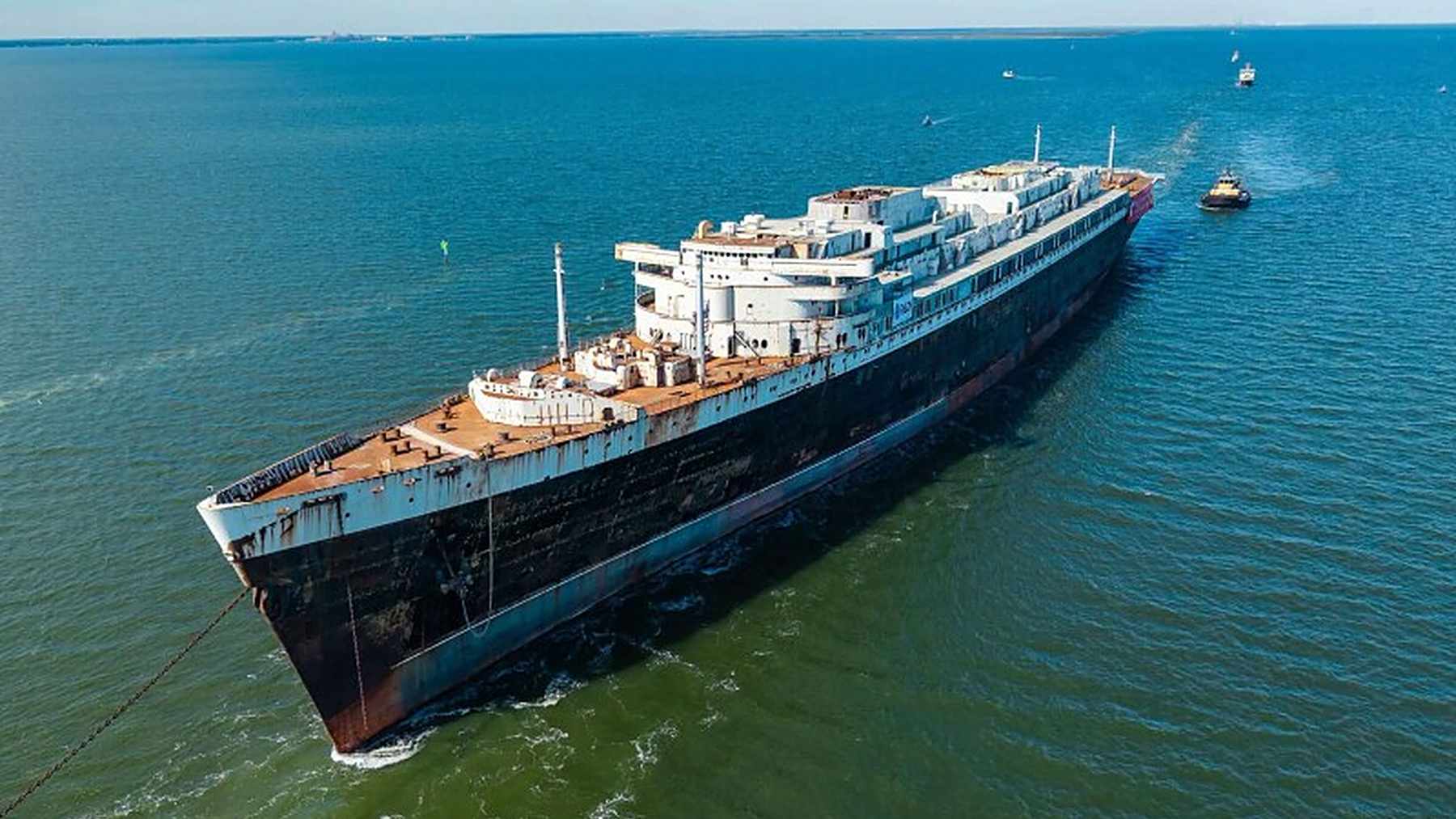
- 1 DAY AGO · INDUSTRYA 990-foot ocean liner that crossed the Atlantic faster than any liner before or since has just started her last trip out of Mobile behind tugboats, headed for a spot 22 nautical miles off the Florida Panhandle where she’ll be sent down into 180 feet of water on Wednesday
- TODAY · THIS ARTICLEA 990-foot ocean liner that still holds the record for the fastest Atlantic crossing is sinking 22 nautical miles off the Florida Panhandle right now, flooding through holes cut in her decks on her way to 180 feet of water
Most ships spend their entire working lives trying very hard not to sink. Crews pump out the bilges, patch the leaks and steer around storms, all so the hull stays on top of the water, which is where it’s supposed to be.
The SS United States is spending Wednesday afternoon doing the exact opposite, on purpose, with a crowd of boats and a livestream watching.
Okaloosa County, Florida, which bought the old liner to turn her into an artificial reef, had planned to send her down on Thursday, Nov. 12. Then the forecast turned. With strong winds expected on Thursday, the county moved the whole job up a day to Wednesday, Nov. 11, and canceled the public send-off ceremony it had set up at the Destin-Fort Walton Beach Convention Center. “Safety is always a top priority in Okaloosa County,” board chairman Trey Goodwin said when the change went out.
So the fastest ocean liner ever built is getting a Veterans Day sinking instead. Honestly, I can think of worse dates for a ship called the United States.
If you missed the run-up, we’ve already covered the prep work in Mobile and the plan for the tow, and her last trip out of Mobile on Monday. Those two pieces have the full rundown on the hull. Here’s the short version. She’s 990 feet long, with a design displacement of 45,400 long tons (a long ton is 2,240 pounds). Her actual weight today hasn’t been published, since both funnels, the radar mast and the fuel came off her in Mobile.
This one’s about what’s happening out there right now.
So how long will it take?
Deployment operations were set to start at 1 p.m. CST at the site, about 22 nautical miles (roughly 25 miles) southwest of Destin-Fort Walton Beach. The official deployment actually began around 1:40 p.m. CST, when crews started letting water into the hull, according to 6abc’s live coverage from the site.
Officials on scene said it would be another 40 to 45 minutes before anyone saw the ship move, and that the whole sinking was expected to take several hours as she fills up.
Is that slow? It’s kind of hard to say, since it depends on what you compare it to. The closest benchmark is the Oriskany, a 32,000-ton aircraft carrier sunk as a reef off Pensacola about two decades ago. The carrier went down in about 37 minutes, and that job used explosives. The SS United States is going down without any, which is why this one’s slower.
If you’re wondering how you sink something that big without blowing it up, it’s actually pretty low-tech. Crews cut 10-foot by 10-foot holes in her decks and pulled more than 400 portholes, county spokesperson Nick Tomecek told the AP. Then they opened the valves on the pipes that once pulled seawater in to cool her boilers, and the Gulf does the rest. Basically, you’re trying to get a 990-foot hull to fill up evenly, so she goes down flat instead of rolling over on the way.
Will she land upright?
That’s pretty much the whole point of all those holes, and it matters more than you’d think. A ship that lands on her side puts her highest deck a lot deeper than one that lands flat, and that’s the difference between a dive most people can make and one they can’t.
The plan is for her to settle upright on the bottom. If she does, her top deck should sit about 55 feet below the surface, the figure the county published in its SS United States FAQ for a site with 180 feet of water.
Why should you care about a few feet? Certification. PADI’s Open Water card, the entry-level scuba certification, comes with a 60-foot limit, so a top deck in the mid-50s would mean pretty much anyone with a basic card can reach the highest part of the wreck, while the lower decks belong to advanced and technical divers. Frankly, that’s the best argument the county has had for this whole project.
I’d hold off on booking a dive charter, though. As of this writing, the county hasn’t published a date for when recreational divers can visit the wreck.
Who’s holding her in place?
The SS United States made her last trip as what the Coast Guard calls a dead ship, which basically means a vessel with no power of her own. She can’t hold her position, so somebody else has to keep her pointed the right way and parked over the right patch of sand while she floods.
The target spot is 30° 07.148′ N, 86° 46.755′ W, and she has to stay over it until she’s gone. The Coast Guard has told any boat that isn’t part of the operation to stay at least one nautical mile away until the sinking is done, and the county had warned that the deployment could draw hundreds of spectator boats.
If you’re not on a boat, you can watch it on the county’s livestream, posted through its SS United States project page, and AJ’s Seafood and Oyster Bar in Destin has been running a viewing party with the live feed since noon.
Not all of her went down
The county has been billing her as the world’s largest artificial reef, a title that had belonged to the Oriskany off Pensacola. But a fair chunk of the ship isn’t making the trip. Her two funnels and radar mast, along with hundreds of other artifacts, were pulled off in Mobile for a planned museum, and the county hasn’t given a date for when that museum will open.
Researchers from Woods Hole Oceanographic Institution, Dauphin Island Sea Lab and Louisiana State University have also signed on to study the ship and the water around her. I’d bet the fish move in long before anyone cuts a ribbon on the museum.
She’s a pretty strange candidate for a reef, if you think about it. The SS United States carried passengers for 17 years, then spent more than half a century out of service while one rescue plan after another fell apart. By tonight, she should be resting in 180 feet of water 22 nautical miles southwest of Destin-Fort Walton Beach, where the water started pouring in at about 1:40 p.m. CST on Wednesday, Nov. 11.
 A recirculation pump at a spring-fed Virginia trout hatchery shut off overnight during a drought that had its spring at a historic low, and about 130,000 of the 249,000 trout being raised for 72 stocked waters in 11 counties died, so the survivors are now being fed extraIndustry · 3 hours ago
 A nearly 23-foot tunnel boring machine just broke through into its first station under downtown Toronto after cutting about 4,265 feet and lining the tunnel with roughly 780 concrete rings, and its twin is due to punch through right beside it in DecemberIndustry · 3 days ago
 A 13,632-ton freighter lies broken in two 530 feet down in Lake Superior, 51 years after she sank in a November storm with all 29 men aboard, and federal scientists estimate up to 1,191 barrels of heavy fuel oil could still be inside a wreck with no reported leakIndustry · 5 days ago