
Limpet mines sound like something out of a black and white war movie. A diver swims up to a hull at night, sticks a magnetic charge to the steel, sets a timer and swims away. The maritime security firm Ambrey counts at least seven merchant ships carrying Russian-origin oil hit that way since 2025, and Russian divers pulled two live ones off a gas tanker outside Ust-Luga in May. On August 12, a company in Richmond, Vermont put out a robot built to do the looking instead.
Greensea IQ calls it Bayonet Sweep. The machine grips a ship’s hull, crawls along the plating from bow to stern and hunts for anything attached to the steel that nobody attached on purpose.
Greensea says a single vehicle can run the whole assessment alone, and that several can go in the water together and pool what they find into one picture. The company also says operators get a georeferenced position for every anomaly, so a suspicious object can be located again by somebody who was not there the first time.
Greensea sells that georeferenced record about as hard as it sells the robot.
The job it takes over is done by hand, in the dark
A hull search is not a glamorous piece of naval work. A diver goes down alongside a ship that is usually still alive, still drawing cooling water, still hooked up to shore power, and runs gloved hands along steel he mostly cannot see.
Researchers who tested a robotic alternative laid the problem out in the journal Ultrasonics: ship hulls are too large to check completely by hand, harbor water is frequently too turbid to see through, and the closeness required to feel for a charge is exactly what puts the diver in danger. Their full-scale trials ran for four days on the USNS Del Monte at Naval Amphibious Base Little Creek, Virginia, with dive support from Explosive Ordnance Disposal Training and Evaluation Unit Two.
Navies also use trained marine mammals for the same search, which tells you something about how hard the sensing problem is.
Limpet mines are built to make that search worse. They are shaped to sit almost neutrally buoyant so a swimmer can handle one underwater, they hold on magnetically, and many carry an anti-handling device that fires the charge if somebody tries to pull it off the plating.
Russian divers found two of them on a tanker in May
The Liberian-flagged LPG tanker Arrhenius, 26,645 dwt, reached Ust-Luga on May 20 and anchored offshore for an inspection under a port security program Russia set up the previous year, according to The Maritime Executive.
Divers found magnetic devices on the hull during that inspection. A specialized explosives team then sent drones down, which confirmed two mines sitting near the engine room. Media reports put the charge at 15 pounds (7 kg) of explosive apiece.
Russia’s FSB described them as naval magnetic mines it believes were built in a NATO country from industrially made parts. The news agency TASS suggested they were homemade rather than any recognizable NATO design. Russian officials said the crew was evacuated and later allowed back aboard, and that a criminal investigation is open. No Ukrainian official has commented, and nobody has been charged.
Divers went first, by hand. Drones came second, and they confirmed what gloved fingers had already found. Greensea IQ is selling the reverse order.
Ambrey’s assessment of the wider pattern is that hull plating deformed inward in every case it examined, consistent with a charge attached from outside, and that the devices tend to go on the aft section of the ship. Some run on timers and some can be triggered remotely, which means a vessel can be two ports away by the time its mine goes off.
The barnacle scrubber grew a military cousin
Greensea IQ did not build this thing from nothing. The company runs a commercial service called EverClean, a subscription arrangement where crawling robots keep biofouling off the hulls of working ships, and it has been accumulating hull-crawling hours that way for years.
Bayonet Sweep is that platform pointed at a different question. A cleaning robot flags a bad patch of coating. This one is supposed to flag an object.
Chief Executive Officer Ben Kinnaman framed the gap it is meant to fill in the launch announcement, saying the technology lets Greensea “plug a vital hole in our port and harbor security infrastructure.” His point about commercial traffic is the honest one: thousands of hulls move in and out of ports every day and almost nobody looks underneath any of them.
Both robots run on Greensea Core, the company’s open-architecture software, and Sweep uses the same interface family as the rest of the Bayonet line. Greensea’s stated reason is operator training, which is a duller benefit than autonomy but a real one. An EOD tech who already knows one Bayonet screen does not have to learn a second.
Inspection robots keep converging on this same trick of doing a specific unpleasant job rather than swimming impressively far. A 20-pound Swiss robot that measures leftover steel thickness inside a flooded ballast tank got a classification society signature, which is what turned it into billable work. A 661-pound drone that can hold station in front of a single weld for 24 hours sells on staying still, not on range.
Greensea has not published the numbers that would settle it
Greensea has not released a sweep speed, a sensor payload, a depth rating, an endurance figure or a price for Bayonet Sweep.
A hull search is a coverage problem before it is a detection problem. Coverage comes down to speed multiplied by hours in the water. Greensea has published neither figure. A reader cannot work out from the announcement whether one vehicle sweeps a frigate in an hour or in a full shift. Kinnaman’s own claim is complete intelligence on a ship’s hull, and a claim like that needs a coverage rate sitting behind it.
The company describes the vehicle as configurable for mission-specific inspections, which is a way of saying the sensor fit changes with the job. Greensea also says the classification step runs aboard the robot and hands the call to a human operator.
Greensea is the only source for every one of those descriptions. No navy, port authority or shipowner has publicly put Bayonet Sweep through an independent evaluation, and the company has named no launch customer.
The Pentagon has been writing Greensea checks all summer
Two contracts landed in the same week of July, both for other parts of the Bayonet line.
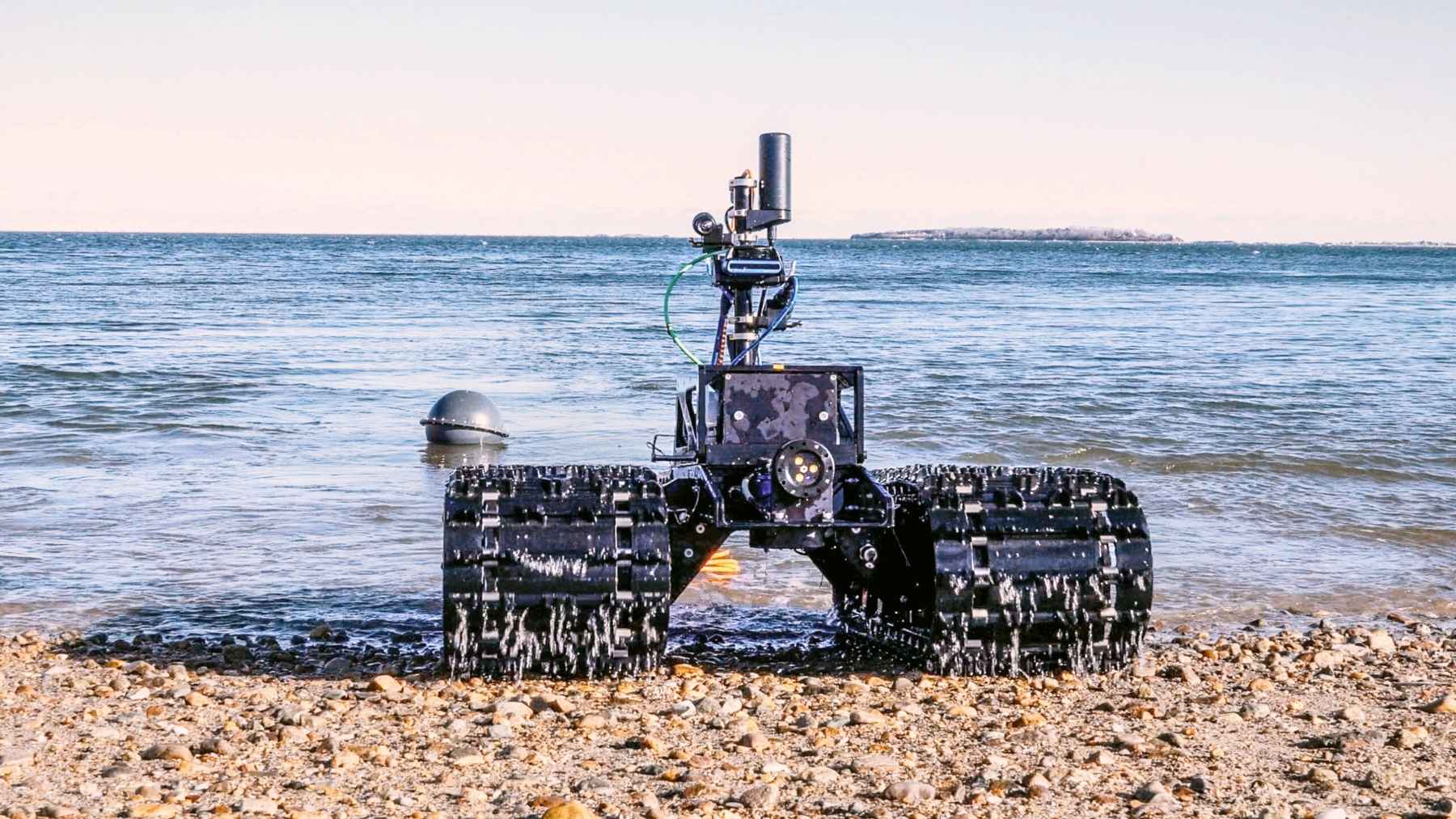
Naval Information Warfare Center Pacific in San Diego awarded Greensea an $18,154,710 indefinite-delivery, indefinite-quantity contract for the Bayonet Underwater Controller, a seven-year sole-source award announced on July 1 and reported by Ocean News & Technology. Bayonet General Manager Fred Gaghan tied it to Special Warfare and EOD work. A week later, on July 8, the Marine Corps put in a $3.7 million delivery order for more Bayonet 250 vehicles, the tracked amphibious crawlers that drive out of the water and across the surf line where swimming drones give up.
Neither contract covers Bayonet Sweep. Both pay for the software and navigation stack underneath it.
Greensea gets to sell that foundation twice. The company has spent years being paid by the Navy and the Marine Corps to teach robots where they are underwater, in water GPS cannot reach, and it now offers a commercial product running on the same stack. A port authority buying Sweep is buying navigation the Pentagon already paid to develop.
Ports are the customer that does not exist yet
Navies already have EOD divers and, in some cases, a mammal program. Commercial ports mostly have neither.
Skuld, the marine insurer, told shipowners after the 2025 Mediterranean blasts to run underwater hull inspections with divers or ROVs after calling at high-risk ports, and to train crews to recognize what a limpet mine looks like. Rules like that create demand for exactly the capability Greensea is selling, and they also explain why a Vermont robotics firm bothered building a security version of its hull cleaner.
Port operators may still not buy it, however well the machine works. Terminal companies run on thin margins and hate spending money on a threat that has not hit them yet. The tanker owners in the Mediterranean did not start checking under their ships until hulls began opening up.
Greensea IQ closed the $18,154,710 Navy award on July 1 and the $3.7 million Marine Corps order on July 8. Bayonet Sweep went out on August 12 with no customer named and no independent test results attached to it.