- 5 MONTHS AGO · INDUSTRYThe U.S. Army just sent a swarm of tiny solar-powered drone boats out to guard a real cargo run in the Philippines, screening a ship full of armored vehicles and allied troops 260 miles up the coast with nobody aboard the escorts, a first for an Army resupply run in the Pacific
- 2 MONTHS AGO · INDUSTRYA 24-foot drone boat that makes its own power from sun, wind and waves will tow a cable of microphones from a winch inside its keel, listening for submarines off Australia for months without refueling, and 40 of them are getting American arrays picked over four rivals
- 2 MONTHS AGO · INDUSTRYWhile storm waves knocked concrete slabs as heavy as 55 tons out of place at a 150-year-old English breakwater, granite boulders of up to 33 tons are going in underwater one at a time, because a sloped rock pile takes the energy out of a wave before it hits the breakwater
- 2 MONTHS AGO · INDUSTRYA 47-foot drone boat launched and recovered a 375-pound underwater robot over 40 times off England with nobody on the water, standing on two torpedo-shaped hulls that give waves almost nothing to grab, and its pilots sat in two countries while Germany watched live
- TODAY · THIS ARTICLEA 242-pound underwater drone plugged into a wave-powered buoy at sea for the first time off California, docking twice with a float that makes about 10 times the power of a solar dock, while it and its sister drones logged almost 2,500 miles in about 2,000 hours
Last Thursday, the Monterey Bay Aquarium Research Institute (MBARI to pretty much everyone) put out a long write-up on how it spent its fall. The short version? It turned a fleet of underwater drones loose in Monterey Bay between early August and mid-October to see how much ocean monitoring they could handle on their own.
MBARI’s reasoning is pretty simple. Ship surveys are expensive, and a crewed vessel can only be in one place at a time. A handful of drones can be in several.
Two results in the MBARI announcement jumped out at me. One drone, called Pontus, swam into a solar-powered docking station 20 times to recharge and hand over its data. Another, called Brizo, latched onto MBARI’s wave energy buoy twice, and that’s the first time one of these drones has docked with it.
The demonstration was run with the National Offshore Wind Research and Development Consortium (NOWRDC), since California is planning floating offshore wind in deep-water lease areas that overlap some of the state’s most productive waters. The David and Lucile Packard Foundation was the main backer, with support from NOWRDC, the California Energy Commission, NYSERDA and the Massachusetts Clean Energy Center.
So what is an LRAUV?
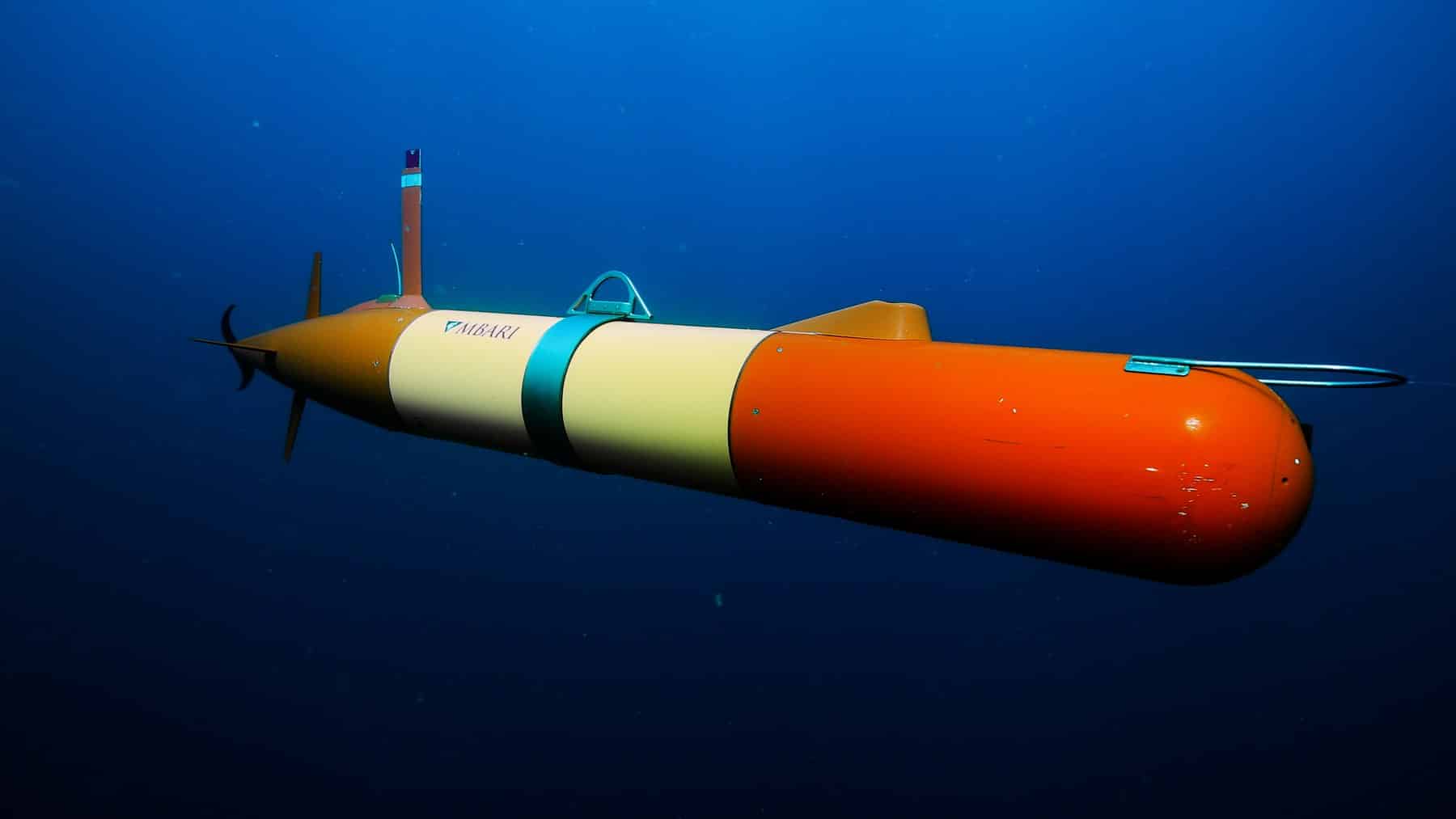
LRAUV stands for long-range autonomous underwater vehicle. That’s a mouthful, so think of it as a skinny self-driving submarine with nobody inside. MBARI lists it at about 6.6 feet long and 242.5 pounds, and the payload section swaps out, so the same drone can carry a camera on one mission and a water sampler on the next.
That’s why each drone in this campaign had its own job:
- Ahi carried Planktivore, an underwater microscope.
- Makai carried Piscivore, an AI-enabled camera system (going by the name, it’s there for the fish).
- Aku ran echosounders.
- Brizo carried the Environmental Sample Processor and a hydrophone.
- Pontus had a bioluminescence sensor paired with machine learning to predict which plankton were around.
- Daphne carried a “sipper” that grabs water samples for chemistry.
Then there’s Hansen, a Wave Glider. It’s a drone too, but it sits on the surface instead of diving.
So why park a drone at sea?
It basically comes down to batteries. MBARI’s LRAUV page projects a range of more than 1,200 miles at a cruising speed of a bit over 2 mph, which is a pretty long way for a drone this size. But when the battery runs low, somebody normally has to go out and get it. That usually means a boat.
Other teams go after the problem by packing more energy on board, like the hydrogen fuel cell drone that stayed underwater for 16 days. MBARI’s approach is to put the charger out in the water instead.
A docking station is a cradle the drone swims into on its own. It tops up, uploads whatever it’s collected, and heads back out to work. Pontus did that 20 times over the campaign, and I’d call that pretty encouraging. One successful dock could be luck. Twenty is a lot harder to wave away.
The wave buoy is the bigger deal
MBARI says its wave energy buoy puts out about 10 times as much power as the solar station. I’d love to tell you what that works out to in watts, but MBARI didn’t put a number on either one in its announcement. It also doesn’t give the buoy’s size or weight, and the campaign logs it links to wouldn’t load for me.
So how do you get electricity out of waves?
MBARI’s engineers have described their wave energy converter in a research paper as a float on the surface connected to a submerged heave plate, with an electro-hydraulic power unit in between. Basically, the float bobs up and down with the swell while the plate hanging below it stays a lot steadier, and the tug between the two drives the generator. As far as I can tell, that’s the design Brizo docked with.
Brizo pulled it off twice. Admittedly, MBARI is presenting this as a first, not as something it’s done a hundred times. Still, I’d argue it’s the more interesting of the two results, because waves don’t clock out at sunset the way solar panels do.
So what did the fleet measure?
The first phase ran from August 3 to 13. Hansen mapped the water column with echosounders, which are basically fancy fish finders: they send pulses of sound down and listen for what bounces back off fish, krill and anything else in the way. Makai and Brizo went along to photograph animals, collect DNA samples and record sound.
Phase two ran from September 21 to October 15 and brought in all six LRAUVs. MBARI sent them out in stages across the north end of the bay and around two survey circles, one at the head of Monterey Canyon and one at the MARS cabled observatory, which MBARI puts about 20 miles offshore. Hansen went back to running echosounder surveys near the canyon head.
Those DNA samples are what scientists call eDNA, short for environmental DNA. Every fish, whale and shrimp sheds bits of itself into the water, so if you filter seawater and sequence what’s in it, you get a pretty good list of who’s been swimming through. Brizo’s Environmental Sample Processor is a small onboard lab that does the filtering at sea, and several of the drones also carried passive eDNA samplers.
MBARI built the campaign around three questions. It wants to know how the ocean’s baseline productivity shifts over time in an upwelling system like Monterey Bay, how predators and prey (endangered whales and commercially important fish included) move and interact, and which ocean conditions, chemistry among them, drive what the drones see.
What MBARI hasn’t shared yet, at least not in this announcement, is what the samples and footage actually showed. If you want to see these drones on a more focused job, we covered two LRAUVs chasing a drifting sediment trap off California back in September.
So can drones replace research ships?
I wouldn’t bet on it, at least not yet. Somebody still has to put these drones in the water and get them back out at the end, and that’s still a job for a boat. From the looks of things, the more realistic win is a fleet that keeps sampling between ship visits and doesn’t need a ride home every time its battery gets low.
Chris Scholin, the MBARI senior scientist who led the demonstration, says the technology “works the same way whether you’re doing basic research or solving a practical problem.” That’s a fair point. A drone counting krill doesn’t care who’s paying for the data.
MBARI says it’ll report to the California Energy Commission over the coming year, and an advisory board is set to go over the results early next year to see what they mean for regulatory and permitting guidance.
 A second 1,680-ton boring machine with a 28-foot cutterhead has started chewing through the rock under New Jersey beside its twin, each one dragging 500 feet of gear and lining its tube with 850 concrete rings, and both get swapped out for new machines before the HudsonIndustry · 20 hours ago
 A 29-pound underwater drone 4.3 to 4.5 feet long and 4.7 inches thick is rated to 984 feet, carries a side-scan sonar plus either a magnetometer or a camera lit by 24,000 lumens, and one person can launch it to run as long as eight hours at up to 6 knotsIndustry · 1 day ago
 A 4.7-mile freight train of 696 empty ore cars ran 535 miles over two days with electric and diesel locomotives spread through it and synced by radio so they pulled and braked as one, and it topped a length record a 4.6-mile ore train had held for a quarter of a centuryIndustry · 2 days ago