
- 1 MONTH AGO · ENERGYA 516-foot cooling tower stands unused beside its working twin at a Lake Erie nuclear plant, built for a second reactor that was canceled with the tower already finished, and the plant is now preparing to squeeze 213 more megawatts out of the one reactor it did get
- 1 MONTH AGO · ENERGYA 300-megawatt reactor designed to cool itself without pumps just became the first small commercial reactor cleared for construction in America, four months ahead of the regulator’s own schedule, on the riverbank where an earlier federal reactor never got built at all
- 1 MONTH AGO · ENERGYTwo 105-ton machines, each 52 feet tall, were set in place at a 300-megawatt reactor that will be the world’s first power plant cooled by molten lead instead of water, to pull droplets out of its steam before they can erode the turbine blades
- 4 DAYS AGO · ENERGYAn 882-ton boiler, one of eight at a closed nuclear plant on the English coast, is slated to be jacked and slid out of its bay under a contract announced late last month, a job meant to take away about a third of the buildings still standing on the site
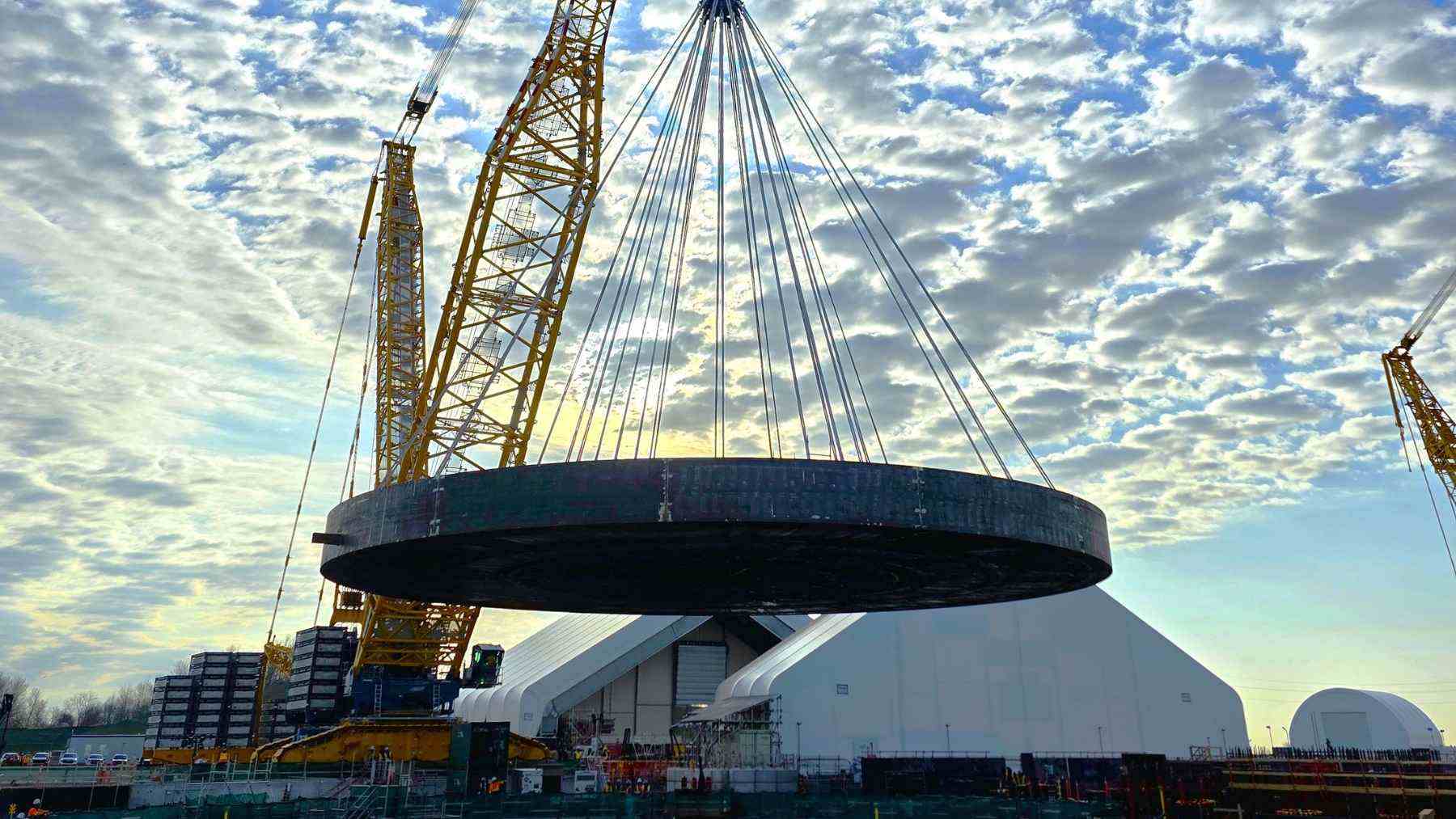
- TODAY · THIS ARTICLEA 1,050-ton slab at the bottom of a 115-foot Ontario shaft is the foundation of the Western world’s first grid-scale small reactor, and the 300-megawatt machine meant to stand on it will now be late, because its engineering is still being finished as the concrete goes in
Anyone who’s had a kitchen remodeled knows the rule. You finish the drawings, you order the cabinets, and only then does somebody start knocking out walls. Do it in the other order and you wind up paying a crew to stand around while the plans catch up.
Ontario Power Generation is finding out what that rule looks like when the kitchen is a nuclear reactor.
On November 10, the province’s government-owned utility said the first small modular reactor at its Darlington site, east of Toronto, is no longer expected to hit its October 2030 commercial operation target. It also won’t come in under the C$7.7 billion it had previously disclosed for Unit 1, which World Nuclear News converts to about US$5.4 billion. That figure covers the reactor plus systems and services the other planned units would share.
You may remember this hole in the ground. Back in July, we covered the 1,050-ton slab OPG lowered to the bottom of a 115-foot shaft at Darlington in April, and later the steel reactor vessel taking shape for it in an Ontario factory. That slab is still down there. The 300-megawatt machine it’s supposed to hold up is what’s running late.
So what went wrong?
According to OPG’s third-quarter results, the problem is engineering that isn’t finished yet. The reactor is a BWRX-300, designed by GE Vernova Hitachi, and nobody has finished building one yet. That’s what “first-of-a-kind” means here. OPG says the supplier’s ongoing engineering for a first-of-a-kind design is affecting both how construction gets done and how the supply chain performs.
OPG CEO Nicolle Butcher put it plainly in the release, saying “we have identified risks that will impact Unit 1’s schedule and budget.” She also said the utility will share more as the work moves along.
GE Vernova Hitachi sees it a bit differently. A spokesperson, Jonathan Allen, told The Globe and Mail that the delay comes from several connected issues spread across engineering, procurement and construction, according to World Nuclear News, and he pointed to inflation and geopolitical risk too. Which, frankly, is about what you’d expect two partners to say when they still have to finish building the thing together. OPG, for its part, says it’s working with GE Vernova Hitachi to close out the outstanding engineering and keep the project moving as quickly as it can.
Why does unfinished engineering slow down a concrete pour?
It helps to know what a small modular reactor is supposed to be. Basically, it’s a nuclear plant cut down to a fraction of the usual size, built from a standard design you can copy over and over, with big chunks made in factories instead of on site. Each BWRX-300 is rated at about 300 megawatts, while the four big CANDU reactors at the existing Darlington station are rated at 878 megawatts each, per the American Nuclear Society. OPG plans four of the small ones, for 1,200 megawatts in all.
That’s a pretty sensible pitch on paper. The catch is the first copy.
Concrete is about as permanent as construction gets. Every pipe, anchor and cable run that passes through a wall has to be in the right spot before it sets, so if a pump or a valve design is still moving around, the pour waits for it. And a supplier can’t fabricate a part to a drawing that isn’t final. As far as I can tell, that chain reaction is what OPG means when it talks about construction execution and supply chain performance. Slow and expensive, basically.
The site hasn’t stopped
Darlington is still a busy job site, though. During the third quarter, crews finished assembling the tunnel boring machine that’ll dig and line the tunnel for the plant’s condenser cooling water, and OPG expects tunneling to start before the end of 2026. They also completed the first pour for the turbine building, which is where the steam will spin the turbine that drives the generator.
Why does a reactor need a tunnel? The BWRX-300 is a boiling water reactor, so water boils in the core and the steam goes straight to the turbine. Once that steam has done its job, it has to be cooled back into water and sent around again, and that takes a lot of cold water. Darlington sits on the north shore of Lake Ontario, which is pretty convenient for that.
Butcher also said critical work is still happening on site every day. So OPG is building and finishing the design at the same time, which is arguably the hardest way to build anything.
How late is it, then?
OPG hasn’t put a number on it. The utility hasn’t given a new commercial operation date or a new budget, and as of November 16, I haven’t seen either one published. What OPG has said is that it’s running a full assessment of cost and schedule that should be substantially complete by mid-2027.
So what did that missed date actually mean? Commercial operation is the point where the unit is officially up and selling power to the grid as a working plant. That comes after fuel loading, testing and a stack of regulatory sign-offs, well after the reactor first starts up.
And October 2030 apparently wasn’t even the first date on the board. OPG’s own project page still lists an older planning goal of making the first unit commercially available by the end of 2029. A couple of you didn’t buy the original budget either, judging by the comments under our July piece.
Still, I’d argue the bigger question is what this does to units two through four. The whole modular argument rests on the later copies getting cheaper and faster because the engineering’s already done. If the first one is where that engineering gets finished, it’s safe to assume Unit 1 is where most of that bill lands. First-of-a-kind builds often go this way. It’s just more visible when the foundation is already sitting at the bottom of a shaft.
OPG calls Darlington the G7’s first small modular reactor, and the province still has four of them planned on the site. The tunnel boring machine is due to start digging before the end of 2026, and OPG expects its new cost and schedule assessment to be substantially complete by mid-2027.
 A 529-ton reactor pulled out of a German nuclear cargo ship has sat empty of fuel in a concrete shaft near Hamburg for 45 years, and regulators just cleared the hall where it will be cut into pieces and packed for disposal, part of a 17-year teardown of the research site around itEnergy · 3 hours ago
 183,600 solar panels went up on 480 acres of old Alberta farmland, and hay is still being cut between the rows while about 260 sheep eat the weeds on the 60-acre patch the hay equipment struggled with and more than two million bees made about 1,000 pounds of honeyEnergy · 5 hours ago
 A 135-foot concrete tower standing in an Orange County lake has had its four lowest gates buried in silt for more than 30 years, and the water behind the 93-year-old dam is now three weeks into a drop from 23 feet deep to 5 that clears the way for a new outlet set in bedrockEnergy · 6 hours ago