Ask most people where the fuel in a nuclear reactor comes from and you’ll probably hear something about uranium mines. That’s true as far as it goes. But uranium fresh out of the ground can’t do much for a power reactor, and before it gets anywhere near one it has to go through an enrichment plant.
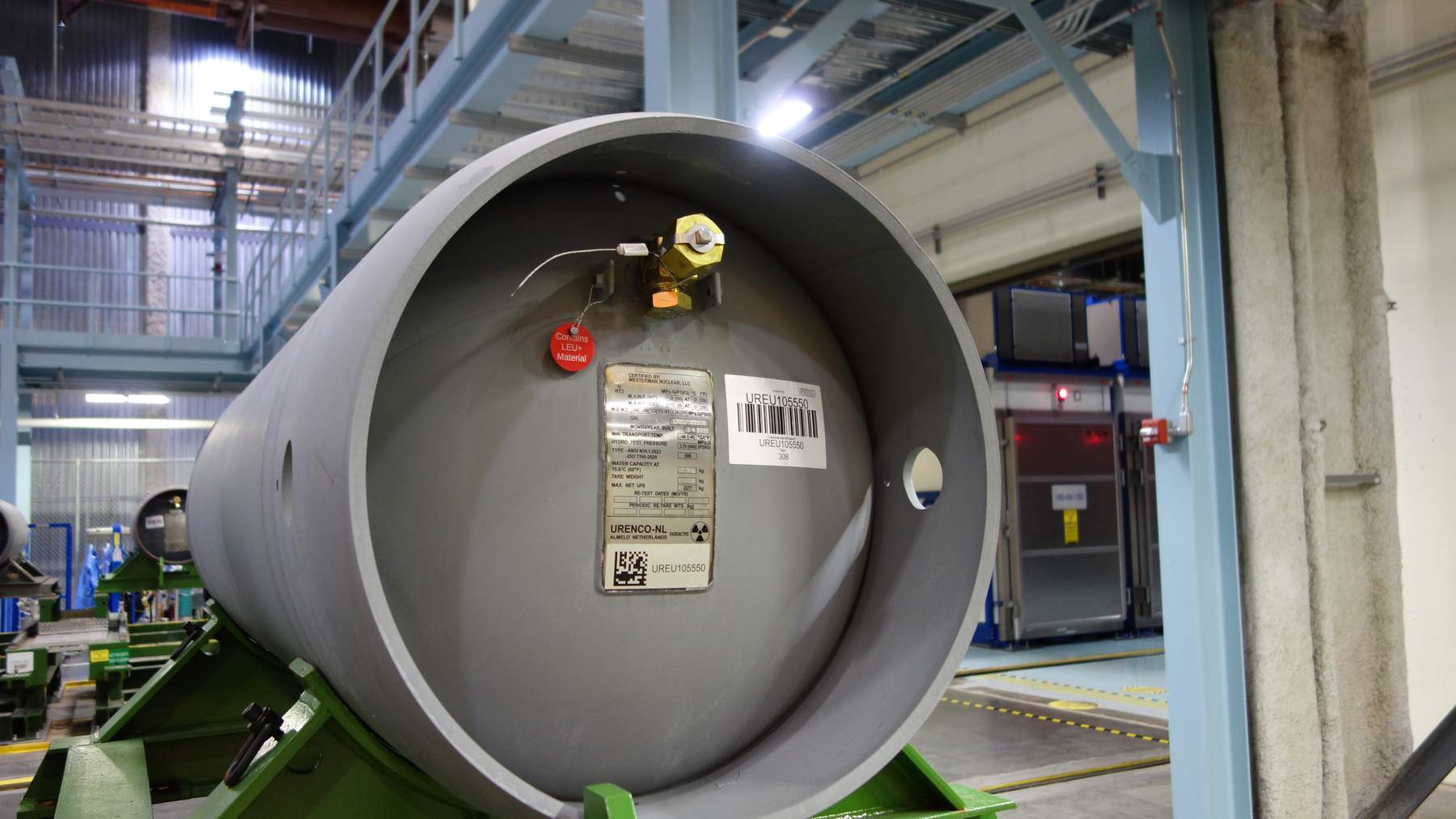
For a lot of American reactors, that plant is a big industrial complex in the New Mexico desert outside the town of Eunice. On November 2, it filled its first commercial cylinder of uranium enriched past 5%, a line that the fuel in ordinary U.S. reactors stays under.
Urenco USA, which runs the site, calls the new product LEU+ and says it’s the first commercial production of it in the Western world. That’s the company’s claim, but its communications director, Jeremy Derryberry, put it pretty bluntly to the Albuquerque Journal: “no one else is offering it to Western companies at this point in time.”
On NRC paperwork the operator shows up as Louisiana Energy Services, which is a slightly confusing name for a plant in New Mexico. It does business as Urenco USA, and that’s the name you’ll see everywhere else.
So what does an enrichment plant do?
Natural uranium is less than 1% uranium-235, the isotope that splits easily and gives off the heat a reactor runs on. Almost all the rest is uranium-238, which is a little heavier and a lot harder to split.
Enrichment is basically a sorting job. The plant turns uranium into a gas, uranium hexafluoride, and spins it at very high speed in long chains of centrifuges called cascades. The heavier U-238 drifts toward the outside wall, and the gas drawn off nearer the middle comes out slightly richer in U-235. Do that over and over and you can push the U-235 share up to whatever level you’re licensed for.
Most commercial reactor fuel sits between 3% and 5%. Urenco’s own scale puts LEU+ at 5% to 10% and high-assay low-enriched uranium, or HALEU, at 10% to 20%. Some federal documents define HALEU more loosely, as anything from 5% up to 20%, so you could argue LEU+ technically sits at the bottom of that range.
Enrichment capacity is measured in separative work units, or SWU. It’s basically a measure of how much sorting a plant can do in a year rather than a weight of uranium, and more of it means more fuel out the door.
The Eunice plant is rated at 4.3 million SWU a year, which Urenco says can cover roughly a third of what the U.S. currently needs in low-enriched uranium. It’s been running for about 16 years and has delivered more than 50 million SWU in that time, according to the company. As far as I can tell, it’s also the only enrichment plant in the country working at commercial scale. The closest thing is a 16-centrifuge HALEU cascade in Piketon, Ohio, which we covered back in July.
That’s frankly a lot of eggs in one New Mexico basket. And a federal law keeps Russian low-enriched uranium out of the U.S. through 2040, according to the Journal.
The plant has 350 employees plus 150 contractors, by the Journal’s count, and Derryberry told the paper that Eunice has supplied fuel at some point to every one of the 94 reactors operating in the U.S.
Existing reactors could go longer between refuelings
So why would anyone want fuel past 5%?
Reactors don’t run nonstop. Every so often they shut down for a refueling outage, swap out part of the fuel in the core, catch up on maintenance and start back up, and the plant isn’t selling power while that’s happening. Fuel with more U-235 packs more energy into each load. Urenco says that lets existing light-water reactors run longer stretches between outages, so they refuel less often and spend less on operations and maintenance. I’d argue that’s a bigger deal than anything LEU+ does for the shiny new reactor designs, simply because 94 of the old ones are already plugged into the grid.
Urenco also pitches LEU+ as fuel for advanced reactors and as feedstock for HALEU. A HALEU plant fed with material that’s already past 5% has less sorting left to do, so it can turn out more from the same equipment.
So why not skip ahead and make HALEU in Eunice? According to Urenco, HALEU needs its own purpose-built facility and a separate sign-off from the NRC, while LEU+ only took a license change. The NRC authorized the plant to enrich to just under 10% more than a year ago, and Urenco says all of its cascades are now licensed for LEU+. Making LEU+ first seems like a pretty sensible order of operations.
So who’s buying it?
Urenco’s announcement doesn’t name a customer, and there’s no price attached. The company also hasn’t said how much uranium went into that first cylinder, which is a slightly odd thing to leave out of an announcement about a cylinder. The Journal says the target market is utilities running light-water reactors and developers of more advanced designs.
There’s one clue, though. In May, the NRC published an environmental assessment for a shipping exemption Urenco had asked for, because the certified package it uses to move uranium hexafluoride cylinders is only approved for material up to 5%. The exemption would cover roughly 40 to 50 cylinders of the 30B type, shipped to a single customer over this year and next, while a newly approved transport package gets manufactured. The filing doesn’t name the customer, but it does suggest Urenco has at least one buyer lined up.
We’ve covered one of Urenco’s fuel customers before, too. The company agreed in February to supply fuel for Deep Fission’s mile-deep reactor project in Kansas, which runs on ordinary low-enriched uranium.
The Eunice site is due to get a second plant
Urenco plans to push the New Mexico site past 7 million SWU over the next decade. Part of that is a new enrichment plant, with construction due to start in 2029 and 2.1 million SWU of new capacity, according to the company. The first cascades are scheduled for 2032, more are due through 2036, and Urenco says the new capacity will be able to make LEU+ as well.
Big nuclear construction projects don’t exactly have a reputation for finishing early, so I’d treat those dates as targets.
Until that second plant shows up, the existing Eunice cascades are doing the work. Urenco filled its first commercial LEU+ cylinder there on November 2, and the NRC filing describes shipments to that single customer through the end of 2027.