- 3 MONTHS AGO · MILITARYA 30-kilowatt laser has to hold its beam on one square inch of a drone that is actively trying to get away, and the Army has just ordered dozens of them after four decades of burning targets on test ranges without ever buying a single one
- 1 MONTH AGO · MILITARYAn American hypersonic missile left a shipping-container-style box on the back of a military truck in the first photo of its ground version, and the Army wants it firing from the same pods HIMARS loads, with the Pentagon ready to buy at least 500 a year once testing ends
- 1 MONTH AGO · MILITARYAn Australian ground drone built to haul a 20-foot shipping container clamped to its deck carries 22,000 pounds, nearly seven times the load of the biggest one Ukraine sends to the front, and can park beside a field hospital and keep it running off a 110-kilowatt-hour battery
- 1 WEEK AGO · MILITARYA 243-foot missile corvette armed with eight vertical launch cells for cruise missiles was struck by drones in the Gulf of Finland, Ukraine’s security service said, as the same overnight raid set oil tanks on fire at a Baltic export port
- TODAY · THIS ARTICLEA 300-kilowatt laser built into a box the size of a shipping container shot down a stand-in for a cruise missile for the first time with no tracking aids bolted to the target, months after the Army had already dropped its plans to put the system into service
Lasers knocking drones out of the sky have pretty much stopped being a novelty. At the end of August, an Army news story described troops at Fort Bliss, Texas, using a laser to bring down three drones, and Pentagon officials keep pointing to the low cost per shot and the fact that a laser doesn’t run out of ammo the way a missile launcher does.
A cruise missile is a much harder job. It’s faster and tougher than a drone, and it gives the laser a lot less time to work.
So it’s a pretty big deal that a 300-kilowatt laser has now taken out a stand-in for a cruise missile, and done it without any help from the target. Jack Cheung, program director for Lockheed Martin’s Laser and Sensor Systems, announced it on LinkedIn, calling it the team’s “FIRST EVER engagement against a surrogate cruise missile target.” A Lockheed spokesperson then told the newsletter Laser Wars that the laser in question was IFPC-HEL, short for Indirect Fire Protection Capability-High Energy Laser. The Army calls it Valkyrie. Interesting Engineering reported the shot on November 19.
Cheung’s post doesn’t say when or where the test happened, and it doesn’t give a distance. He did say the beam got the job done in a short engagement from a meaningful distance, but he didn’t put a number on either one. I’d love to know what counts as meaningful here. Hopefully Lockheed shares that eventually.
So how does a laser actually kill a missile?
A laser weapon doesn’t hit a target the way a bullet does. It’s basically a very concentrated heat source, and it has to stay locked on the same small patch of the target until that patch burns through or whatever’s underneath stops working.
That’s why the kilowatt figure matters so much. More power means you spend less time parked on one spot. Then there’s the air between the laser and the target. Heat shimmer, dust and humidity all scatter and bend the beam, and a powerful beam heats the very air it’s passing through, which spreads it out even more. Laser weapons in Valkyrie’s class use adaptive optics in the beam director to correct for some of that turbulence, which is pretty much the same trick big observatories use to sharpen their view of the stars. And all of this has to happen while the target is moving fast and the beam director is swinging to keep up with it.
So how long did the beam have to stay on target?
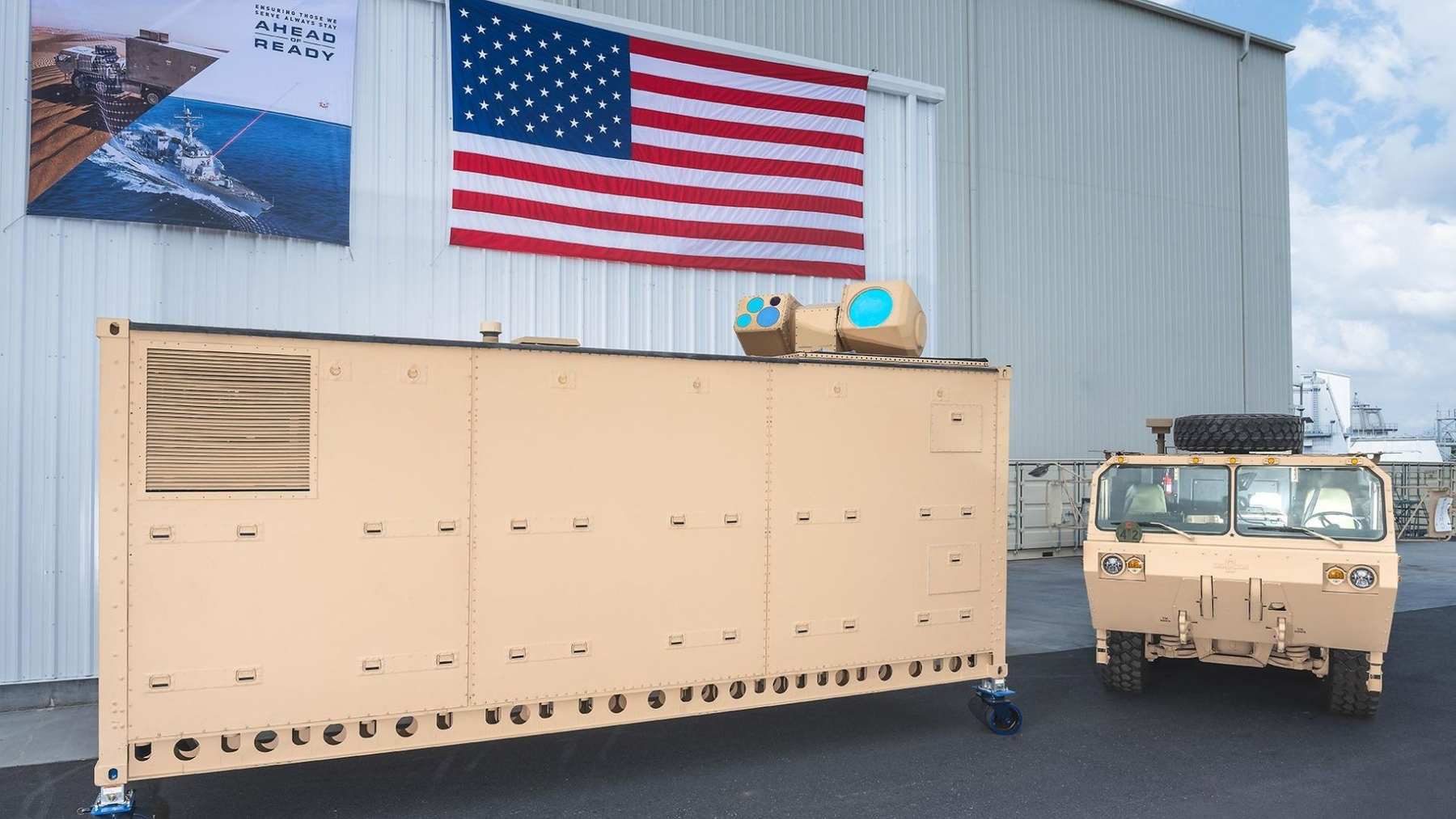
Lockheed hasn’t said. It also hasn’t described the surrogate itself, so you can’t really tell from the announcement whether the stand-in was a modified drone or something closer to the real thing. The machine doing the shooting is easier to picture. Valkyrie’s beam director sits on top of a tan enclosure roughly the size of a shipping container, and the laser’s weight, dimensions and wavelength haven’t been published.
Track augmentation was the training wheels
Cheung also said this was the first kill without track augmentation. That’s test-speak for helping the laser find and follow its target, usually by bolting something like a beacon or a reflector onto the target before it flies. It’s a perfectly normal thing to do early in a program, but you can’t count on a real cruise missile showing up with a reflector strapped to it.
Taking the aids away means Valkyrie’s own sensors had to spot the target, lock on and hold the beam steady with nothing helping from the other end. Cheung also said the shot had full kill chain integration. As far as I can tell, that means every step from detecting the target to firing ran through the actual system rather than being patched together for the test.
Frankly, that’s the more interesting half of the announcement. A laser that only works against a target wearing a reflector is a bit of a lab demo. One that does it cold is a lot closer to a weapon.
The Army had already moved on
The timing is a little awkward, though. In a Congressional Research Service report dated March 9, the Army said Valkyrie wouldn’t be fielded to its units. Its prototype contract had already been cut from two systems to one, and CRS said that remaining prototype was going through final lab testing at a Lockheed facility in Morristown, New Jersey. Instead of going to an Army unit, it would be used to inform a joint laser program.
CRS didn’t explain why the Army made that call, and I’m not going to guess. What I can tell you is where Valkyrie sits on the Pentagon’s own scale. When the Pentagon announced its new joint laser contracts in July, it said lasers in the 300 to 500 kilowatt range are what robust cruise missile defense needs. That arguably puts a 300-kilowatt system at the very bottom of the band the Pentagon itself is aiming for.
Despite all that, Valkyrie still got rolled out on June 23 at White Sands Missile Range in New Mexico, where Defense Secretary Pete Hegseth and Pentagon research and engineering chief Emil Michael watched several laser weapons fire. So the Army stepped away from the system while it kept getting shown off to some fairly senior people, and now it’s racked up its biggest result yet. It’s a bit like a car getting its best lap time the week after the team decided not to race it.
So where does Valkyrie’s work go now?
If you’re wondering whether that work just gets thrown out, it doesn’t. The lessons go into the Joint Laser Weapon System, or JLWS. Interesting Engineering, citing Laser Wars, says the Army and Navy are developing it together, and that the Pentagon’s fiscal 2027 budget request says what was learned on IFPC-HEL will be applied there. Shooting down cruise missiles is one of the program’s goals.
The Pentagon’s July announcement describes containerized lasers built to go on either ground or naval platforms, starting at about 150 kilowatts and working up to the 300 to 500 kilowatt band later. It also lists a separate 500-kilowatt integrated system, and Lockheed’s piece of the program is the containerized 500-kilowatt laser we covered back in August. If anything, that makes Valkyrie’s shot a pretty useful data point for whatever comes next.
The Pentagon announced the first two JLWS agreements, with Lockheed Martin Aculight and nLight Defense, on July 9. They’re worth $86 million to start, with a program ceiling of $847 million.
 A 37-foot drone boat that carries a third of its own weight in diesel can sit on station for up to 23 days on one 790-gallon tank, sprint at 40 knots and haul 2,000 pounds in an enclosed bay, and it’s meant to be built in under three months for about $1 millionMilitary · 5 hours ago
 A 43-foot-wide nuclear attack submarine, about 9 feet fatter than the boats it is meant to replace, is being drawn as a mothership that launches, catches and recharges its own underwater drones without tying up its torpedo tubes, and each one could cost about $9 billionMilitary · 1 day ago
 An 8.8-ton drone submarine that fits inside a shipping container runs on hydrogen fuel cells adapted from space launches, can cover 3,100 miles or stay out 45 days, and five NATO allies have bought it while the navy back home has about 20 drones for 151,000 miles of coastMilitary · 1 day ago